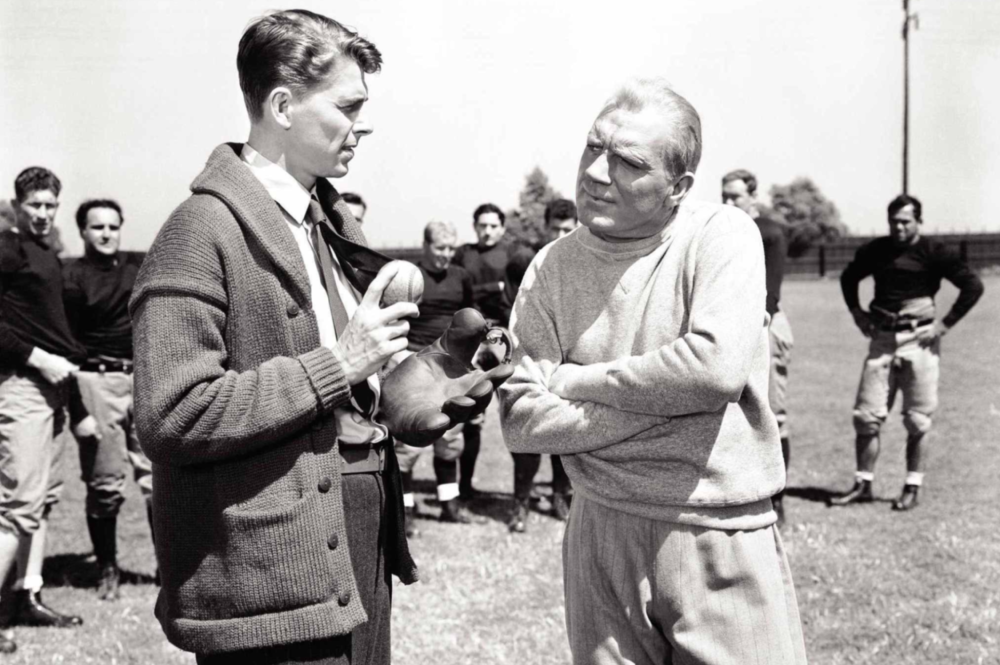
Knute Rockne, All American is a 1940 Sports drama film directed by Lloyd Bacon. The film stars Pat O’Brien, Gale Page, and Ronald Reagan. Knute Rockne, All American is based on the life of Knute Rockne, the University of Notre Dame’s popular and beloved football coach.
Director: Lloyd Bacon (with William K. Howard)
Production Company: Warner Bros.
Distributor: Warner Bros.
Cast: Pat O’Brien, Gale Page, Ronald Reagan, Donald Crisp, Albert Bassermann, John Litel, Henry O’Neill, Owen Davis Jr., John Qualen
US Box Office: $3,790,000 ($151,100,000 adjusted for inflation)
Film Format: Black & White
Genre: Sports, Drama
Release Date: October 4, 1940 (South Bend premiere) October 5, 1940
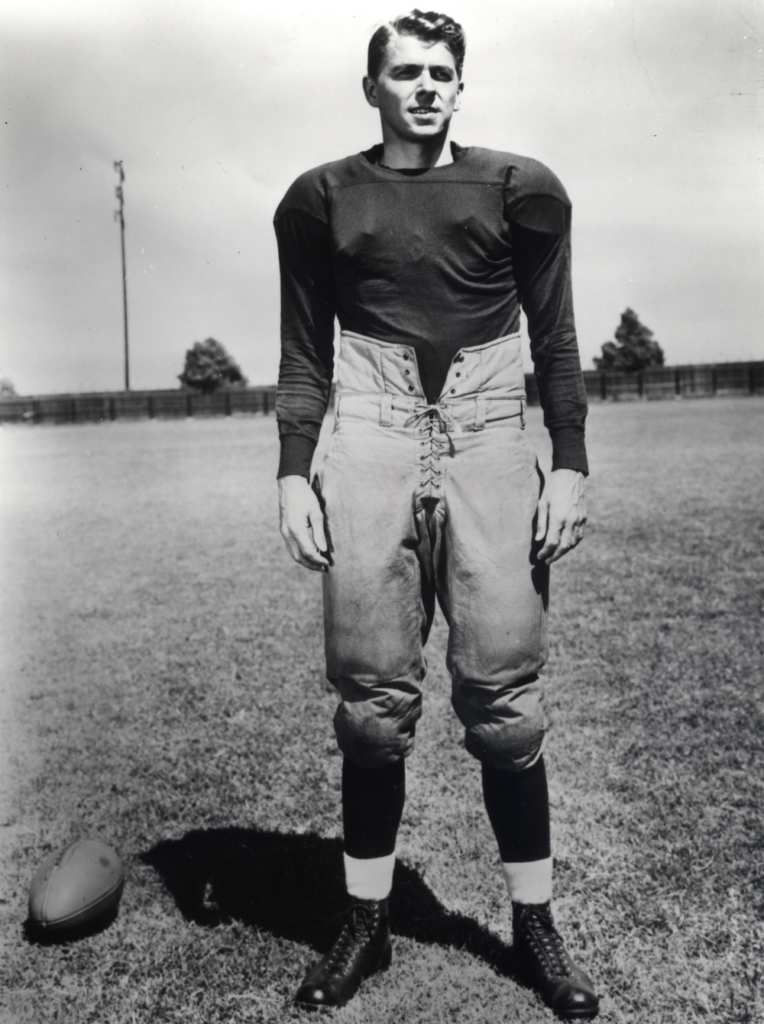
Plot Summary: After graduating from the University of Notre Dame, football star and Norwegian immigrant Knute Rockne (Pat O’Brien) becomes the school’s new football coach. The combination of strategy, intuition, and a strong moral compass makes Rockne a fantastic coach for the college. Early in his career, Knute marries his longtime girlfriend Bonnie Skiles (Gale Page). One of the players recruited to Rockne’s team is the humble and reserved, but extremely talented, George “the Gipper” Gipp (Ronald Reagan). Gipp’s football skill is legendary, but he unfortunately dies of pneumonia. Although devastated by Gipp’s death, Rockne continues his coaching career and is inspired by Gipp’s final words.
Production: In the late 1930s, Warner Bros. studio executives began working on a film based on the life of football coach Knute Rockne. Rockne, who died in a plane crash in 1931, and was an innovative and popular football coach at the University of Notre Dame. Warner Bros. executive producer Hal B. Wallis made a deal with the University of Notre Dame which allowed the college to have a great deal of creative control over the film. Bonnie Skiles Rockne, Knute’s widow, also had some control over the casting of her husband and how he was portrayed in the film. The original screenplay for Knute Rockne, All American was written by Robert Buckner, and was based on Bonnie Rockne’s private papers as well as the recollections of Knute’s close friends. William K. Howard was initially chosen by Warner Bros. to direct Knute Rockne, All American. Howard had been working as a director in the United Kingdom in the mid-1930s, where he notably directed Fire Over England (1937), and he signed a contract with WB following the success of his crime drama Back Door to Heaven (1939).
Warner Bros. executives’ first choice for the role of Knute Rockne was John Payne, however Payne was removed from consideration when he left his contract with the studio in 1939. James Cagney wanted to play the part of Rockne, but the University of Notre Dam prevented him from being considered. Cagney had signed a petition in support of the anti-Catholic Loyalist faction during the Spanish Civil War, so the Catholic University of Notre Dame (which had control over the casting) refused to allow Cagney to be considered for the part. Irish-American actor Pat O’Brien was eventually cast as Rockne. O’Brien had a contract with Warner Bros. and he recently starred in the comedy Boy Meets Girl (1938), the crime drama Angels with Dirty Faces (1938), and the racing drama Indianapolis Speedway (1939) for the the studio. Bonnie Rockne approved of O’Brien’s casting as her late husband.
Several young leading men were considered for the supporting role of football player George Gipp including John Wayne, Robert Young, and Robert Cummings. Dennis Morgen and Ronald Reagan both did screen tests for the part and Reagan ended up winning the role. Ronald Reagan had a contract with Warner Bros. and his acting career had only just begun in 1937. He recently had supporting roles in the musical comedies Going Places (1938) and Naughty but Nice (1939) and starred in the college comedy-drama Brother Rat (1938).
Principle photography on Knute Rockne, All American began in April of 1940. Midway through filming, director William K. Howard was replaced with Lloyd Bacon. Warner Bros. executives removed Howard from the film because of differing opinions over the direction of film’s story. In particular, Howard wanted Rockne to convert to Catholicism in the film, which WB wasn’t interested in. Lloyd Bacon was a prolific and reliable contract director for Warner Bros. Knute Rockne, All American was the last of ten films that Bacon directed O’Brien in. The previous films were: Here Comes the Navy (1934), Devil Dogs of the Air (1935), In Caliente (1935), The Irish in Us (1935), San Quentin (1937), Submarine D-1 (1937), Boy Meets Girl (1938), Cowboy from Brooklyn (1938), and Indianapolis Speedway (1939).
Knute Rockne, All American was partially shot on location at the University of Notre Dame campus in South Bend, Indiana. It was the first Hollywood film to have been shot at Notre Dame. Interior scenes were shot on Stages 12, 18, 22, and 25 at Warner Bros. Burbank Studios in California. To shoot the football games, shots of the actors were combined with actual newsreel footage of Notre Dame’s football games. Pat O’Brien’s makeup took three hours to apply every day.
Fun Facts and Trivia: Four real-life college football coaches appear as themselves in Knute Rockne, All American. The coaches are: Howard Jones (University of Southern California, 1925-1940), “Pop” Warner (Stanford University, 1924-1932), Amos Alonzo Stagg (University of Chicago, 1892-1932), and William H. Spaulding (UCLA, 1925-1938). Aside from playing the role of Harry Stuhldriver (one of Rockne’s “Four Horsemen” backfield players), Nick Lukats also served as a technical advisor on the film. Lukats was chosen for an advisor role because he had attended the University of Notre Dame in real life and played football for the school. Actor George Reeves played one of the minor football players in Knute Rockne, All American. Reeves had supporting roles and bit parts in a few other high profile films of this era, including Gone with the Wind (1939), and he would later be best known for starring as Superman in the television series Adventures of Superman (1952-1958).
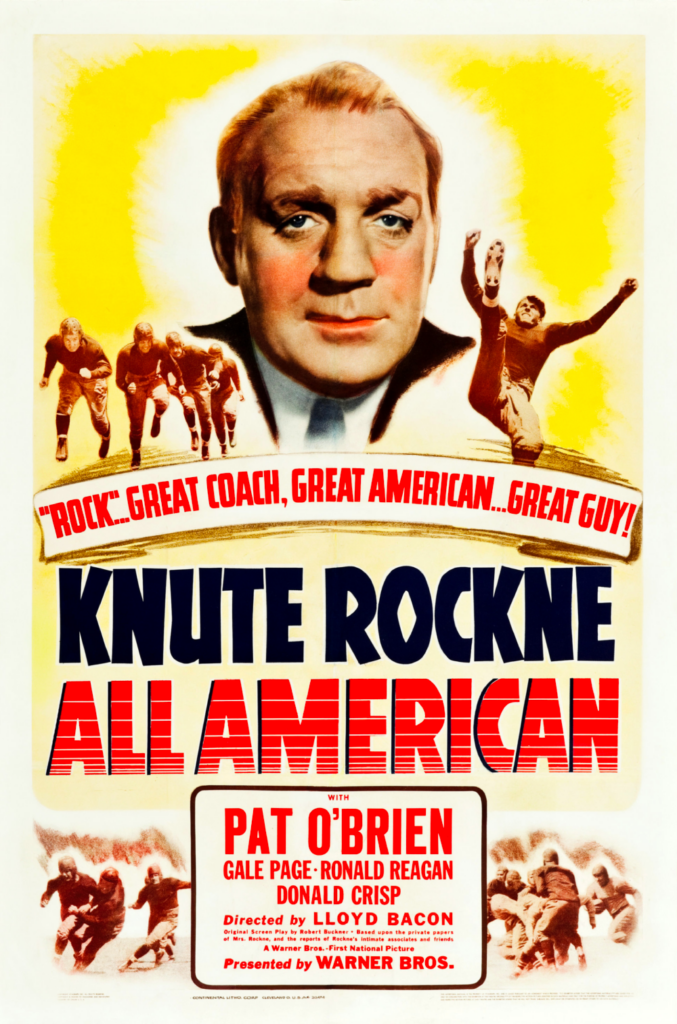
Reception: Knute Rockne, All American had its world premiere in South Bend, Indiana on October 4, 1940. The film had a more conventional Hollywood premiere the next day and went into general release shortly after this. Knute Rockne, All American was one of the top twenty-five highest grossing films of the year and it earned a modest profit for Warner Bros. Pat O’Brien, Ronald Reagan, and Donald Crisp (Father Callahan) reprised their film roles in a December 2, 1940 Lux Radio Theatre adaptation of the film. Fay Wray played the part of Bonnie Rockne in the radio version.
Knute Rockne, All American received positive reviews from film critics when it was first released. Variety had strong praise for Pat O’Brien’s performance and the film’s inspirational appeal. The magazine described Knute Rockne, All American as “one of the best biographical picturizations ever turned out.” Bosley Crowther of The New York Times similarly applauded O’Brien’s performance and he wrote of the film, “As a memorial to a fine and inspiring molder of character in young men, this picture ranks high.” Harrison’s Reports praised the film’s thrilling football scenes and thought that Knute Rockne, All American had better dramatic development than previous football movies. The January 1941 edition of Photoplay ranked Knute Rockne, All American as one of the best films of the month and O’Brien’s performance as one of the best of the month.
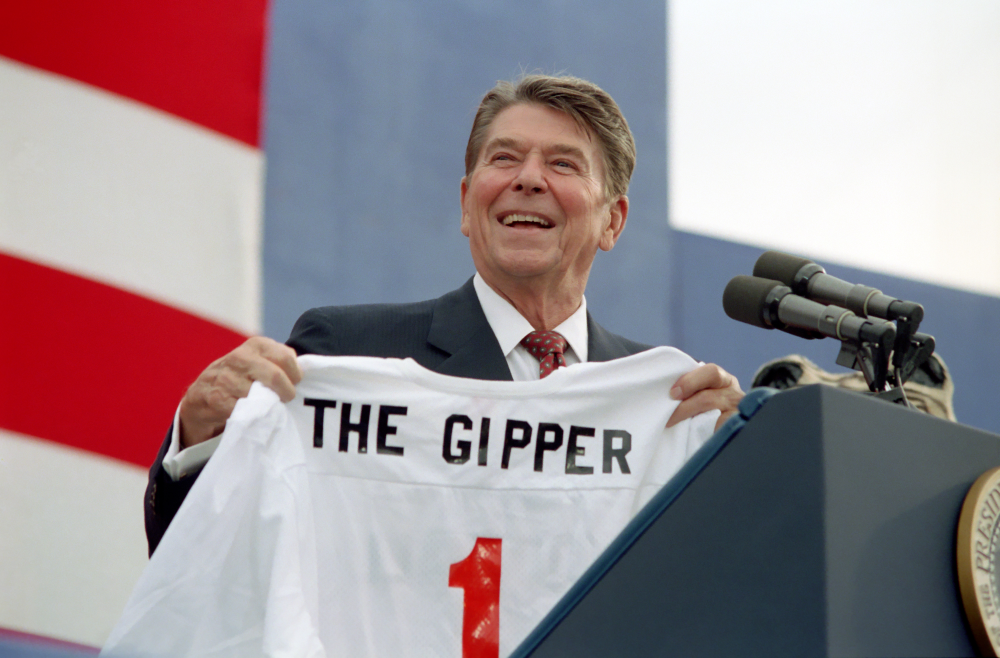
O’Brien would later consider his role as Knute Rockne to be one of his three greatest performances, alongside his roles as Hildy Johnson in The Front Page (1931) and Father Duffy in The Fighting 69th (1940). There was renewed interest in Knute Rockne, All American when Ronald Reagan successfully ran for President of the United States in 1980. The film’s high-quality, good acting performances, and strong morals made it popular with Reagan’s fans. One of Reagan’s campaign slogans was “Win one for the Gipper” after the line spoken by Reagan and the speech given by O’Brien in Knute Rockne, All American and Reagan himself was frequently nicknamed “the Gipper” after the character he played. After Reagan’s death in 2004, President George W. Bush spoke the line, “We can now truly win one for the Gipper” at the Republican National Convention that year.
Knute Rockne, All American receives mixed-to-positive reviews in modern times. Tim Dirks of Filmsite called Knute Rockne, All American “excellent” and lauded the film for its inspirational value and Pat O’Brien’s performance. In positive reviews John J. Puccio of Movie Metropolis and Dennis Schwartz both noted that Knute Rockne, All American had a major impact on future sports biopics. Mike Massie of Gone With the Twins conversely gave the film a negative review. He didn’t think Knute Rockne, All American was exciting enough and especially criticized the film’s tragic ending (as opposed to other sports films, which usually end after the lead wins a climactic game). In 2005 the American Film Institute ranked the line, “Tell ’em to go out there with all they got and win just one for the Gipper” as the 89th best American film quote on their AFI’s 100 Years … 100 Movie Quotes list.
Why You Should See It: Knute Rockne, All American is an exciting and interesting sports drama film. Pat O’Brien gives a great performance as coach Knute Rockne. O’Brien manages to capture the intuition, morality, and passion for football that made the real Rockne an excellent coach. The film in-general does a good job of showing Rockne’s skill as a coach and how innovative he was for college football. Ronald Reagan also gives a good performance. Although he doesn’t have that much screen time, Reagan makes an impact as Gipp, and “the Gipper” speech in Knute Rockne, All American is quite memorable.