
Mr. Blandings Builds His Dream House is a 1948 comedy film directed by H.C. Potter. The film stars Cary Grant, Myrna Loy, and Melvyn Douglas. Mr. Blandings Builds His Dream House is based on Eric Hodgins’ 1946 novel of the same name.
Director: H.C. Potter
Production Company: RKO Radio Pictures
Distributor: Selznick Releasing Organization
Cast: Cary Grant, Myrna Loy, Melvyn Douglas, Reginald Denny, Sharyn Moffett, Connie Marshall, Louise Beavers, Ian Wolfe
US Box Office: $6,875,000 ($164,500,000 adjusted for inflation)
Film Format: Black & White
Genre: Comedy
Release Date: March 25, 1948 (premiere); June 4, 1948
Plot Summary: Advertising executive James Blandings (Cary Grant) lives with his wife in Muriel (Myrna Loy) and their two daughters in an apartment in New York City. Mr. Blandings is tired of the family’s old, cramped apartment, so he purchases an old Connecticut farmhouse against the better judgement of his lawyer Bill Cole (Melvyn Douglas). Mr. Blandings’ dream house project quickly turns into a nightmare when the old house must be torn down and the new construction is beset with constant problems that cause the price to skyrocket.

Production: In 1947 producer Dore Schary, who had recently been hired by RKO Radio Pictures as their head of production, began working on a film adaptation of the novel Mr. Blandings Builds His Dream House (1946) by Eric Hodgins, which was previously published as a story by Fortune magazine. RKO purchased the film rights to the book for $200,000. Hodgins based the book on his own difficult experience trying to build a “dream house” in Connecticut. In 1939 Hodgins (a vice president for Time, Inc. at the time) planned to build a house for $11,000 but ended up paying $56,000 for its completion. Two years after moving in, he was bankrupt and was forced to sell the house. RKO brought Hodgins to Hollywood to serve as a consultant for the film. Screenwriting duo Melvin Frank and Norman Panama were hired to write the script for Mr. Blandings Builds His Dream House. The two also served as co-producers for the film alongside Schary. Frank and Panama had recently worked on the comedy films Road to Utopia (1946) and It Had to Be You (1947). H.C. Potter was chosen to direct Mr. Blandings Builds His Dream House. Potter recently directed the comedy films The Farmer’s Daughter (1947) and A Likely Story (1947) for RKO.
Cary Grant was cast as James Blandings, the main character of Mr. Blandings Builds His Dream House. Grant recently starred in RKO’s Christmas comedy-drama The Bishop’s Wife (1947). H.C. Potter had previously directed Grant in Mr. Lucky (1943). Actress Irene Dunne was Potter’s first choice for the role of Muriel Blandings, James’ wife. Grant and Dunne had been successfully paired in The Awful Truth (1937), My Favorite Wife (1940), and Penny Serenade (1941) and Potter hoped he could replicate this success by pairing the two again, however Dunne had already been assigned to RKO’s I Remember Mama (1948) and was unavailable. Myrna Loy was cast in the part instead. Mr. Blandings Builds His Dream House was the last of three films to co-star Grant and Loy, after Wings in the Dark (1935) and The Bachelor and the Bobby-Soxer (1947).

H.C. Potter began filming Mr. Blandings Builds His Dream House in October of 1947 and wrapped up in December. Interior scenes were primarily shot on set at RKO Studios in Hollywood. The film production crew built an actual house on the Fox Ranch property in the Malibu Creek canyon near Calabasas, California to serve as an exterior shooting location for the Blandings family home. The old Fox Ranch property is currently part of the Malibu Creek State Park. The original 1947 house still exists today and now serves as an administrative building for the state park.
Fun Facts and Trivia: During one scene of Mr. Blandings Builds His Dream House the house’s excavation site floods, which requires the builders to use pumps to remove the excess water. During the filming of this scene the crew ironically had the opposite problem. The film set leaked, so large pumps were required to keep the set full of water while the scene was being shot.
There were two failed attempts to adapt Mr. Blandings Builds His Dream House into a television series in the 1950s. The first series was proposed by Four Star Productions and titled Blandings’ Way. The company produced a pilot episode for the series which starred Macdonald Carey (as James Blandings) and Phyllis Thaxter (as Muriel Blandings). Studio executives weren’t interested, so the pilot was just aired on television as an episode of the anthology series Stage 7 in 1955. The second, titled The Blandings, was proposed by Screen Gems Productions. The pilot for that series starred Steve Dunne (as James) and Maggie Hayes (as Muriel). This pilot was similarly not picked up and just aired as an episode of the anthology series Goodyear Theatre in 1959.
Reception: Although Mr. Blandings Builds His Dream House was produced by RKO Radio Pictures, David O. Selznick distributed the film independently through his company, the Selznick Releasing Organization. This was due to a deal between Selznick and RKO in which Selznick got to distribute the film in exchange for producer Dore Schary leaving his contract with Selznick to join RKO.
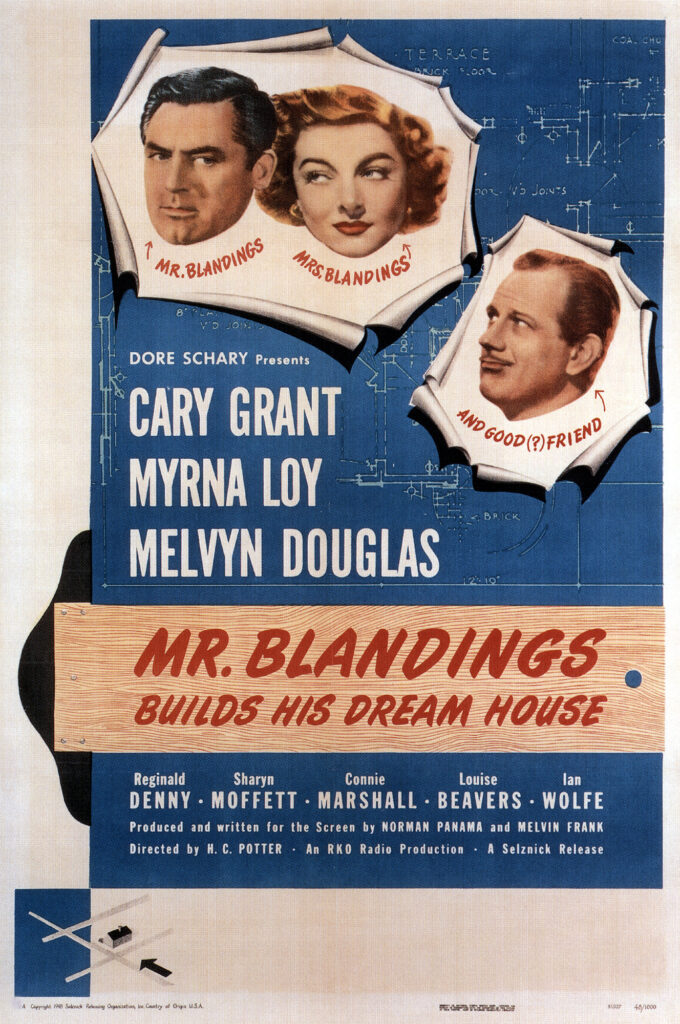
Mr. Blandings Builds His Dream House premiered in New York City on March 25, 1948. The film went into general release on June 4. Mr. Blandings Builds His Dream House was a moderate success at the box office. Despite the strong box office performance, RKO ended up losing money on the film due to its high production cost and the studio’s distribution deal with Selznick. As part of a promotional stunt, RKO built 73 replicas of Mr. Blandings’ “dream house” across the United States. Over sixty of these houses were equipped by General Electric and many of the homes were sold through raffle competitions.
Screen Directors Playhouse broadcast a thirty-minute radio adaptation of the film on July 1, 1949 in which Cary Grant reprised his role as James and Frances Robinson played Muriel. A Lux Radio Theatre adaptation was broadcast on October 10, 1949 and featured Grant with Irene Dunne (who was H.C. Potter’s first choice for the role of Muriel). A second Screen Directors Playhouse adaptation was broadcast on June 9, 1950. This radio version featured Cary Grant and Betsy Drake, Grant’s wife at the time (from 1949 to 1962). This broadcast was so popular that NBC broadcast a weekly radio comedy series in 1951 called Mr. and Mrs. Blandings that served as a sequel to the original story and featured Grant and Drake.
Mr. Blandings Builds His Dream House received mostly positive reviews when it was first released. Bosley Crowther of The New York Times praised the film for its entertainment value. John McCarten of The New Yorker described Mr. Blandings Builds His Dream House as being, “quite ingeniously put together.” He thought that it was just as good as George Washington Slept Here (1942), an earlier comedy film with a similar “nightmare house project” scenario. James Agee of Time magazine praised H.C. Potter’s direction and noted that Cary Grant and Myrna Loy were well-suited to star in this sort of comedy. The critics at Variety gave the film a mixed review. They praised Grant’s performance but disliked the “unnecessary jealousy twist” between Grant and Douglas.
Mr. Blandings Builds His Dream House continues to receive mostly positive reviews in retrospect. Matt Brunson of Film Frenzy praised the performances and dialogue of Grant, Loy, and Douglas. John J. Puccio of Movie Metropolis applauded Grant for his ability to perfectly embody the “everyman” leading character despite his typical glamorized screen persona. Carol Kling of the Los Vegas Review-Journal and Josh Gilchrist of the Billings Outpost both gave Mr. Blandings Builds His Dream House perfect 5/5-star reviews. In 2000 the American Film Institute ranked Mr. Blandings Builds His Dream House as the 72nd funniest American film of all time on their “AFI’s 100 Years…100 Laughs” list.
Why You Should See It: Mr. Blandings Builds His Dream House is a funny comedy film. Grant was always good at playing overwhelmed/easily-flustered characters in these sort of comedy films. Grant has plenty of witty dialog and always has a good facial reaction whenever something absurd or unreasonable happens to him. The scene where Grant, Loy, and Douglas all got locked in the store room was hilarious. The bathroom scene at the start of the film was pretty funny too.