
The Stratton Story is a 1949 sports drama film directed by Sam Wood. The film stars James Stewart and June Allyson. The Stratton Story is based on the life of professional baseball player Monty Stratton.
Director: Sam Wood
Production Company: Metro-Goldwyn-Mayer
Distributor: Metro-Goldwyn-Mayer
Cast: James Stewart, June Allyson, Frank Morgan, Agnes Moorehead, Bill Williams, Bruce Cowling, Cliff Clark, Mary Lawrence
US Box Office: $9,577,500 ($199,200,000 adjusted for inflation)
Film Format: Black & White
Genre: Sports, Drama
Release Date: May 12, 1949 (Cleveland premiere); April 21, 1949 (New York Premiere)
Plot Summary: In the mid-1930s, baseball scout Barney Wile (Frank Morgan) recruits a young Texas farmer named Monty Stratton (James Stewart) to be a pitcher for the Chicago White Sox. Monty joins the team, and eventually becomes a valued member of the White Sox. During this time, Monty meets, falls in love with, and later marries a young woman named Ethel (June Allyson). Unfortunately, tragic strikes in 1938 and Monty’s leg is amputated after a hunting accident. The amputation completely upends Monty’s life and threatens to destroy his career.
Production: In late 1947, Metro-Goldwyn-Mayer began working on a film about the life of Major League Baseball pitcher Monty Stratton. Stratton had pitched for the Chicago White Sox from 1934 to 1938, before his leg was amputated after a hunting accident. Despite his disability, Stratton was able to make a comeback and became a pitcher for several minor league teams. The film, titled The Stratton Story, was produced by MGM director and producer Jack Cummings and was based on a story by screenwriter Douglas Morrow. The film was written by Guy Trosper and George Wells. The real Monty Stratton served as a technical advisor on The Stratton Story. MGM originally chose Roy Rowland to direct the film, but he was quickly replaced with Sam Wood. Wood had directed several sports-related films in the past including The Pride of the Yankees (1942), another baseball biopic. That film was about the life of Yankees player Lou Gehrig.
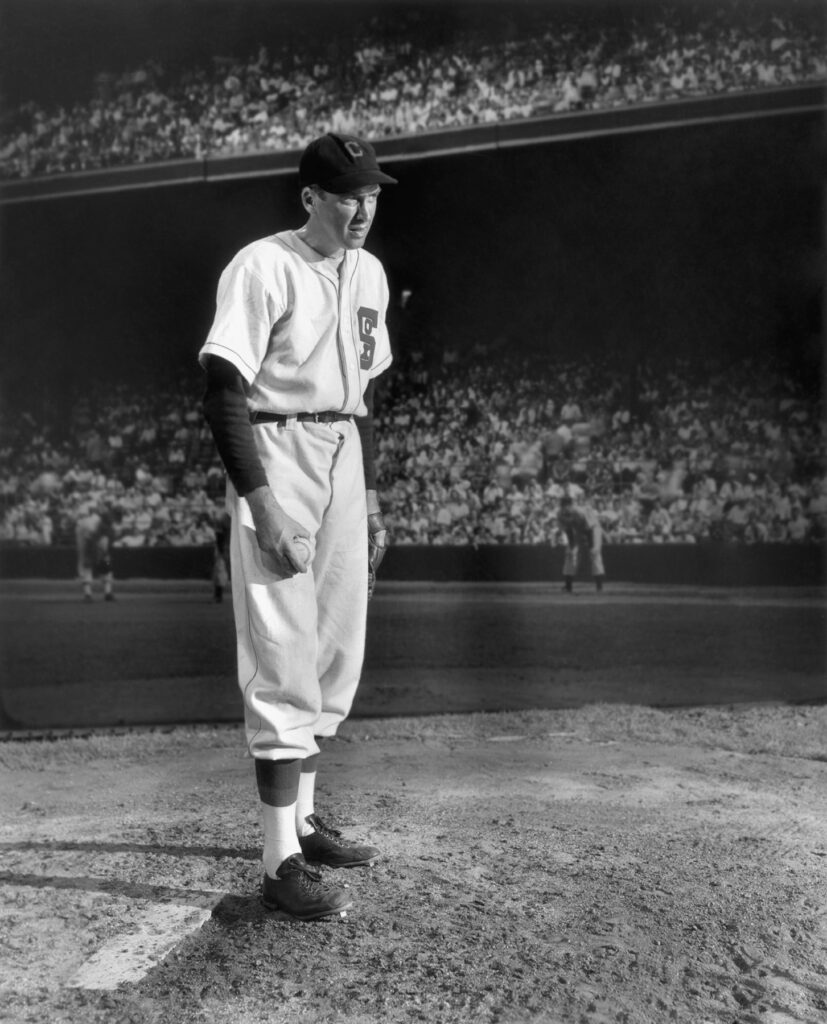
Several actors were considered for the part of Monty Stratton, including Gregory Peck and Van Johnson. In March of 1948 Johnson was cast in the role, but he quickly dropped out as he had recently been injured in a car accident and his doctor warned him that the role would be too strenuous. Ronald Reagan (who was at that time under contract with Warner Bros.) was also interested in the role, but Warner Bros. refused to loan him to MGM because they assumed The Stratton Story would be a failure. James Stewart was eventually cast in the part. Stewart took the role because he thought that his character could be an inspiration to disabled World War II veterans trying to adjust to life back home. Stewart recently starred in the comedy You Gotta Stay Happy (1948) and the crime thriller Rope (1948). Janet Leigh and Donna Reed were both considered for the part of Ellen Stratton, Monty’s wife. After Stewart was cast as Monty, MGM removed Donna Reed from consideration. Reed and Stewart had previously starred together in It’s a Wonderful Life (1946). Although It’s a Wonderful Life has since become a beloved Christmas classic, it lost money at the box office, and MGM assumed that audiences didn’t want to see Stewart and Reed paired as a couple again. June Allyson was eventually cast as Ellen. She had recently starred in the musical Good News (1947) and the romantic comedy The Bride Goes Wild (1948).
Sam Wood began shooting The Stratton Story in October of 1948 and filming wrapped up in late December. Location shooting was done at several different baseball parks in California including: Brookside Park in Pasadena (the spring training site for the White Sox), Wrigley Field (home of the minor league Los Angeles Angels), and Gilmore Field in Los Angeles (home of the minor league Hollywood Stars). Gilmore Field was used to represent the Texas stadium seen in The Stratton Story‘s finale. Some filming also took place at Comiskey Park in Chicago (the home of the White Sox). Unfortunately, all of these stadiums have since been demolished. Archive footage of several other American League stadiums was used for establishing shots. Interior scenes were shot on set at MGM Studios in Culver City.
Fun Facts and Trivia: Although Agnes Moorehead plays the mother of Jimmy Stewart’s character, she was actually only about seven years older than him in real life. Stewart was also about five years older than the real Monty Stratton. Stewart and Frank Morgan previously appeared together in the romantic comedy The Shop Around the Corner (1940) and the drama The Mortal Storm (1940). The Stratton Story was one of Morgan’s last films. He unfortunately died of a heart attack in September of 1949, only a few months after The Stratton Story was released.
Several major league baseball players have supporting roles or bit parts as themselves in The Stratton Story. Bill Dickey (New York Yankees, 1928-1943); Jimmy Dykes (White Sox, 1933-1939); Merv Shea (White Sox, 1934-1937); and Gene Bearden (Cleveland Indians, 1947-1950) all portray themselves. Several contemporary news articles indicated that White Sox player Ted Lyons was going to play himself in the film as well, but he was ultimately played by actor Bruce Cowling instead. Fellow White Sox player Luke Appling was also played by an actor, Dean White. Additionally, many other professional baseball players appeared as uncredited extras in the film.
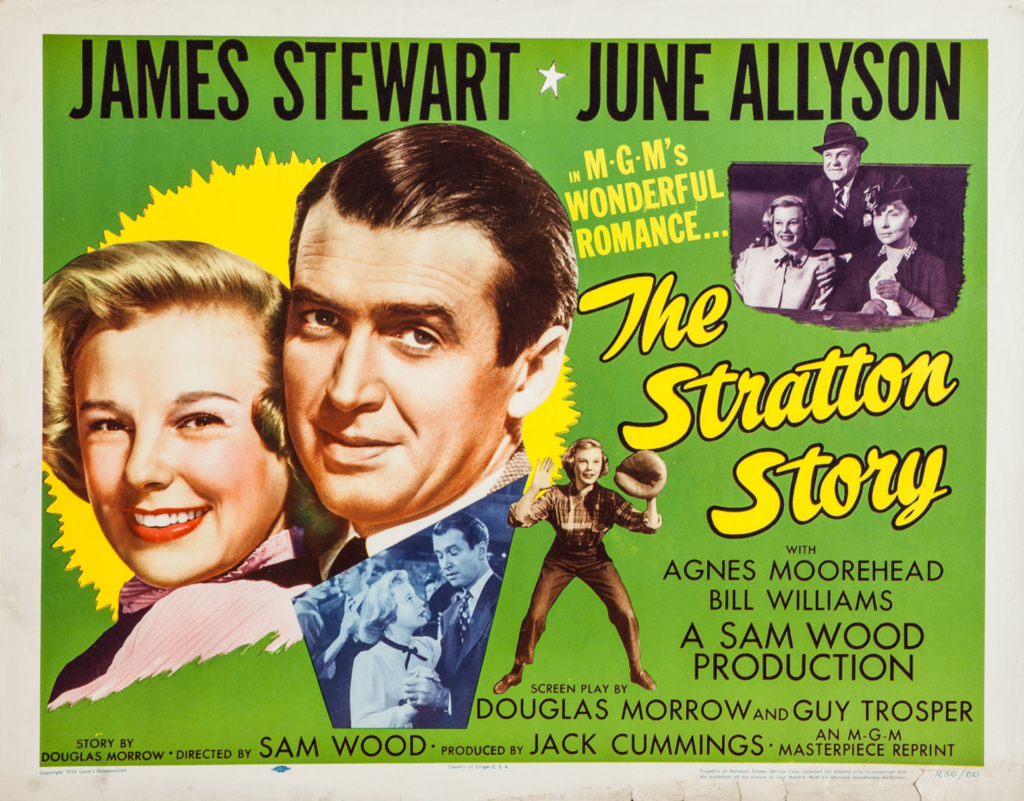
Reception: The Stratton Story premiered on April 21, 1949 in Cleveland, Ohio (to honor the Cleveland Indians’ opening home game that season), followed by a more conventional premiere in New York City on May 12. The film went into wide release in June. The Stratton Story was one of the top ten highest grossing films of 1949 and it earned a profit for MGM. Jimmy Stewart and June Allyson reprised their film roles in a February 13, 1950 radio adaptation of The Stratton Story for CBS Lux Radio Theatre. Stewart and Allyson were later paired together in The Glenn Miller Story (1954) and Strategic Air Command (1955).
Aside from its single Academy Award, The Stratton Story received several other film awards that year. The magazine Motion Picture Exhibitor gave its award for “Best Male Performance” to Stewart and its award for “Best Female Performance” to Allyson. Photoplay magazine gave The Stratton Story its Gold Medal award for “Favorite Picture of the Year”, and ranked Stewart as the “Most Popular Male Star” of the year. The Stratton Story was also named the best film of the year by the Protestant Motion Picture Council and the Christian Herald.
The Stratton Story received positive reviews from film critics when it was first released. Thomas M. Pryor of The New York Times had strong praise for James Stewart’s performance as Stratton and noted that he was perfect for the part. Jay Carmody of The Evening Star commended Sam Wood for making The Stratton Story “honest and affecting” and also praised Stewart’s performance. Elsa Branden of Photoplay magazine similarly lauded Stewart’s performance. Moira Walsh of the magazine America also gave The Stratton Story a positive review. She praised the film for its excitement and for successfully capturing “the flavor of the ball park and the feeling of actual play.”
The Stratton Story has continued to receive generally positive reactions from modern film critics. Dennis Schwartz praised the film for its inspirational content. John J. Puccio of Movie Metropolis gave The Stratton Story a mildly positive review. He praised the film’s generally uplifting nature and Stewart’s strong performance.
Oscars: The Stratton Story won one Oscar at 22nd Academy Awards ceremony: Douglas Morrow received an Oscar for Best Motion Picture Story. That was the only Academy Award nomination that The Stratton Story received.
Why You Should See It: The Stratton Story is a very good classic sports film. All of the main cast members give good performances, especially Jimmy Stewart. Stewart was perfectly cast and is very likeable in the role. He is great in both the film’s light hearted moments as well in its somber moments. Sam Wood does a good job directing the film as well, in both its serious and humorous moments. The baseball scenes are exciting and well-shot. The Stratton Story has plenty of entertaining moments and it is very inspirational, particularly its finale.