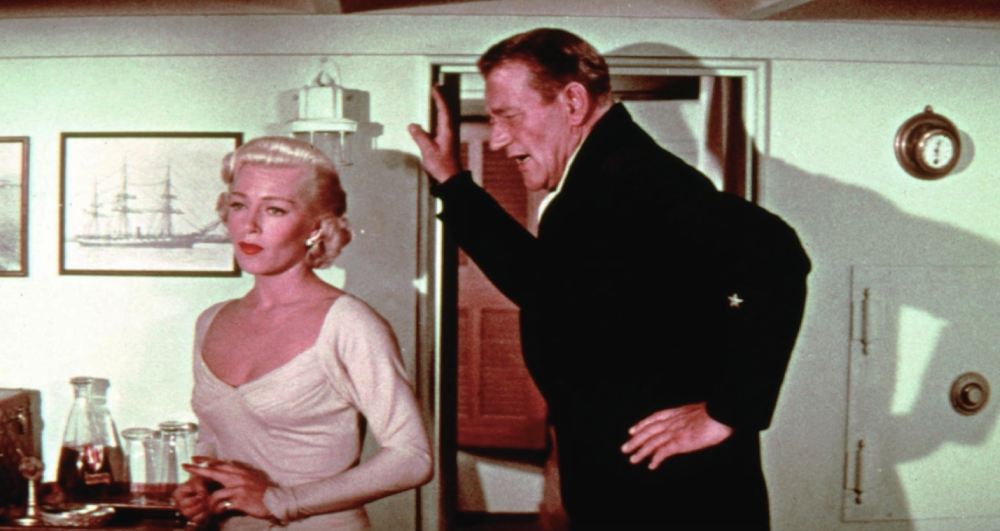
The Sea Chase is a 1955 seafaring war drama directed by John Farrow. The film stars John Wayne, Lana Turner, and David Farrar. The Sea Chase is an adaptation of Andrew Geer’s 1948 novel of the same name.
Director: John Farrow
Production Company: Warner Bros.
Distributor: Warner Bros.
Cast: John Wayne, Lana Turner, David Farrar, Lyle Bettger, Tab Hunter, James Arness, Dick Davalos, John Qualen, Paul Fix
US Box Office: $15,000,000 ($299,100,000 adjusted for inflation)
Film Format: WarnerColor (shot in CinemaScope)
Genre: War, Drama
Release Date: June 4, 1955
Plot Summary: Karl Ehrlich (John Wayne) is the captain of the German freighter Ergenstrasse, which is docked in Sydney, Australia shortly before the start of World War II. Although he dislikes the current Nazi regime, Ehrlich has a strongly patriotic dedication to Germany. The Ergenstrasse manages to sneak out of the Australian harbor right before the British Empire declares war on Nazi Germany, in a desperate attempt to return home to Germany with one extra passenger onboard, German spy Elsa Keller (Lana Turner). Ehrlich initially dislikes Keller because she had previously attempted to seduce Ehrlich’s friend British Commander Jeff Napier (David Farrar) to steal information from him. Despite this, Karl and Elsa eventually begin to fall in love. The Ergenstrasse is doggedly pursued by the Australian Navy, including Ehrlich’s former friend Napier, a pursuit which is intensified after the Ergenstrasse‘s treacherous first mate Kirchner (Lyle Bettger) goes against Ehrlich’s orders and murders unarmed Scottish civilians at a rescue station.
Production: Writer Andrew Geer published the World War II novel The Sea Chase in 1948. Geer’s novel was about a German freighter that escapes from Australia at the start of World War II and makes a daring attempt return home through the Pacific and Atlantic Oceans. Although the novel’s story was fictional, The Sea Chase was loosely based on a real incident. The SS Erlangen was a German freighter that snuck out of a New Zealand harbor on the eve of the war; the Erlangen evaded a New Zealand light cruiser, stocked up on food and wood-fuel from several islands, and managed to made it to neutral Chile. From there, the Erlangen attempted to return home to Germany, only to be stopped by a British cruiser off the coast of Uruguay, and sunk by her own crew to avoid capture. Warner Bros. executives were interested in Geer’s novel and the studio purchased the film rights shortly after the novel was published.
Warner Bros. initially began pre-production work on The Sea Chase in 1951. James Warner Bellah and John Twist wrote the first screenplay draft for the film in September. Production on The Sea Chase was soon delayed, but the studio restarted the project in 1953. In August, Warner Bros. hired John Farrow to produce and direct The Sea Chase. Farrow had recently directed the war film Submarine Command (1951), the western Ride, Vaquero! (1953), and the adventure Botany Bay (1953). Frank S. Nugent rewrote the film’s screenplay. Nugent went uncredited for his work, with Bellah and Twist being the only credited screenwriters.
John Wayne, best known for his work on Western films, was cast as the lead character Captain Karl Ehrlich in June of 1951. Wayne stayed attached to the role after WB resumed production in 1953. John Farrow had previously directed Wayne in the western Hondo (1953), which Wayne produced. Wayne also recently starred in the war films Operation Pacific (1951) and Flying Leathernecks (1951), and in the aviation dramas Island in the Sky (1953) and The High and the Mighty (1954). Lana Turner was cast as Elsa Keller, the femme fatale spy who ends up falling in love with Ehrlich. Turner had a contract with MGM at the time and the studio loaned her to Warner Bros. to make The Sea Chase. Known for her troubled personal life, Turner recently starred in the drama The Bad and the Beautiful (1952) and the war film Betrayed (1954).
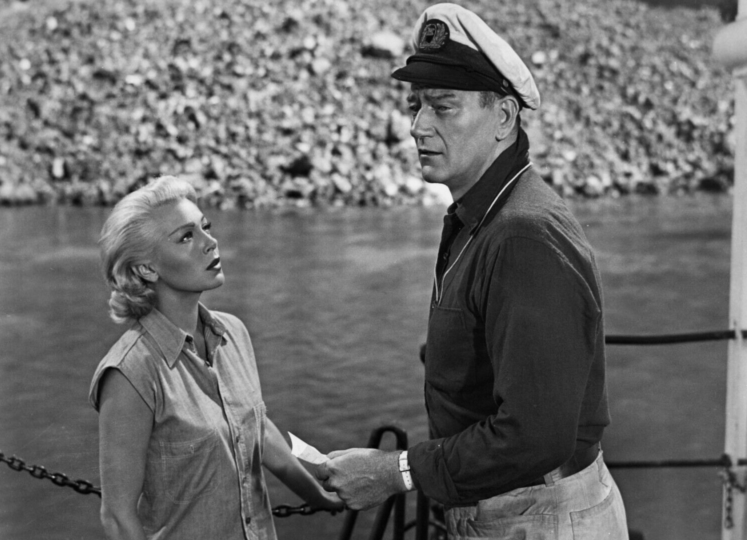
John Farrow began shooting The Sea Chase in September of 1954 and principle photography wrapped up in December. The shots of the ships at sea were filmed off the coast of Hawaii, and the scenes set at Pom Pom Galli island were shot on location in Hawaii. The Caribbean Sea and Mexico were both considered for shooting locations before Hawaii was chosen. Establishing shots of the Ergenstrasse in the Australian harbor were shot on location in Sydney, Australia by a second unit crew. The film was shot in the widescreen CinemaScope format. Wayne developed an ear infection from scuba diving shortly before filming began and he was apparently in pain for much of the shoot. Actors Paul Fix (Max Heinz) and Luis Van Rooten (Matz) also suffered infections due to skin diving.
John Wayne didn’t particularly care for director John Farrow, and in Wayne’s opinion Farrow did a poor job directing The Sea Chase. Farrow had directed Hondo, but according to Wayne he didn’t have creative responsibility over that film as Wayne (who also produced Hondo) and the cinematographers would discuss and set up the scenes before Farrow arrived on set. Wayne would later say of Farrow in an interview, “But he did direct Sea Chase and prove to me that he should not be put in charge of a producer-director position. He failed to tell the good story that was in the book. But now, we’re talking about a matter of opinion and that’s only my opinion. For some, he may be considered a fine director.” Lana Turner also disliked Farrow as she though that he was rude to her and her co-stars.
The Ergenstrasse was portrayed by two ships in The Sea Chase. For the establishing shots in Sydney Harbour, she was played by the coal transport Birchgrove Park. For the scenes shot on location near Hawaii, she was portrayed by the Margaret Shafer, which was owned and leased by Shafer Brothers Steamship Lines at the time. The HMAS Rockhampton was portrayed by the HMCS New Glasgow, a Canadian frigate that served as an anti-submarine escort during World War II. The ship had recently been updated and recommissioned as a Prestonian-class frigate.
Fun Facts and Trivia: The Sea Chase was the last of four films to co-star John Wayne and James Arness (Schleiter) together. The two had previously appeared together in Big Jim McLain (1952), Island in the Sky (1953), and Hondo (1953), and Arness would later star in the western Gun the Man Down (1956) which was produced by Wayne. Wayne and Arness were friends, and on Wayne’s recommendation, Arness was cast as lead character Matt Dillon in the long-running western television series Gunsmoke (1955-1975).
The Sea Chase was one of nine films to feature John Wayne and character actor John Qualen (Chief Engineer Schmitt). The other films were: The Long Voyage Home (1940), The Shepard of the Hills (1941), The High and the Mighty (1954), The Searchers (1956), North to Alaska (1960), The Man Who Shot Liberty Valance (1962), Donovan’s Reef (1963), and The Sons of Katie Elder (1965). It’s interesting to note that The Long Voyage Home also involved a civilian vessel attempting to return home near the start of World War II (albeit a British ship rather than a German ship).
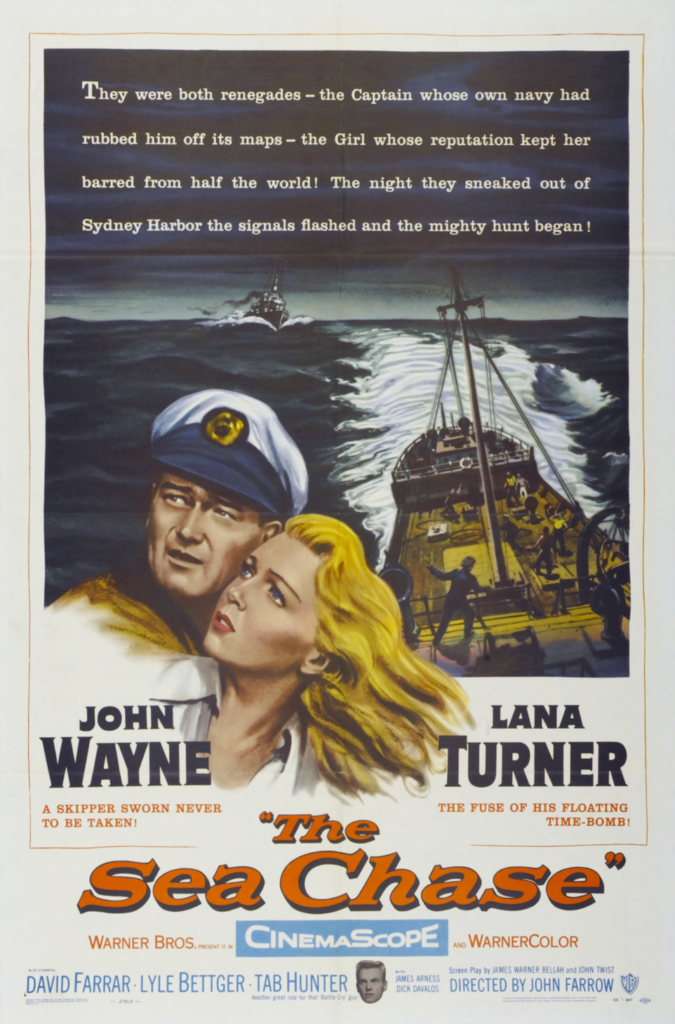
Reception: The Sea Chase was released in the United States on June 4, 1955. The film was a financial success for Warner Bros. and it became one of the top fifteen highest grossing films of the year. The film’s success was likely due to its high production values, use of the widescreen CinemaScope format, and the pairing of popular stars John Wayne and Lana Turner.
Although The Sea Chase was a box office hit, it received mixed-to-negative reviews from critics at the time. Harry McArthur of The Evening Star criticized The Sea Chase for its slow pace. McArthur noted that the film did have a few exciting moments, but was boring on the whole. The critics at Variety also gave the film a negative review. They noted that The Sea Chase had potential, but criticized it for lacking suspense. The Key West Citizen was more positive and praised the lead actors and the action scenes.
The Sea Chase continues to receive mixed-to-negative reviews from modern critics. Emanuel Levy described The Sea Chase‘s script as “terrible” and criticized the decision to cast the all-American John Wayne as a German captain. Christopher Lloyd (not the actor) of The Film Yap described The Sea Chase as “forgettable.” He criticized the decision to add a romance to what was otherwise a grim sea adventure and noted that the film’s tone and narrative was unfocused. In a mixed, but mildly positive review, Nathanael Hood of The Retro Set praised John Wayne’s performance.
Why You Should See It: The Sea Chase is a dramatic and interesting war film. The production values are top notch, the ship scenes all look great and the cinematography is outstanding. It was an unusual choice to cast John Wayne as a German freighter captain, but given that none of the actors use German accents, it does work well enough. Wayne gives a good performance; Ehrlich has an admirable sense of honor and patriotism, though his obsession with getting home ultimately gets the best of him. The Sea Chase has a few standout moments. The scene where the Ergenstrasse sneaks out of the Australian harbor featured fantastic lighting and fog effects and was suspenseful. The climactic battle in the rain was also exciting. However, I do think that on the whole The Sea Chase could have been more exciting. The Pom Pom Galli island and Chile scenes slow down the pace of the film.
Leave a Reply