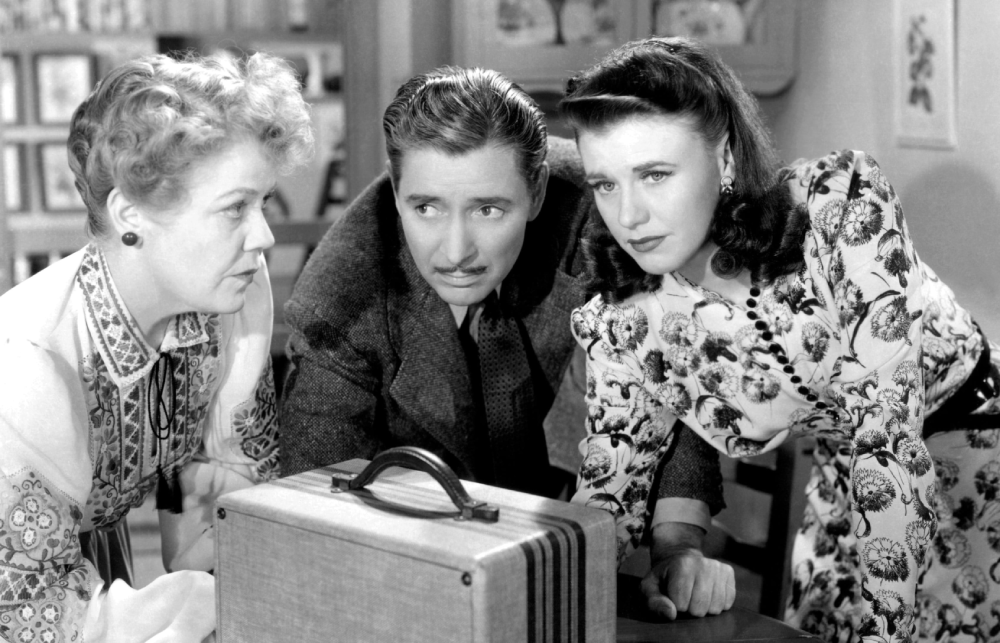
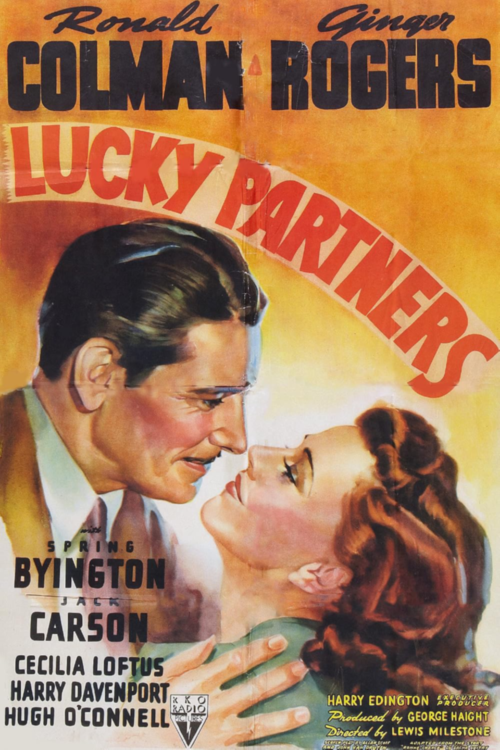
Lucky Partners is a 1940 romantic comedy film directed by Lewis Milestone. The film stars Ronald Colman, Ginger Rogers, and Jack Carson. Lucky Partners is a remake of 1935 French comedy film Good Luck directed by Sacha Guitry.
Director: Lewis Milestone
Production Company: RKO Radio Pictures
Distributor: RKO Radio Pictures
Cast: Ronald Colman, Ginger Rogers, Jack Carson, Spring Byington, Cecelia Loftus, Harry Davenport, Leon Belasco, Eddie Conrad, Walter Kingsford
US Box Office: Unknown
Film Format: Black & White
Genre: Comedy
Release Date: August 2, 1940
Plot Summary: In Greenwich Village, artist David Grant (Ronald Colman) randomly passes book store employee Jean Newton (Ginger Rogers) on the street and he wishes her good luck on a whim. Later that day, Jean receives an expensive gown for free. Believing that David will bring her good luck, Jean asks him to pay for half a ticket for a sweepstakes horse race with a $150,000 prize. David agrees to do so, only if Jean will go on a non-romantic trip with him before she marries her fiancé Freddie Harper (Jack Carson). Although they don’t win the $150,000, Jean gets $6,000 due to her half of the ticket being sold. She agrees to go on a trip with David to Niagara Falls, NY, much to the annoyance of Freddie.
Production: In 1939 RKO Radio Pictures producer George Haight began working on a new romantic comedy film for the studio. Haight decided the film should be an adaptation of the 1935 French comedy film Good Luck [Bonne Chance], which starred, was written, and was directed by Sacha Guitry. The film was given the title Lucky Partners. The initial script for Lucky Partners was written by Allan Scott, a contract screenwriter for RKO who was best known writing many of the Fred Astaire and Ginger Rogers dance-musicals. Lewis Milestone was assigned to direct Lucky Partners. Director Lewis Milestone had signed a two picture contract with RKO following the release of his drama film Of Mice and Men (1939), with Lucky Partners being the first project the studio assigned to him. Though better known for dramas like All Quiet on the Western Front (1930) and The General Died at Dawn (1936), Milestone had directed the musical comedy Paris in Spring (1935) a few years ago.
Acclaimed British-American actor Ronald Colman was cast as mysterious artist David Grant, the male lead of Lucky Partners. Colman had recently starred in the drama The Light That Failed (1939) and the adventure films Lost Horizon (1937) and The Prisoner of Zenda (1937). Actresses Carole Lombard and Ginger Rogers were both considered for the lead female role Jean Newton, who is initially interested in David because he brings her luck, but ends up falling in love with him. Lombard turned down the part so she could star in Vigil in the Night (1940). Ginger Rogers had been offered the role of Hildy Johnson in Howard Hawks’ comedy His Girl Friday (1940), but she turned that film down because she was excited by the chance to co-star with Colman, who she admired. Rogers had a contract with RKO and she was best known at the time for co-starring with Fred Astaire in a series of nine dance-musicals for the studio beginning with Flying Down to Rio (1933) and ending with The Story of Vernon and Irene Castle (1939). Rogers also recently starred in the comedies Vivacious Lady (1938) and Bachelor Mother (1939).
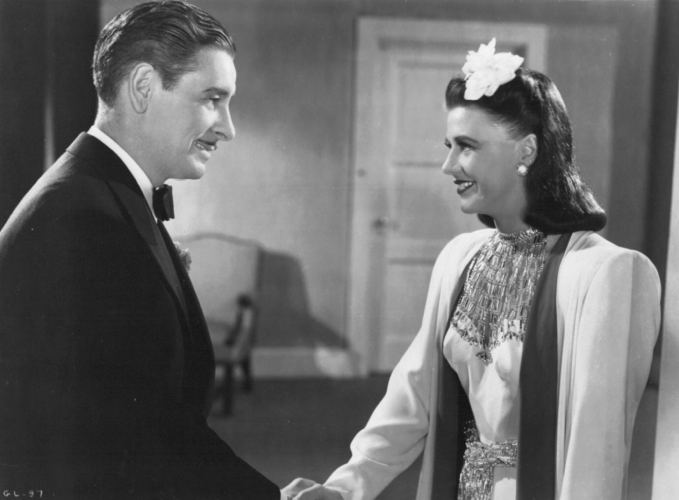
Though well-known as a blonde, Ginger Rogers decided to dye her hair brown for the role of Jean Newton. Rogers thought that this was more appropriate because Jean was just supposed to be an average girl, not a glamourous entertainer. Rogers’ hair ended up turning a darker shade than what she was hoping for, and was reportedly embarrassed watching the rushes after shooting because she though she looked terrible. Despite embarrassment over her hair, Rogers got along well with Colman and she was frequently left in awe of him during filming. She later wrote in her autobiography, “I’d sit there gazing at him with a perpetual grin of pleasure on my face, just like a fan.”
Lewis Milestone began shooting Lucky Partners at the beginning of April 1940 and principle photography didn’t wrap up until July 6. For a comedy film shot entirely on set, this was an unusually long production period. The production length was due to a long delay. Early on in the shoot, Milestone and producer Haight got cold feet about Scott’s script and decided to rewrite the screenplay. Filming was delayed while John Van Druten and several others (including Milestone and Haight) rewrote the script. After the new screenplay was ready, Milestone got sick, delaying production for another eighteen days. Shooting on Lucky Partners ran so far behind schedule that Rogers couldn’t take her contractually mandated break between pictures, and she had to immediately begin shooting her next film Kitty Foyle (1940).
Fun Facts and Trivia: Lucky Partners was the sixth of seven films that Ginger Rogers and Jack Carson appeared together in. The other films were: Stage Door (1937), Vivacious Lady (1938), Having a Wonderful Time (1938), Carefree (1938), Fifth Avenue Girl (1939), and The Groom Wore Spurs (1951). In the earlier movies Rogers was the leading lady while Carson played a supporting role, but the two were both leads in The Groom Wore Spurs. Lucky Partners was also the last of ten RKO films written by Allan Scott that starred Ginger Rogers. The earlier films were: Roberta (1935), Top Hat (1935), In Person (1935), Follow the Fleet (1936), Swing Time (1936), Shall We Dance (1937), Carefree, Fifth Avenue Girl (1939), and Primrose Path (1940). Many years later Scott also wrote the script for the infamously bad independent comedy The Confession (1964) that starred Rogers.
In the scene where Jean is talking to David on the telephone, she trips on the telephone wire, falls to the floor, and then stars laughing. The fall wasn’t in the script, Ginger Rogers really did accidently trip over the cord. Director Lewis Milestone decided to use this take for the final film because he thought that Ginger’s reaction did a good job of showing how excited her character was to see David.
Reception: Lucky Partners was released in the United States on August 2, 1940, less than a month after shooting wrapped up. Although the box office gross for Lucky Partners was lower than Rogers’ musical films with Fred Astaire, the film still earned a decent profit for RKO Radio Pictures, unlike Carefree and The Story of Vernon and Irene Castle, which both lost money. The relatively low box office for Lucky Partners was apparently a result of Ginger Rogers’ surprisingly controversial decision to dye her hair brown. According to Harold Heffernan of The Evening Star, Rogers’ hair color change confused angered many of her fans and RKO received hundreds of angry fan letters as a result. On April 6, 1941 Screen Guild Theater aired a thirty minute radio adaptation of Lucky Partners in which Ginger Rogers reprised her role.
Lucky Partners received mostly positive reviews from film critics when it was first released. Bosley Crowther of The New York Times noted that foreign films didn’t always translate well to the United States when remade, but that Lucky Partners was a surprisingly excellent adaptation of Sacha Guitry’s Good Luck. Crowther stated that Lucky Partners, “retained the impudent charm and rippling wit of the very Gallic Mr. Guitry” and he praised the direction of Lewis Milestone. The Evening Independent complimented the pairing and performances of Ginger Rogers and Ronald Colman, and described the film as “excellent entertainment.” The Wilmington News similarly lauded Lucky Partners for its cast and comedy, and stated that the film provided, “an exhilarating lift for the soul such as movie-goers haven’t experience in a long while.” The November edition of Photoplay ranked Lucky Partners as one of the best films of the month and Colman’s performance as David Grant as being among the best of the month.
Why You Should See It: Lucky Partners is an average, but enjoyable comedy film. Ginger Rogers and Ronald Colman have a charming romantic dynamic and they make a good couple. The portion of the film set at the Niagara Falls hotel was really entertaining and has plenty of fun moments including the split-screen telephone call between Jean and David. Although director Lewis Milestone is much more well-known today for his drama films, he skillfully handles the humor in Lucky Partners.