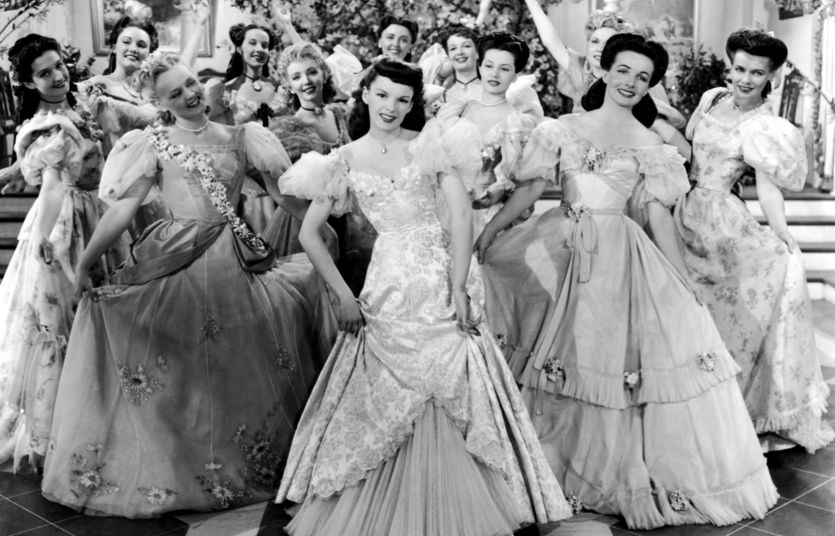
The Harvey Girls is a 1946 Western musical-comedy film directed by George Sidney. The film stars Judy Garland, John Hodiak, and Angela Lansbury. The Harvey Girls is an adaptation of Samuel Hopkins Adams’ 1942 novel of the same name, which was a story about several “Harvey Girl” waitresses from the historical Harvey House railroad restaurant chain.
Director: George Sidney
Production Company: Metro-Goldwyn-Mayer
Distributor: Metro-Goldwyn-Mayer
Cast: Judy Garland, John Hodiak, Ray Bolger, Angela Lansbury, Preston Foster, Virginia O’Brien, Kenny Baker, Marjorie Main, Chill Wills, Selena Royal, Cyd Charisse
US Box Office: $10,280,000 ($258,900,000 adjusted for inflation)
Film Format: Technicolor
Genre: Musical, Comedy, Western
Release Date: January 19, 1946 (premiere)
Plot Summary: Susan Bradley (Judy Garland) a “mail order bride” from Ohio, travels by train to the southwest town Sandrock to marry the mysterious H.H. Hartsey who she has only conversed with through letters. Upon arriving in Sandrock, Susan learns that Hartsey (Chill Wills) is just a goofy old man and the romantic letters he supposedly wrote her were actually from his boss, saloon owner Ned Trent (John Hodiak), apparently as a joke. To get back at Trent, Susan becomes a “Harvey Girl” waitress at the respectable new Harvey House restaurant, the rival business to Trent’s sleazy Alhambra saloon. Susan quickly becomes befriends farm girl Alma (Virginia O’Brien) and would-be-dancer Deborah (Cyd Charisse), two of her fellow Harvey Girls. Although business rivals, Susan and Ned Trent begin the fall in love with each other, much to the annoyance of saloon singer Em (Angela Lansbury), who is also attracted to Trent.
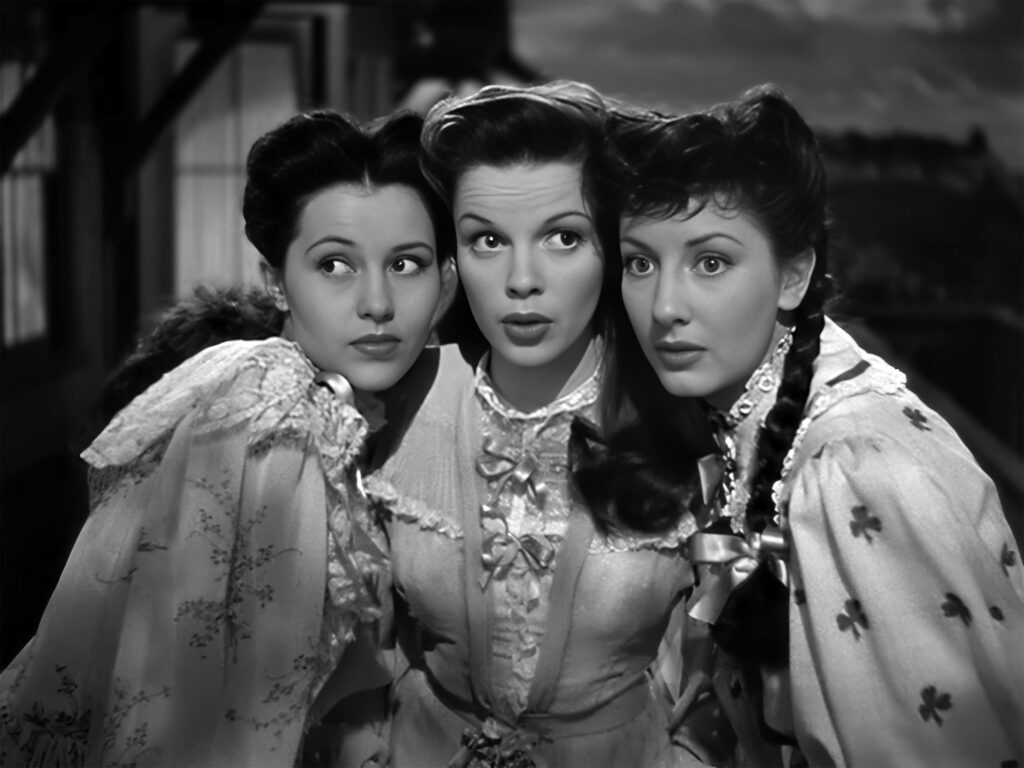
Production: Metro-Goldwyn-Mayer studio executives purchased the film rights to Samuel Hopkins Adams’ novel The Harvey Girls (1942) shortly after the book had been published. The novel was a fictional story about several Harvey Girl waitresses from the Harvey House restaurant chain. The real-life Harvey House chain of restaurants was started by Fred Harvey in 1876, the restaurants were usually located near railroad stations and typically served train passengers, and they employed waitresses known as “Harvey Girls.” MGM executives originally intended for the The Harvey Girls to be a dramatic western and to star Lana Turner. However, after seeing a performance of the Rodgers and Hammerstein Broadway play Oklahoma! (1943) Roger Edens, an associate producer for the Arthur Freed’s musical unit, decided that The Harvey Girls would be better as a musical comedy.
Arthur Freed was chosen to produce The Harvey Girls after Eden convinced studio higher-ups that the film would work better as a musical comedy. Freed was the boss of MGM’s musical unit at the time, and he recently produced the musicals Du Barry Was a Lady (1943), Girl Crazy (1943), and Meet Me in St. Louis (1944) for the studio. The story for The Harvey Girls was written by Eleanore Griffin and William Rankin, loosely based on Adams’ novel. Edmund Beloin, Nathaniel Curtis, Harry Crane, James O’Hanlon, Samson Raphaelson, and Kay Van Riper all made contributions to the film’s screenplay. Harry Warren (music) and Johnny Mercer (lyrics) wrote all the film’s songs, and Lennie Hayton composed the general score. George Sidney was chosen to direct The Harvey Girls. He recently directed the musicals Thousands Cheer (1943), Bathing Beauty (1944), and Anchors Aweigh (1945) for the studio.
Judy Garland was cast as Susan Bradley, the film’s main character and one of the Harvey Girls. At the time, Garland was hoping that she could be cast in Yolanda and the Thief (1945), she was interested in that film because it would have given her a chance to work with Fred Astaire and be directed by her then-fiancé Vincente Minnelli. Roger Eden convinced Garland to instead star in The Harvey Girls because the role of Susan Bradley was specifically designed to showcase her talents. Garland was one of MGM’s most popular musical stars of the 1940s. She recently starred in the musicals For Me and My Gal (1942), Girl Crazy, and Meet Me in St. Louis. John Hodiak was cast as Ned Trent, the saloon owner who is initially an enemy of Susan but later falls in love with her. He recently had roles in Song of Russia (1944) and A Bell for Adano (1945).
British actress Angela Lansbury was cast as Em, the saloon singer who is Susan’s main rival. The Harvey Girls was only Lansbury’s fourth film and her first film playing an American character. Lansbury could sing well and had a soprano voice, but MGM thought that her natural voice was too high for a saloon singer, so her singing in The Harvey Girls was dubbed Virginia Reess, who had a deeper voice. Deborah was played by dancer Cyd Charisse, in her first speaking role in a film. Charisse’s singing was dubbed by Marion Doenges. Ray Bolger has a supporting role in The Harvey Girls as the comic relief character Chris Maule. Garland and Bolger previously starred together in the beloved fantasy musical The Wizard of Oz (1939).
George Sidney began shooting The Harvey Girls in January of 1945 and principal photography wrapped up in early June. Most of the scenes featuring actors were shot on set at MGM Studios in Culver City and on location at the Iverson movie ranch. A second unit filmed establishing and background shots on location in Victorville, California and at the Monument Valley in southern Utah and northern Arizona. The Harvey House set built for The Harvey Girls was inspired by the design of the Castañeda Hotel in Las Vegas, New Mexico. The Castañeda Hotel was a railroad hotel operated by the Fred Harvey Corporation from the 1890s until it closed in 1948. The bulk of the “On the Atchison, Topeka and the Santa Fe” musical number was supposedly shot in one take (from Judy Garland’s entrance until the conductor yells “All Aboard!” at the end).
Principle photography on The Harvey Girls lasted almost five months, a very long time for a film of this era. This was partially due to Judy Garland’s poor attendance. At the height of her career in the 1940s, Garland had a very troubled personal life and numerous issues. Garland missed eleven days of shooting and arrived late on set forty days. Actress Virginia O’Brien was pregnant during shooting. Due to the delays caused by Garland, O’Brien’s character Alma had to be cut from several scenes once it became too difficult to hide her pregnancy. This is the reason why Alma disappears from the film after O’Brien’s “The Wild, Wild West” solo number.
Fun Facts and Trivia: The train conductor in The Harvey Girls was played by Byron Harvey Jr. He was the grandson of the real Fred Harvey and was the president of the Fred Harvey Corporation at the time of filming. Judy Garland and Marjorie Main (Sonora Cassidy) previously appeared together in Meet Me in St. Louis (1944) and later appeared in Summer Stock (1950). Main would later be best known for playing Ma Kettle in ten films in the Ma and Pa Kettle series from 1947 to 1957.
Three of the songs written by Harry Warren and Johnny Mercer for The Harvey Girls went unused: “March of the Doagies” (sung by Judy Garland), “Hayride” (sung by Garland and Ray Bolger), and “My Intuition” (sung by Garland and John Hodiak). Scenes featuring “March of the Doagies” and “My Intution” were shot, but ended up being cut from the final film. Garland and Bolger made a vocal recording of “Hayride”, but that song was never filmed.
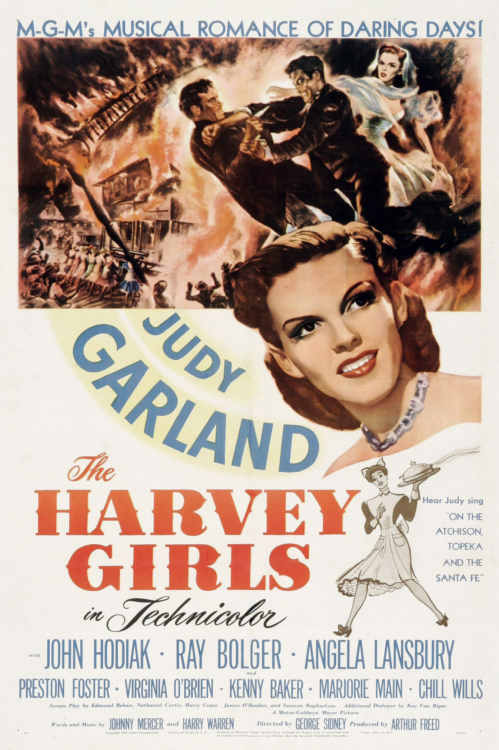
Reception: The Harvey Girls premiered in Hollywood on January 19, 1946. The film went into general release a few weeks later. The Harvey Girls was a financial success for MGM and was one of the top fifteen highest grossing films of the year. One reason why the film was a success was due to the popularity of the film’s big musical number “On the Atchison, Topeka, and the Santa Fe.” Before The Harvey Girls had even finished shooting, MGM sold the rights to “On the Atchison, Topeka, and the Santa Fe” to several different recording companies, which allowed the song to become well-known in 1945. The version of the song sung by original lyricist Johnny Mercer with backup vocals by the Pied Pipers for Capital Records was especially popular. The Mercer version spent sixteen weeks on the Billboard charts and was the No. 1 ranked song from July 28 to September 8, 1945. Versions recorded by Bing Crosby with Six Hits and a Miss and Judy Garland with The Merry Macs were also big hits. By the time The Harvey Girls released in January, “On the Atchison, Topeka, and the Santa Fe” was already well-known and the studio was able to use the song’s popularity in their advertising material for the film.
The Harvey Girls received generally positive reviews from critics when it was first released. Howard Barnes of the New York Herald Tribune had strong praise for the film’s overall production values and stated of the film, “The Harvey Girls is a perfect demonstration of what Hollywood can do with its vast resources when it wants to be really showy.” Barnes also enjoyed Judy Garland’s performance and her singing. Jay Carmody of The Evening Star praised the film’s fun tone, which he considered to be one of The Harvey Girls‘s better qualities. Time magazine enjoyed Judy Garland’s performance. The March edition of Photoplay magazine ranked The Harvey Girls as one of the best films of the month and ranked the performances of Judy Garland and John Hodiak as being among the best of the month.
The Harvey Girls continues to receive mostly positive reviews from modern critics. Steve Crum of Video-reviewmaster.com praised the film’s songs and fun tone, though he noted that The Harvey Girls wasn’t one of Garland’s best films. Matt Brunson of Film Frenzy applauded the film’s enthusiastic tone. In an otherwise mixed review, Ken Hanke of Mountain Xpress praised the song “On the Atchison, Topeka and the Santa Fe.” In 2004 the song “On the Atchison, Topeka and the Santa Fe” was one of 400 songs nominated by the American Film Institute for their list of their “AFI’s 100 Years…100 Songs” list of the best songs from American films. In 2006 The Harvey Girls was one of 180 films nominated by the AFI for its’ list of the top 25 greatest movie musicals.
Oscars: The Harvey Girls was nominated for two Oscars at the 19th Academy Awards ceremony: Best Musical Score (Lennie Hayton) and Best Song (for “On the Atchison, Topeka and the Santa Fe” with music by Harry Warren and lyrics by Johnny Mercer). The film won one Oscar, which Warren and Mercer recieved for “On the Atchison, Topeka and the Santa Fe.” Lennie Hayton lost the Best Musical Score award to Morris Stolhoff for The Jolson Story.
Why You Should See It: The Harvey Girls is an average but enjoyable musical comedy film. The film’s musical numbers are very high quality. “On the Atchison, Topeka and the Santa Fe” had great production values and was well choreographed. I also liked the “It’s a Great Big World” number with Judy Garland, Virginia O’Brien, and Cyd Charisse. The technicolor cinematography in The Harvey Girls is top notch as well.