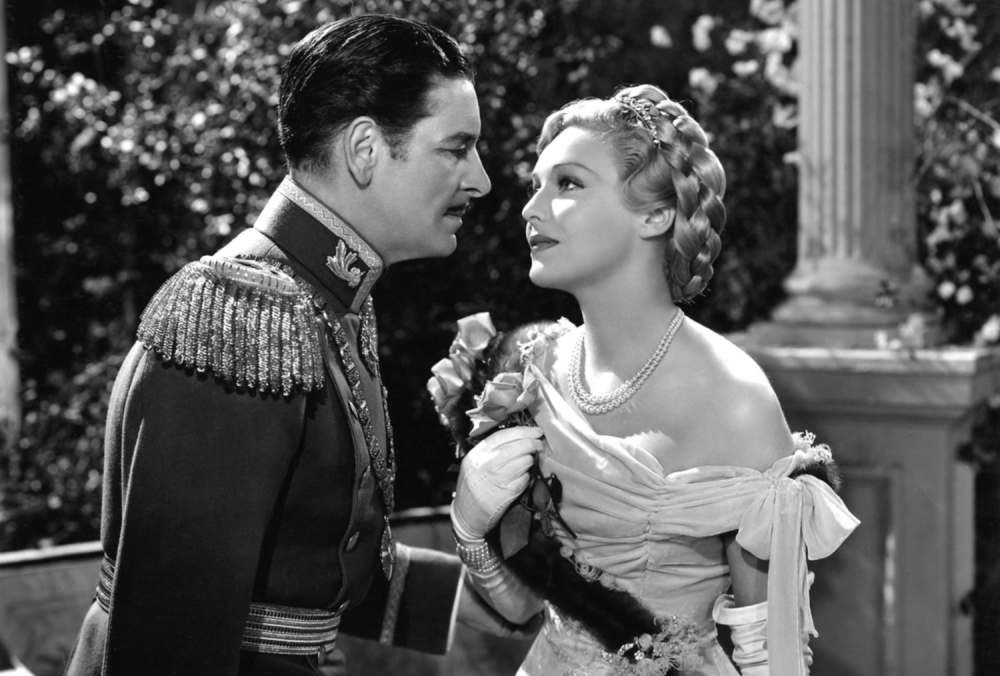
The Prisoner of Zenda is a 1937 adventure film directed by John Cromwell and produced by David O. Selznick. The film stars Ronald Colman, Madeleine Carroll, and Douglas Fairbanks Jr. The Prisoner of Zenda is an adaptation of Anthony Hope’s 1894 novel of the same name.
Director: John Cromwell (with W.S. Van Dyke and George Cukor)
Production Company: Selznick International Pictures
Distributor: United Artists
Cast: Ronald Colman, Madeleine Carroll, Douglas Fairbanks Jr., C. Aubrey Smith, Raymond Massey, Mary Astor, David Niven, Torben Meyer
US Box Office: $3,625,000 ($144,500,000 adjusted for inflation)
Film Format: Black & White
Genre: Adventure, Drama
Release Date: September 2, 1937 (premiere)
Plot Summary: While visiting the Kingdom of Ruritania, Englishman Rudolf Rassendyll (Ronald Colman) meets his distant relative, the soon-to-be King Rudolph V (Ronald Colman). The day before his coronation, Rudolph is drugged by his jealous half-brother Duke Michael (Raymond Massey). Rudolph’s allies Colonel Zapt (C. Aubrey Smith) and Captain Fritz von Tarlenheim (David Niven) convince Rassendyll to impersonate the King for the coronation to keep Michael from taking power. The coronation goes as planned, but Rassendyll is forced to continue impersonating the King after the unconscious Rudolph is kidnapped by Michael’s deceitful ally Rupert of Hentzau (Douglas Fairbanks Jr.). While Rassendyll, Zapt, and von Tarlenheim search for the King, Rassendyll finds himself falling in love with Princess Flavia (Madeleine Carroll), the woman who is engaged to the real Rudolph.
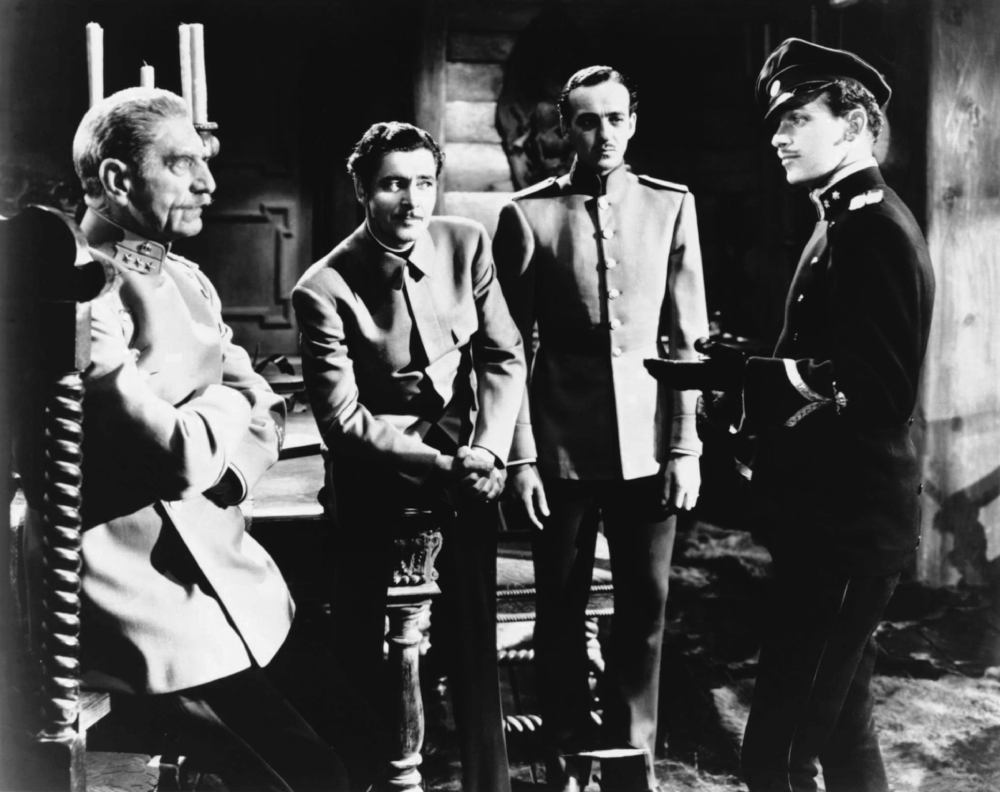
Production: In 1933, Metro-Goldwyn-Mayer executives began pre-production work on a film adaptation of Anthony Hope’s adventure novel The Prisoner of Zenda (1894). This version of the film was to be a musical, and the studio planned for the film to star Jeanette MacDonald and Nelson Eddy with Richard Rodgers and Lorenz Hart writing the music. By 1935, the studio removed the musical aspect and considered casting William Powell and Myrna Loy in the lead roles. The MGM version of The Prisoner of Zenda was never produced.
Independent film producer David O. Selznick purchased the film rights to The Prisoner of Zenda from MGM in January of 1937. Selznick was interested in adapting The Prisoner of Zenda because of the characters’ sense of duty contrasted with the recent abdication of King Edward VIII. Edward VIII had abdicated the British throne to marry divorcee Wallis Simpson. By contrast, Princess Flavia in The Prisoner of Zenda gives up her love rather than sacrifice her royal duty. Selznick’s version of The Prisoner of Zenda was based on Hope’s novel as well as its 1896 stage play adaptation by Edward Rose. The final screenplay was written by John L. Balderston, with the adaptation done by Wells Root, and additional dialogue by Donald Ogden Stewart. Ben Hecht and Sidney Howard also made uncredited contributions to the script. Selznick’s first choice to direct The Prisoner of Zenda was Frank Borzage, however Borzage was under contract with Warner Bros. at the time and Jack L. Warner refused to loan him to Selznick. John Cromwell was chosen instead. He recently directed the drama film Little Lord Fauntleroy (1936) for Selznick, and had also notably directed Of Human Bondage (1934), the film that made Bette Davis a star. The film’s score was composed by Alfred Newman.
Ronald Colman was cast in the dual role of Major Rassendyll and King Rudolph. Colman had always been Selznick’s top choice and Selznick actually waited to purchase the rights to The Prisoner of Zenda from MGM until he was certain that Colman was available. Colman previously starred in the acclaimed drama A Tale of Two Cities (1935), which Selznick had produced for MGM. He also recently starred in the adventure films: Under Two Flags (1936) and Lost Horizons (1937). British actress Madeleine Carroll was cast as Princess Flavia. She was loaned to Selznick by Walter Wanger Productions. Carroll recently starred in the historical drama Lloyd’s of London (1936) and was notably the leading leady in two of Alfred Hitchcock’s British thrillers: The 39 Steps (1935) and Secret Agent (1936).
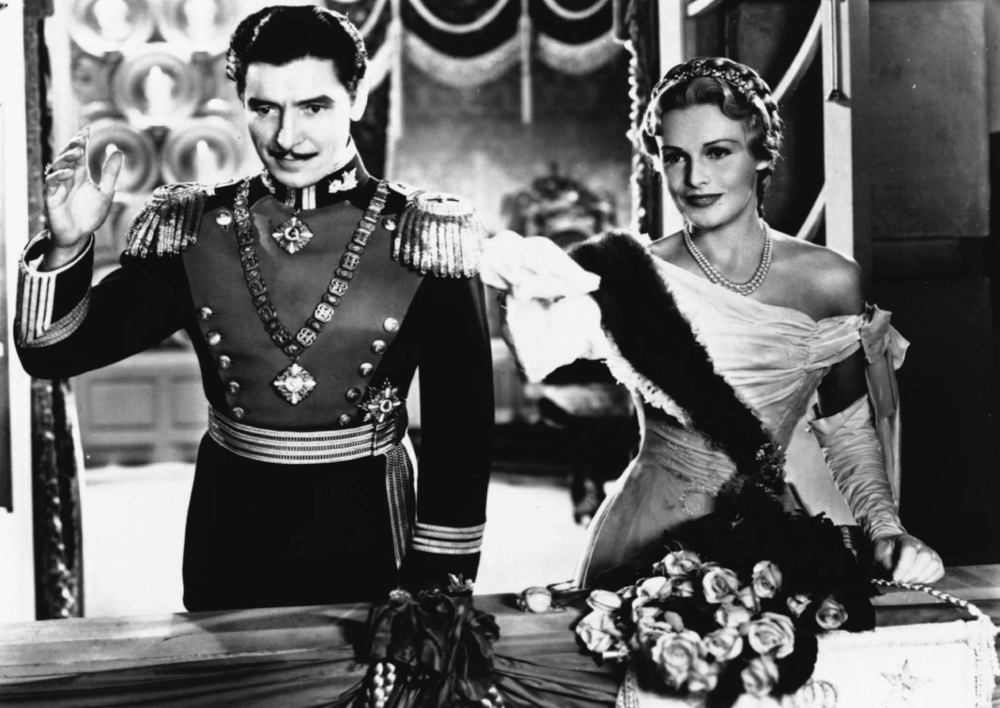
Douglas Fairbanks Jr. auditioned for the dual role of Rassendyll and King Rudolph, but Selznick thought that Fairbanks was perfect for the part of villain Rupert of Hentzau and cast him in that part instead. Fairbanks was initially disappointed, but his father, the legendary silent star Douglas Fairbanks Sr., convinced his son that this casting was a blessing in disguise. He told his son, “not only is The Prisoner of Zenda one of the best romances written in a hundred years and always a success, but Rupert of Hentzau is probably one of the best villains ever written.” Fairbanks Jr. recently starred in the British dramas Accused (1936) and Jump for Glory (1937).
John Cromwell began filming The Prisoner of Zenda in March of 1937. The film was primarily shot on set (both indoors and on outdoor lots) at Culver Studios in Culver City, CA. The first scene to be shot was the scene where Rassendyll and Rudolph first meet and shake hands (with their faces clearly visible at the same time). To film the scene, Colman shook hands with his double, whose head and shoulders were matted out using glass in front of the camera. Colman then took the place of his double and everything except his head and shoulders were matted out. The two reels were edited together to show Colman shaking hands with himself! Cromwell did not get along well with the actors. David Niven and Fairbanks Jr. would have late night parties after filming wrapped up for the day and Cromwell described the two as “overindulged and lazy,” while Colman had trouble remembering his lines. Colman and Carroll both insisted that Cromwell only film their faces from one side (the same side, which would have made face-to-face conversations between the two impossible) which greatly annoyed Cromwell.
Cromwell had to leave the production in May to begin pre-production work on The Adventures of Marco Polo. Selznick brought in George Cukor to direct a few of the final drama-heavy scenes, including the renunciation scene with Madeleine Carroll. Selznick was disappointed with Cromwell’s work on the fencing scenes, so he hired W.S. Van Dyke, a reliable studio director praised for his speed and efficiency, to reshoot these scenes. Cromwell was the only one who received credit for directing The Prisoner of Zenda.
Fun Facts and Trivia: The orchestra conductor who is forced to stop and restart the orchestra whenever the royal couple stop dancing was played by comedian Al Shean. He notably performed together with Ed Gallagher as part of the “Gallagher and Shean” Broadway and vaudeville act in the 1910s and 1920s. Shean was also well known for being the uncle of the Marx Brothers comedy team. Sigvard Bernadotte, the former Prince of Sweden served as a technical advisor on The Prisoner of Zenda. He was excluded from the Swedish line of succession when he married a common woman (not unlike the Edward VIII situation that inspired Selznick to make The Prisoner of Zenda). Bernadotte worked on a few other Hollywood films during this time.
Veteran English actor C. Aubrey Smith who played Colonel Zapt, had been one of the cast members of the original 1896 London stage production of The Prisoner of Zenda where he originated the dual role of Rassendyll and King Rudolph. Over the years Smith played many of the novel’s characters in various stage adaptations of The Princess of Zenda. Raymond Massey, who had trouble understanding Michael, asked Smith for advice. Smith simply told him, “My dear Ray, in my time I have played every part in The Prisoner of Zenda except Princess Flavia. And I always had trouble with Black Michael!”
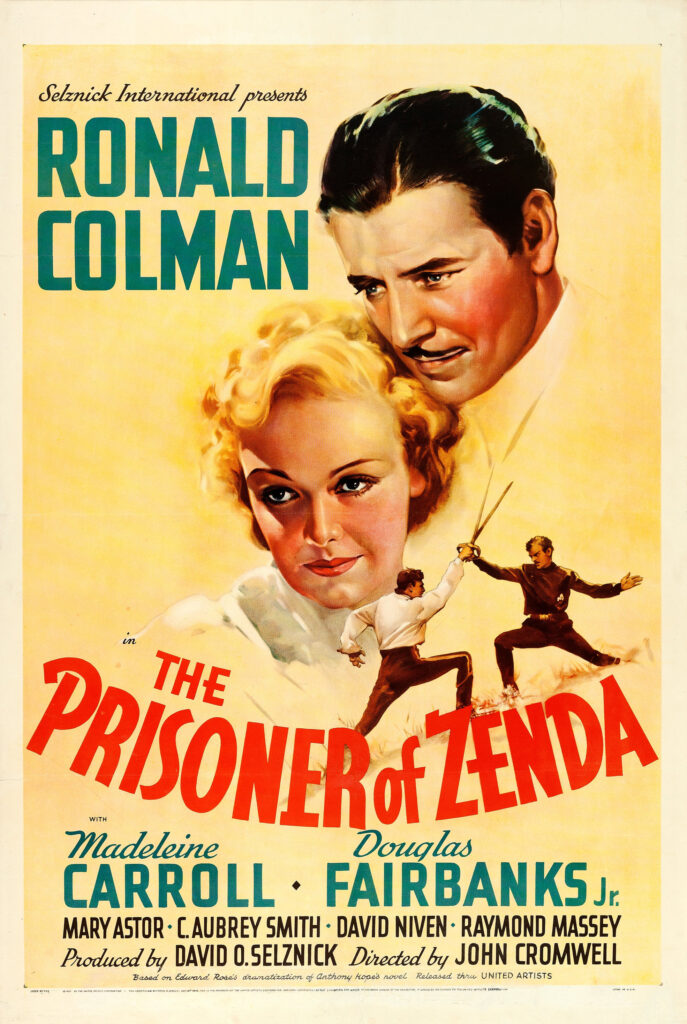
Reception: The Prisoner of Zenda had its world premiere in New York City on September 2, 1937. As part of a publicity event for this premiere, Russell J. Birdwell (Selznick’s publicity chief) and a dozen town residents flew from the town of Zenda in Ontario, Canada to New York to attend the premiere. That Zenda had been named after Hope’s novel. The Prisoner of Zenda‘s Los Angeles premiere at Grauman’s Chinese Theater also featured a publicity stunt. At the time, there was a heated dispute in the LA area over Culver City’s (where MGM Studios and several other production companies were based) interest in officially changing its name to “Hollywood.” To mark the end of the dispute over this name change, representatives from Culver City literally buried a hatchet in cement at the theater. California governor Frank Merriam attended the ceremony.
The Prisoner of Zenda was one of the top twenty highest grossing films in the United States that year, though it only earned a modest profit for Selznick given its expensive budget. Ronald Colman, Douglas Fairbanks Jr., and C. Aubrey Smith reprised their film roles in a June 6, 1939 Lux Radio Theatre radio broadcast of The Prisoner of Zenda. Colman’s wife Benita Hume played Princess Flavia. Colman and Hume later reprised their roles for a February 20, 1949 radio adaptation of the film for Screen Director’s Playhouse.
The Prisoner of Zenda received positive reviews from film critics when it was first released. Jay Carmody of The Evening Star praised for the acting performances, the screenplay, and production design. Carmody was particularly impressed by Coleman’s dual role and Douglas Fairbanks Jr.’s villainous performance. The Roanoke Rapids Herald liked the actors and strongly praised of the film’s production values and set design, which the newspaper described as, “some of the most impressive and beautiful scenes ever filmed.” Katharine Hillyer of The Washington Daily News also praised the cast and the production design. She noted that The Prisoner of Zenda was, “a lively show that should entertain exacting movie fans.” The November issue of Photoplay ranked The Prisoner of Zenda as one of the best films of the month and ranked the performances of Colman and Carroll as being among the best of the month.
In 1947, David O. Selznick announced that he would produce a film adaptation of Hope’s novel Rupert of Hentzau (1898), the sequel to The Prisoner of Zenda. Selznick planned for the film to star Joseph Cotton (as Rassendyll and King Rudolph), Louis Jordan, and Alida Valli. However, the film was never made. In 1952, MGM released their own Technicolor film adaptation of The Prisoner of Zenda, starring Stewart Granger, Deborah Kerr, and James Mason. The 1952 film was an almost of shot-for-shot remake of the 1937 version. The 1952 version used the same script, featured most of the same dialogue, and even reused Alfred Newman’s original score!
The Prisoner of Zenda continues to receive positive reviews from modern critics. James Sanford of the Kalamazoo Gazette gave the film a perfect 5/5 star rating and said The Prisoner of Zenda was “as much fun as a swashbuckler could hope to be.” Ken Hanke of Mountain Xpress also gave the film a 5/5 star rating and noted that it was nearly perfect. In 2001, The Prisoner of Zenda was one of 400 films nominated by the American Film Institute for its “AFI’s 100 Years…100 Thrills” list of the top 100 most exciting American movies.
Oscars: The Prisoner of Zenda was nominated for two Oscars at the 10th Academy Awards ceremony: Best Score (Alfred Newman) and Best Art Direction (Lyle R. Wheeler). Stephen Goosson won the Best Art Direction award for Lost Horizon and Charles Previn recieved the Best Score award for One Hundred Men and a Girl.
Why You Should See It: The Prisoner of Zenda is an excellent adventure film. Alfred Newman’s score is great. The Prisoner of Zenda features some very impressive large-scale sets including the cathedral set used for the coronation scene. Ronald Colman is good in both of his roles as Rassendyll and King Rudolph. Douglas Fairbanks Jr. gives a fantastic performance as the cunning and deceitful villain Rupert of Hentzau. The Prisoner of Zenda has a strong moral compass and the main protagonists’ dedication to duty is highly admirable.