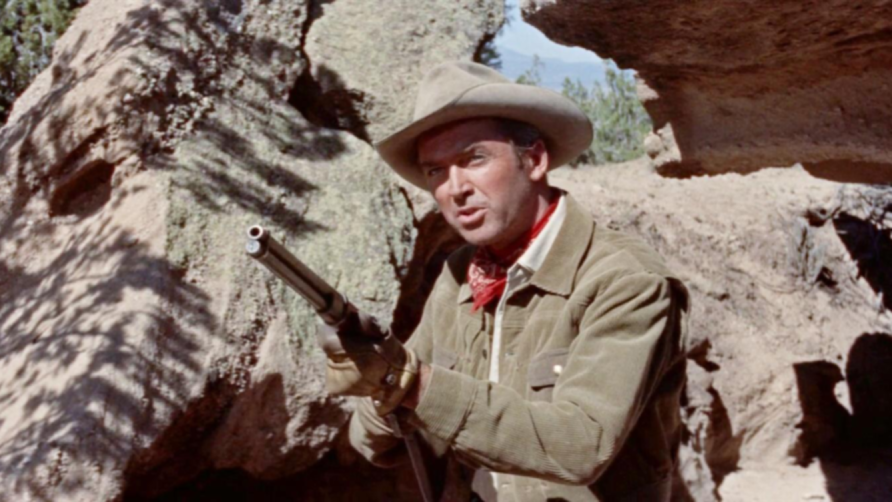
The Man from Laramie is a 1955 Western directed by Anthony Mann. The film stars James Stewart, Arthur Kennedy, Donald Crisp, and Cathy O’Donnell. The Man from Laramie was based on the 1954 serialized story of the same name written by Thomas T. Flynn.
Director: Anthony Mann
Production Company: William Goetz Productions
Distributor: Columbia Pictures
Cast: James Stewart, Arthur Kennedy, Donald Crisp, Cathy O’Donnell, Alex Nicol, Aline MacMahon, Wallace Ford
US Box Office: $8,250,000 ($164,500,000 adjusted for inflation)
Film Format: Technicolor (shot in CinemaScope)
Genre: Western, Drama
Release Date: August 31, 1955 (New York City); September 20, 1955
Plot Summary: Will Lockhart (James Stewart) from Laramie travels to the small town of Coronado. Although Lockhart is officially there to deliver supplies to Barbara Waggoman’s (Cathy O’Donnell) store, he has actually come on a mission of revenge. Lockhart’s brother was killed by a group of Apache using repeating rifles and he wants to find the man who sold the Apache those guns. Barbara is a sweet young lady, but the rest of her family is rather unpleasant. Alec Waggoman (Donald Crisp), Barbara’s uncle who is a ranch owner and the town boss; Alec’s sadistic son Dave (Alex Nicol); and Alec’s assistant Vic Hansbro (Arthur Kennedy) all try to force Lockhart to leave town. However, Lockhart refuses to leave until he finds the man responsible for his brother’s death, putting him into conflict with Alec and Dave.
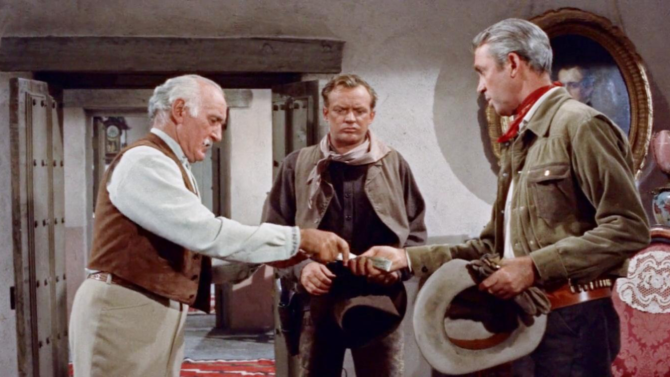
Production: In late 1954 producer William Goetz purchased the rights to “The Man from Laramie,” (1954) a western story written by Thomas T. Flynn and originally serialized in The Saturday Evening Post. Flynn later published the story as its own novel in 1955. Goetz and director Anthony Mann were interested in adapting “The Man from Laramie” into a darker “psychological western” film, with the intention of casting James Stewart in the lead role. The screenplay for The Man from Laramie was written by Phillip Yordan and Frank Burt based on Flynn’s story. Goetz produced the film independently through his company “William Goetz Productions” and The Man from Laramie was distributed by Columbia Pictures.
Director Anthony Mann cast James Stewart to play the lead role of Will Lockhart in The Man from Laramie. Mann and Stewart first worked together on the western Winchester ’73 (1950) for Universal. Fritz Lang was originally supposed to direct that film, but he dropped out because he didn’t think that Stewart was a good fit for the tough lead character. Stewart had seen a rough cut of Mann’s yet-to-be-released western Devil’s Doorway (1950) and was impressed, so he suggested that Mann replace Lang. Winchester ’73 became a critical and financial success so Stewart and Mann were paired together for several more films from different studios. Mann directed Stewart in the westerns Bend of the River (1952), The Naked Spur (1953), and The Far Country (1954); and in the non-westerns Thunder Bay (1953), The Glenn Miller Story (1954), and Strategic Air Command (1955). Actor Arthur Kennedy was cast to play sympathetic antagonist Vic Hansbro in The Man from Laramie. He received an Academy Award nomination for Best Supporting Actor for his role in the film Trial, also released that year.
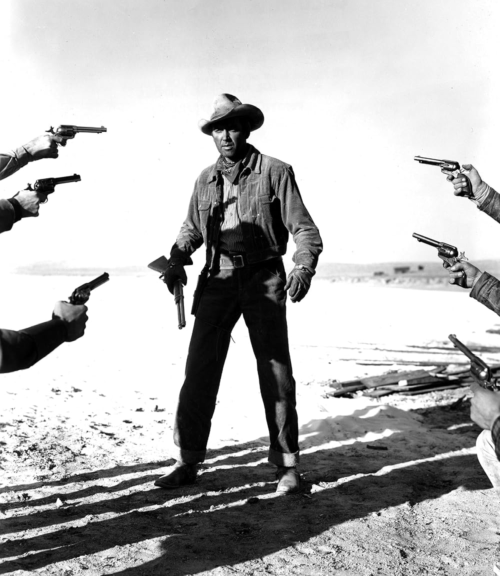
Filming on The Man from Laramie began in early 1955. William Goetz chose to have the film shot in Technicolor and in the wide-screen CinemaScope format to emphasize the beauty and vastness of the desert scenery. The Man from Laramie was Anthony Mann’s first CinemaScope film, though Strategic Air Command had been filmed in Paramount’s similar VistaVision format. The Man from Laramie was primarily shot on location in New Mexico. The Bonanza Creek Movie Ranch in southwest Santa Fe County served as a prominent filming location and was used to represent the city of Coronado. Filming was also done at the Taos Pueblo and the Tesuque Pueblo, which were north of the Bonanza Creek Movie Ranch.
Jimmy Stewart himself participated in one of The Man from Laramie‘s most dangerous stunt scenes. In the scene where Will Lockhart and Dave Waggoman first meet, Dave (on horseback) lassos Will and drags him across the ground because he believes Will is stealing his salt. Normally a stuntman would have been playing Will in these shots, but Stewart insisted that he do the stunt himself. Stewart knew that the scene would look better if he did it himself (as opposed to close ups of his head being intercut with wide shots of a stuntman being dragged across the ground), so Mann agreed to let him do it. The sequence was completed in one ninety-second take.
Fun Facts and Trivia: James Stewart and Arthur Kennedy starred together in three films: Bend of the River (1952), The Man from Laramie, and Cheyenne Autumn (1964), all of which were westerns. Kennedy and Donald Crisp had previously appeared together in the drama City for Conquest (1940). City for Conquest was Kennedy’s first film, though he had worked as a stage actor before that.
The Man from Laramie was the last of six films to feature Stewart and James Millican (Sheriff Tom Quigby) together. The two had previously appeared in You Can’t Take It with You (1938), Mr. Smith Goes to Washington (1939), The Mortal Storm (1940), Winchester ’73 (1950), and Strategic Air Command (1955). Millican had supporting roles and bit parts in over 100 films, many of which were westerns, including the popular High Noon (1952).
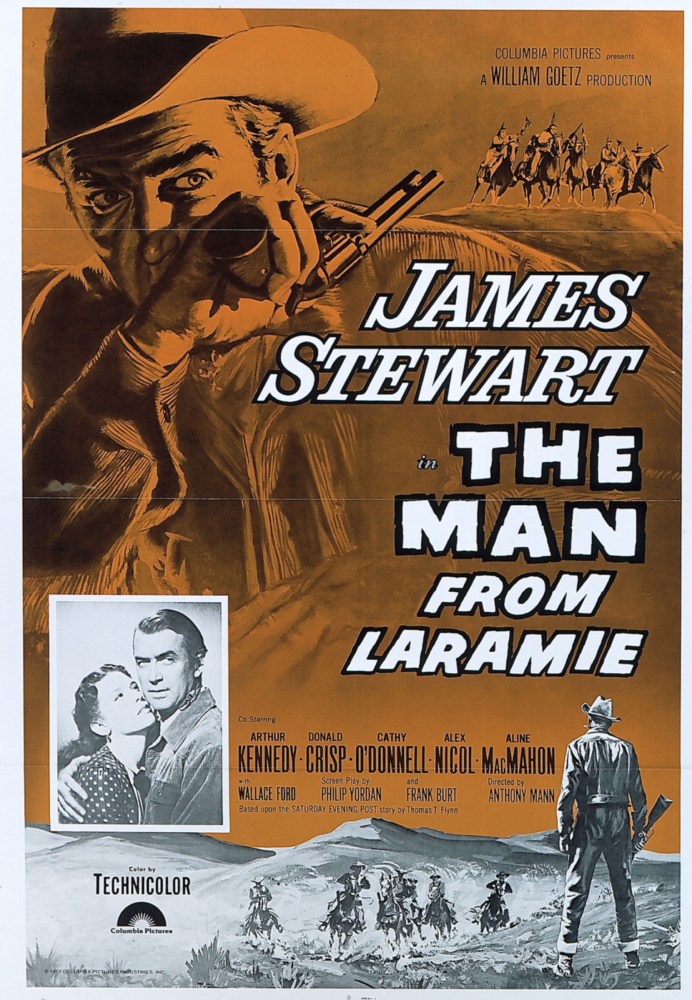
Reception: The Man from Laramie premiered in New York City on August 31, 1955. The film went into wide release on September 20th. The Man from Laramie was a box office success and was Columbia’s second highest grossing film of the year, after John Ford’s biopic The Long Gray Line. Although The Man from Laramie didn’t earn as much money as The Glenn Miller Story or Strategic Air Command it was the highest grossing of the Mann-Stewart western films. The film’s title song “The Man from Laramie” was very popular in the United Kingdom, where a cover version sung by Jimmy Young topped the UK singles charts in October of 1955. The song was less popular in the United States. A version sung by Al Martino only peaked at No. 19 on the US singles charts.
The Man from Laramie received mostly positive reviews from film critics when it was first released. Jay Carmody of The Evening Star had strong praise for the film’s acting, especially Jimmy Stewart’s performance, and director Anthony Mann’s use of suspense. Carmody also thought that the character depth made The Man from Laramie more interesting than typical westerns. Gadsden County Times similarly lauded Stewart’s performance, which the newspaper described as “unforgettable,” and the film’s action. Andre Bazin of the elite French film magazine Cathiers du Cinema gave The Man from Laramie a strongly favorable review. Bazin praised Mann’s directing, specifically his skillful use of violence and how he handled the conflict between the characters.
Despite its financial success, The Man from Laramie was the last western to pair Anthony Mann and Jimmy Stewart together. Mann was slated to direct Night Passage (1957) starring Stewart, but he quit during pre-production and was replaced with James Neilson. Mann disagreed with the casting of Audie Murphy as the secondary lead character and got into an argument with Stewart over the film’s quality. Mann dismissed Night Passage as “trash” and claimed that Stewart was only making the film because it gave him a chance to play the accordion. This annoyed Stewart so much that the two never made any more films together, despite their previous good working relationship.
The Man from Laramie has continued to receive positive reviews from modern film critics. Jeffrey M. Anderson of Combustible Celluloid argued that The Man from Laramie was the best of the five westerns Stewart and Mann made together. Emanuel Levy similarly claimed that it was one of the greatest Mann-Stewart collaborations. Matt Brunson of Film Frenzy praised The Man from Laramie for fitting so much action into its 100 minute run time. Daniel Eagan of Film Journal International lauded The Man from Laramie for its “brutal” violence and noted that the family conflict in the film made it similar to William Shakespeare’s play King Lear.
Why You Should See It: The Man from Laramie is a good western drama. Jimmy Stewart gives a strong performance as Will Lockhart. Stewart’s heroes in the Mann-Stewart westerns were more complex and nuanced than the sort of standard “good guys” that Stewart became famous for playing in the 1930s. Charles Lang’s cinematography was also fantastic. The Man from Laramie features plenty of beautiful shots of mountains and the desert wilderness. The Man from Laramie was very violent for the time, but Mann handled the violence in a generally classy manner that kept it from becoming exploitative. George Duning’s score was also fitting and memorable.