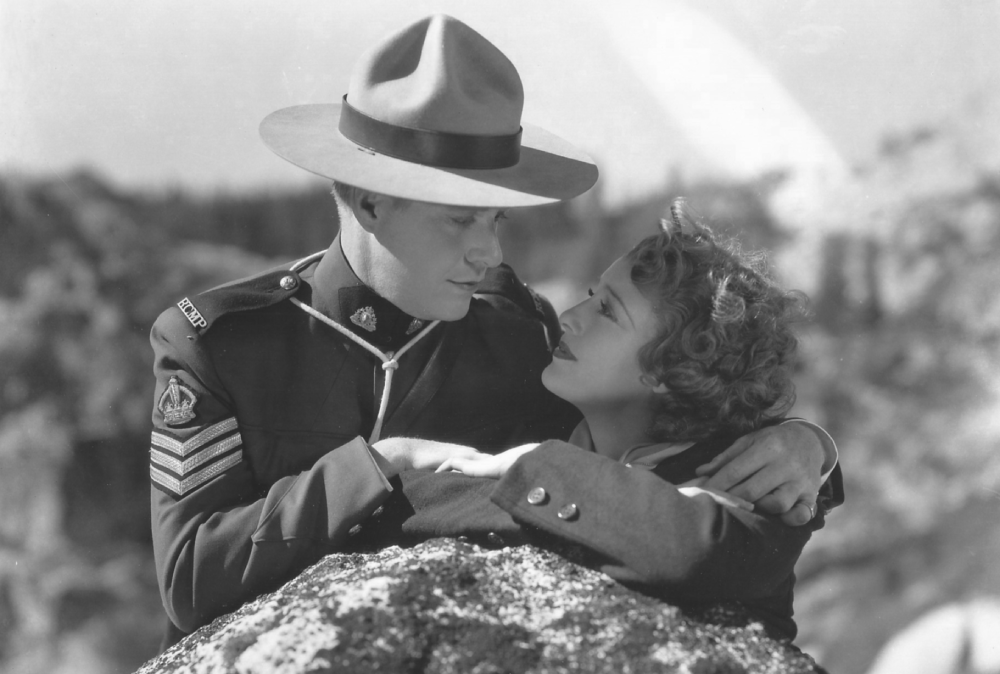
Rose Marie (or Rose-Marie) is a 1936 Northern-Western musical film directed by W.S. Van Dyke. The film stars Jeanette MacDonald and Nelson Eddy and it notably features James Stewart in an early supporting role. Rose Marie is an adaptation of the 1924 Broadway musical of the same name.
Director: W.S. Van Dyke
Production Company: Metro-Goldwyn-Mayer
Distributor: Metro-Goldwyn-Mayer
Cast: Jeanette MacDonald, Nelson Eddy, Reginald Owen, Allan Jones, James Stewart, Alan Mowbray, Gilda Gray
US Box Office: $4,237,500 ($162,200,000 adjusted for inflation)
Film Format: Black & White
Genre: Western, Musical, Adventure
Release Date: January 28, 1936
Plot Summary: In Canada, opera star Marie de Flor (Jeanette MacDonald) learns that her brother Jack Flower (James Stewart) has escaped from prison and killed the Mountie policeman assigned to track him down. Marie travels to the Northern wilderness to meet with Jack and give him money to escape the country. Marie ends up traveling with Sergeant Bruce (Nelson Eddy), the new Mountie assigned to catch Jack (but he does not initially know that Jack is the person she’s looking for). Marie and Bruce soon find themselves falling in love, which complicates Bruce’s mission.

Production: In early 1935 MGM producer Hunt Stromberg began working on a film adaptation of the 1924 Broadway musical Rose-Marie by Otto Harbach and Oscar Hammerstein II. The studio had previously adapted the musical into a 1928 silent drama film of the same name. Frances Goodrich and Albert Hackett wrote the screenplay for the film, titled Rose Marie. Stromberg chose W.S. Van Dyke to direct the film. Van Dyke was under contract with MGM and was well respected at the studio for his speed and efficiency as a director. He recently directed the comedy films The Thin Man (1934) and Forsaking All Others (1934).
Opera singer and actor Nelson Eddy was cast as Bruce, a Canadian Mountie sergeant and the film’s leading male character. Actress and opera singer Grace Moore was initially considered to play the part of opera singer Marie de Flor, the film’s leading lady, but she decided to pass on the role. The role of Marie was instead given to actress Jeanette MacDonald who began her career on Broadway. Eddy and MacDonald previously starred together in the musical film Naughty Marietta (1935), which had also been directed by W.S. Van Dyke. Naughty Marietta was Nelson Eddy’s first role as a leading man, before that he only had minor roles in films, such as playing himself Dancing Lady (1933). Jeanette MacDonald recently starred in the musicals Love Me Tonight (1932) and The Merry Widow (1934).
James Stewart was cast as John Flower, an escaped convict and the brother of MacDonald’s character. Rose Marie was only his third feature-length film after The Murder Man (1935) and Next Time We Love (1936). Early in his career, Stewart appeared in both supporting roles and as a leading man in some lower-budget films, such as Speed (1936) and Born to Dance (1936). Stewart’s starring role in Frank Capra’s romantic comedy You Can’t Take It with You (1938) made him a big star.

W.S. Van Dyke began filming Rose Marie in September of 1935, and shooting wrapped up in December. Although Rose Marie is set in Canada, only a small amount of footage was actually shot there. The scene where the Mounties cross the river was shot at Seymour River near North Vancouver, British Columbia and featured actual Canadian Mounties. Most of the scenes set in the Canadian Wilderness were shot on location at Emerald Bay State Park and Lake Tahoe in eastern California. The canoe scene where Nelson Eddy sings “Rose Marie” was specifically shot at Zephyr Cove on Lake Tahoe. The Indian Festival featuring the “Totem Pole Dance” sequence was shot at Lake Tahoe over a period of six weeks and featured over 700 native extras from fifty different tribes. Although Nelson Eddy and Jeanette MacDonald were married to other people, the two had a long affair together, which had begun in 1935 before Rose Marie started shooting.
Fun Facts and Trivia: Jimmy Stewart was not the only future leading man to have a supporting role in Rose Marie. Teddy, Marie’s suitor at the beginning of the film, was played by David Niven in a bit part. Niven’s name was misspelled as “David Nivens” in the credits. Nelson Eddy was extremely insecure about potential competition from fellow singer Allan Jones (Marie’s unnamed costar who plays “Romeo” and “Mario Cavaradossi” in the opera scenes) and he begged MGM studio head Louis B. Mayer to reduce Jones’ screen time in Rose Marie. Jones was originally planned to have his own solo number, where he sings “E lucevan le stelle” from the opera Tosco, but this scene was cut from the film at Eddy’s insistence.
One of the extras in Rose Marie was wanted criminal Robert Miller Barr. Barr and another man killed two police officers in Yreka, California in early 1935. While hiding out near Lake Tahoe in eastern California, Barr got a job as an extra in Rose Marie. Barr appeared in eight scenes in the film. Barr was later captured by law enforcement officers in September of 1936. Another extra in Rose Marie was James Murray. Murray had once been a silent film star, he was notably the leading man of The Crowd and MGM’s 1928 version of Rose-Marie. However, Murray’s career had faltered by the early 1930s due to his alcoholism and high-profile arrests, and he resorted to appearing in bit parts. He died in July of 1936, Rose Marie and San Francisco (1936) were Murray’s last two films.

Reception: Rose Marie had its premiere on January 28, 1936 and went into general release not long afterwards. The film was a big success for MGM and became one of the top ten highest grossing films of the year. Audiences liked Eddy and MacDonald’s chemistry and singing, which made Rose Marie very popular. The two stars were later paired together in six more musical films for MGM: Maytime (1937), The Girl of the Golden West (1938), Sweethearts (1938), New Moon (1940), Bitter Sweet (1940), and I Married an Angel (1942). Van Dyke directed Sweethearts, Bitter Sweet, and I Married an Angel (and was an uncredited co-director for New Moon).
As part of a publicity stunt for Rose Marie, MGM offered $2,000 to the first woman in 1936 who would name her twin daughters “Rose” and “Marie.” The prize money was won by Mrs. Esker R. Owens of Fort Smith, Arkansas. In 1947 The Screen Guild Theater broadcast a thirty minute radio adaptation of Rose Marie with Nelson Eddy and Jeanette MacDonald reprising their film roles. In 1954 MGM released another film adaptation of Rose-Marie which starred Ann Blyth and Howard Keel. To avoid confusion between the two films, the 1936 film was retitled Indian Love Call (after one of the film’s songs) when it was broadcast on television.
Rose Marie received positive reviews when it was first released. Frank S. Nugent of The New York Times had strong praise for the film’s beautiful wilderness cinematography and for the singing of MacDonald and Eddy. Ann Ross of Maclean’s magazine also gave Rose Marie a positive review. She described the film as “lavish entertainment.” Don Craig of The Washington Daily News praised the singing of Jeanette MacDonald and Nelson Eddy. The March issue of the magazine Photoplay ranked Rose Marie as being one of the best films of the month and ranked Nelson Eddy and Jeanette MacDonald as giving two of the best performances of the month.
Rose Marie still tends to receive a positive response from modern critics. Ken Hancke of Mountain Xpress described the film as being a, “charming version of the operetta.” Carol Cling of the Las Vegas Review-Journal also gave the film a good review. In 2002, Rose Marie was one of the 400 films nominated by the American Film Institute for its “AFI’s 100 Years… 100 Passions” list of the most romantic American films. In 2004, the song “Indian Love Call” was one of 400 songs nominated by the AFI for their “AFI’s 100 Years… 100 Songs” list of the best songs from American films.
Why You Should See It: Rose Marie is a charming and frequently exciting musical-western film. Nelson Eddy and Jeanette MacDonald have good chemistry and do a great job singing. I enjoyed the titular “Rose Marie” song that Eddy sings. The forest and mountain cinematography in Rose Marie is beautiful and fantastic.