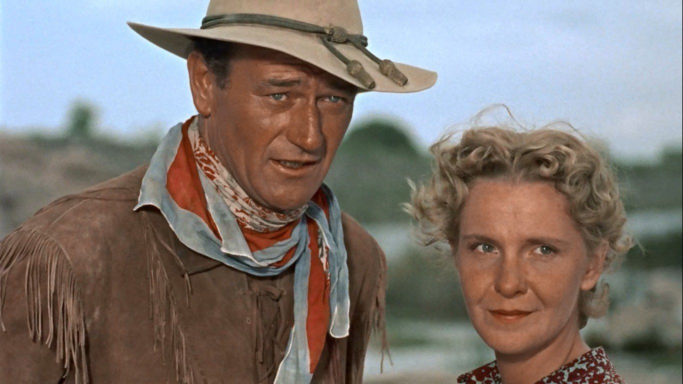
Hondo is a 1953 western film directed by John Farrow. The film stars John Wayne, Geraldine Page, and Ward Bond. Hondo is based on the short story “The Gift of Cochise” (1952) by Louis L’Amour.
Director: John Farrow
Production Company: Wayne-Fellows Productions (Batjac Productions)
Distributor: Warner Bros.
Cast: John Wayne, Geraldine Page, Ward Bond, Michael Pate, James Arness, Leo Gordon, Lee Aaker
US Box Office: $10,250,000 ($163,500,000 adjusted for inflation)
Film Format: WarnerColor (shot in 3-D)
Genre: Western
Release Date: November 27, 1953
Plot Summary: US Army cavalry scout Hondo Lane (John Wayne) meets Angie Lowe (Geraldine Page), and her young son Johnny (Lee Aaker) on their ranch. Angie and her son have been alone ever since she was deserted by her treacherous and unfaithful husband Ed (Leo Gordon). The Apache in the area are preparing to go to war, so Hondo needs to evacuate the family. Angie refuses at first, so Hondo sticks around and eventually forms a close bond with her and Johnny. Tensions on the ranch escalate when the Apache start to intimidate Angie and their chief Vittorio (Michael Pate) takes an interest in Johnny.

Production: In 1952, the magazine Collier’s published a western short story by Louis L’Amour titled “The Gift of Cochise” (1952). Western film star John Wayne had read the story and enjoyed it, so he decided that he wanted to adapt it into a film. Wayne purchased the rights to “The Gift of Cochise” later that year in 1952. Wayne and Robert Fellows produced the film themselves with their recently formed production company Wayne-Fellows Productions (which would later be renamed Batjac Productions after Fellows left a few years later). The script for the film was written by James Edward Grant, a friend and frequent collaborator of Wayne, and the film was named Hondo, after the story’s main character. Grant expanded on the plot of the original short story, and L’Amour was given the rights to create a novelization for Hondo based on Grant’s script. L’Amour wrote his book as the film was in production and he published the novel Hondo in 1953, before the film’s release. John Farrow was chosen to direct Hondo. Farrow had recently directed the western Copper Canyon (1950) and the war film Submarine Command (1951).
Although Fellows first considered casting Glenn Ford in the role of Hondo Lane, the film’s main character, Wayne ultimately decided that he wanted to play the part himself. Wayne desired the play the part because he thought that L’Amour’s story and character perfectly captured the spirit of the Old West that he admired. Wayne later stated, “In the man Hondo, I found the very spirit of the old West.” Fellows and Wayne first considered casting Katharine Hepburn in the role of Mrs. Angie Lowe, Hondo‘s leading lady, and they offered her the part before the script was written. However, once the script was completed, Fellows got cold feet about the idea. He realized that the part of Mrs. Lowe was smaller than what was he had envisioned (originally considered to be as prominent as Wayne’s role), so rather than risk Hepburn turning down the supporting role, he just retracted the offer. Instead, Fellows and Wayne decided to cast Geraldine Page in the role. Page was a Broadway stage actress known for her method acting. She only appeared in one film prior to Hondo, having an uncredited bit part in the drama Taxi (1953).
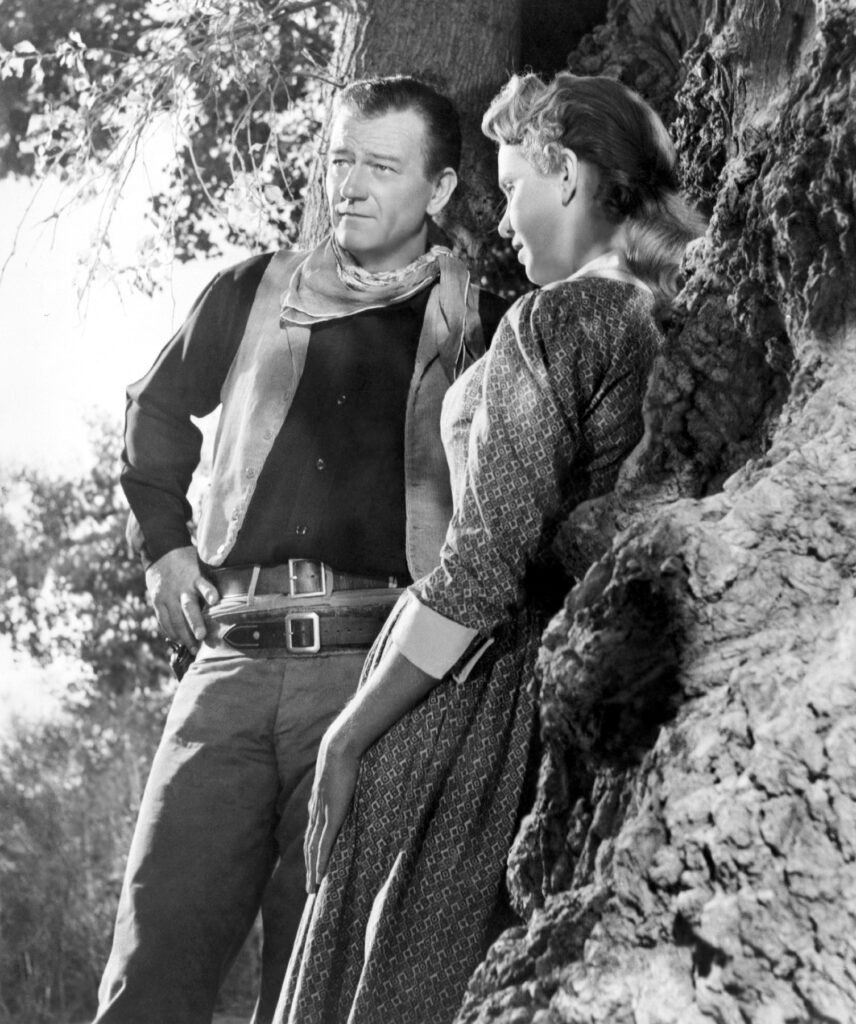
Wayne and Fellows wanted to shoot Hondo in the new 3-D film format, which was very popular with audiences at the time. Warner Bros. supplied the production with their newly developed “All-Media Camera” which could shoot in multiple film formats, including 3-D, because it used two lenses that could create the stereoscopic effects necessary for 3-D. However, this presented a number of problems for the production crew. The All-Media Camera was bulky and filming had to be delayed as it was transported to the film’s desert shooting locations. Farrow and cinematographer Robert Burks were unfamiliar with the device and had trouble adjusting to it. Additionally, the camera frequently broke down due the wind blowing sand into its mechanism. In Hondo, Farrow and Wayne primarily used 3-D to increase the depth of expansive wide shots and to amplify characters in the background. 3-D was only occasionally used to show objects coming directly towards the camera (and thus coming towards the audience, which was frequently done in other 3-D movies), as they didn’t want to treat the technology as a cheap gimmick.
John Farrow began shooting Hondo in June of 1953 and filming wrapped up in August. Hondo was primarily shot on location in the desert near the city of Camargo in the Mexican state Chihuahua. All the scenes at the Lowe family ranch were shot at Camargo. Early on during filming, Wayne and Fellows believed that they would have to cut the scene where it rains at the Lowe ranch because Camargo had been in the middle of a serious drought for the past seven years. Fortunately, Camargo experienced a twelve hour rain storm when the crew was on location, so John Farrow was able to shoot the scene as planned. The scenes at the cavalry base were filmed near a church in the city of San Francisco de Conchos, Chihuahua. Some additional location shooting was done back in the United States at several desert towns in southern Arizona (including Sasabe) and in Tooele County, Utah.
Filming on Hondo took longer than expected and John Farrow was forced to leave the production in August because he was contractually obligated to direct another film. As a favor to his friend John Wayne, iconic western director John Ford directed the scene where the Apache attack the cavalry wagon train. This was the last scene that needed to be shot on Hondo. Ford chose to not receive any credit for his work on Hondo.
Fun Facts and Trivia: Despite its short length (only 84 minutes) Hondo features an intermission. The intermission occurs right after Hondo Lane is captured by the Apache. Michael Pate reprised his role as Apache chief Vittorio in the short-lived television series Hondo (1967). He was the only actor from the film to appear in the show. Pate also played another Native American character with that name in an episode of the television series Wanted: Dead or Alive (1958-1961).
Two of John Wayne’s later westerns, Rio Lobo (1970) and The Train Robbers (1973), contain subtle references to Hondo. In Rio Lobo a wanted poster for a “Hondo Lane” is visible on a wall in the sheriff’s office. In The Train Robbers, the two main characters are named after the leads in Hondo. John Wayne’s character is named “Lane” and the last name of Ann-Margret’s character is “Lowe.”
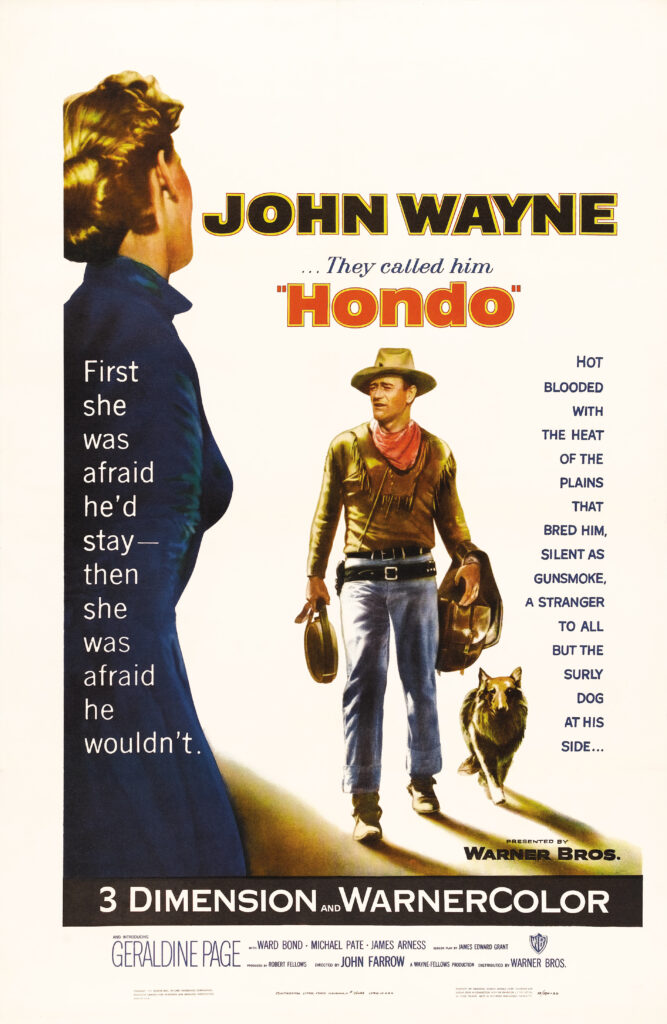
Reception: Hondo was released in the United States on November 27, 1953. Despite all the effort that Farrow, Wayne, and the rest of the cast and crew put into shooting Hondo in 3-D, the film was ultimately only given a limited release in that format. Although 3-D was very popular during Hondo‘s development, public interest in the format was starting to wane by the time Hondo actually released. Many theaters had abandoned the format (or simply never used it to begin with) due to the considerable expense and diminishing returns. Hondo was primarily released in a standard 2-D format, where it quickly became a box office hit. Hondo was one of the top fifteen highest grossing films of the year and managed to make a profit after only eight weeks in theaters, despite the considerable expense of shooting it in 3-D.
Despite Hondo‘s box office success, Wayne was personally disappointed by the film’s performance. He thought that Hondo could have been much bigger. Wayne attributed the film’s performance to the competition that Hondo received from fellow western Shane (1953), which had a similar premise. In both films the main character is a gunslinger who protects a frontier family and develops a close friendship with a young boy. Geraldine Page didn’t appear in another film until 1961, when she starred in the drama Summer and Smoke. Although not a communist herself, Page was a close associate of communist acting teacher Uta Hagen and she was blacklisted shortly after Hondo‘s release. Page continued to work as a stage actress during this time. Batjac Productions later produced Hondo (1967), a short-lived television series based on the film which starred Ralph Taeger as Hondo Lane.
The magazine Variety gave Hondo a positive review. The Variety critics described Hondo as “an exciting offbeat western” and they praised the film’s beautiful location shooting, complex characters, and acting performances. Jay Carmody of The Evening Star also gave Hondo a positive review. He praised the film’s script and the acting performances, especially Geraldine Page. Hondo has continued to receive positive reviews in retrospect. Jeffrey Anderson of Combustible Celluloid claimed that Hondo was John Wayne’s best film to have not been directed by John Ford or Howard Hawks. John J. Puccio of Movie Metropolis described Hondo as “an intelligent yet thrilling film.” Matt Brunson of Film Frenzy and Carol Cling of the Las Vegas Review-Journal also gave the film positive reviews.
Oscars: Hondo was nominated for one Academy Awards at the 26th Academy Awards ceremony, Best Supporting Actress (Geraldine Page). Page lost the Oscar to Donna Reed in From Here to Eternity. Hondo was originally nominated for a second Academy Award, Best Story (Louis L’Amour), however the film was disqualified due to a misunderstanding. The opening credits of Hondo only stated that the film’s story was created by L’Amour (but did not specify that it was based on a published story by L’Amour rather than being a story that he wrote specifically for the film). L’Amour informed the Academy that he didn’t create Hondo‘s story explicitly for the film, and the nomination was withdrawn.
Why You Should See It: Hondo is a strong classic western film. Farrow and cinematographer Robert Burks did an excellent job photographing Hondo. The film’s locations look beautiful and are very expansive. The cast of Hondo is also top notch. Geraldine Page gives a stand-out performance and she definitely deserved her Academy Award nomination. Page brought a lot of depth to the part of Mrs. Lowe and she offered the right combination of sweetness and grit for a frontier mother. Wayne also does a good job as the character Hondo, and Ward Bond is memorable in his supporting role as Buffalo Baker.