
The Bishop’s Wife is a 1947 romantic comedy-drama film directed by Henry Koster. The film stars Cary Grant, Loretta Young, and David Niven. The Bishop’s Wife is based on the the 1928 novella of the same name written by Robert Nathan.
Director: Henry Koster
Production Company: Samuel Goldwyn Productions
Distributor: RKO Radio Pictures
Cast: Cary Grant, Loretta Young, David Niven, Monty Woolley, James Gleason, Gladys Cooper, Elsa Lancaster, Sara Haden, Karolyn Grimes
US Box Office: $7,500,000 ($179,400,000 adjusted for inflation)
Film Format: Black & White
Genre: Comedy, Drama, Fantasy
Release Date: December 9, 1947 (US premiere); February 16, 1948 (general release)
Plot Summary: During the Christmas season, an angel named Dudley (Cary Grant) is sent to help solve Bishop Henry Brougham’s (David Niven) problems. Henry believes that Dudley has been sent to help him secure the funds to build a new Cathedral, but Dudley was actually sent to help Henry save his failing relationship with his wife Julia (Loretta Young).
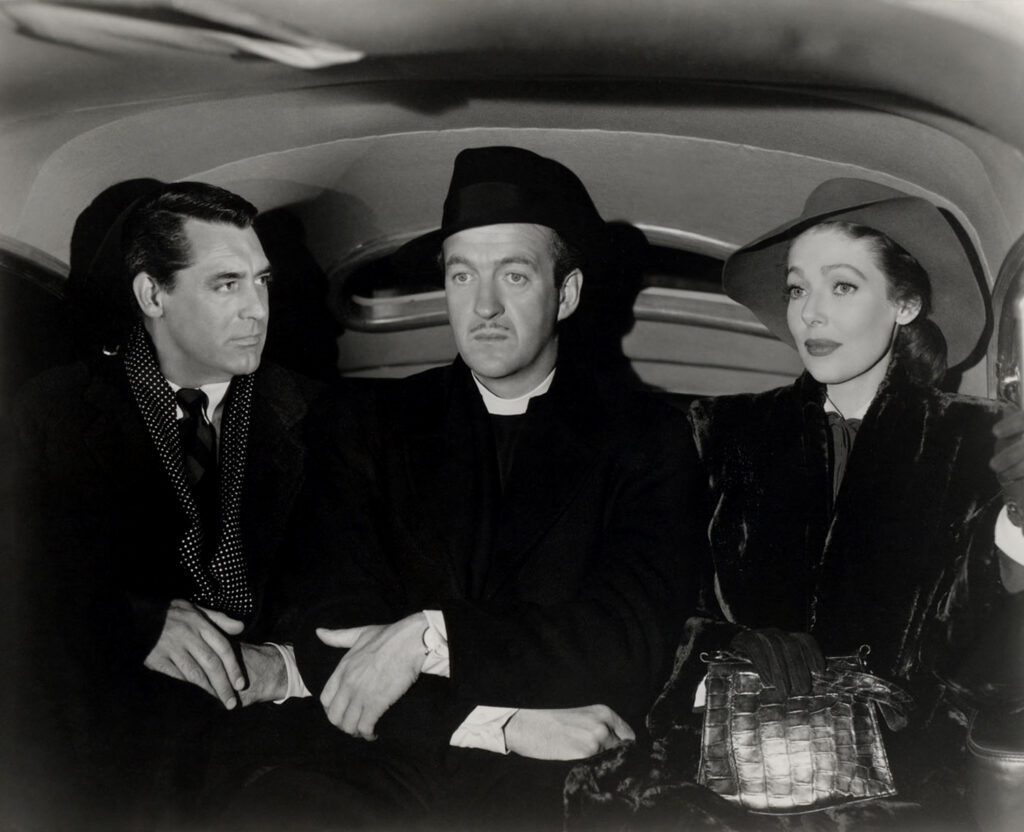
Production: In late 1946 film producer Samuel Goldwyn decided to produce a film adaptation of Robert Nathan’s 1928 novella The Bishop’s Wife, about an angel who helps a bishop and his wife solve their problems. Goldwyn decided to produce the film through his independent film studio “Samuel Goldwyn Productions” and he partnered with RKO Radio Pictures to distribute the film. The producer initially hired Robert E. Sherwood to write the film’s screenplay and William A. Seiter to direct the film.
Goldwyn originally cast David Niven to play the part of Dudley the Angel, and Dana Andrews was chosen to play the part of Bishop Henry Brougham. Teresa Wright was also originally cast by Goldwyn to play the part of Julia Brougham, but she dropped out of the role once she became pregnant. Goldwyn replaced her with Loretta Young, who was under contract with RKO at the time. Goldwyn had to lend Andrews to RKO in exchange for Young, so he gave the part of Henry to Cary Grant instead.
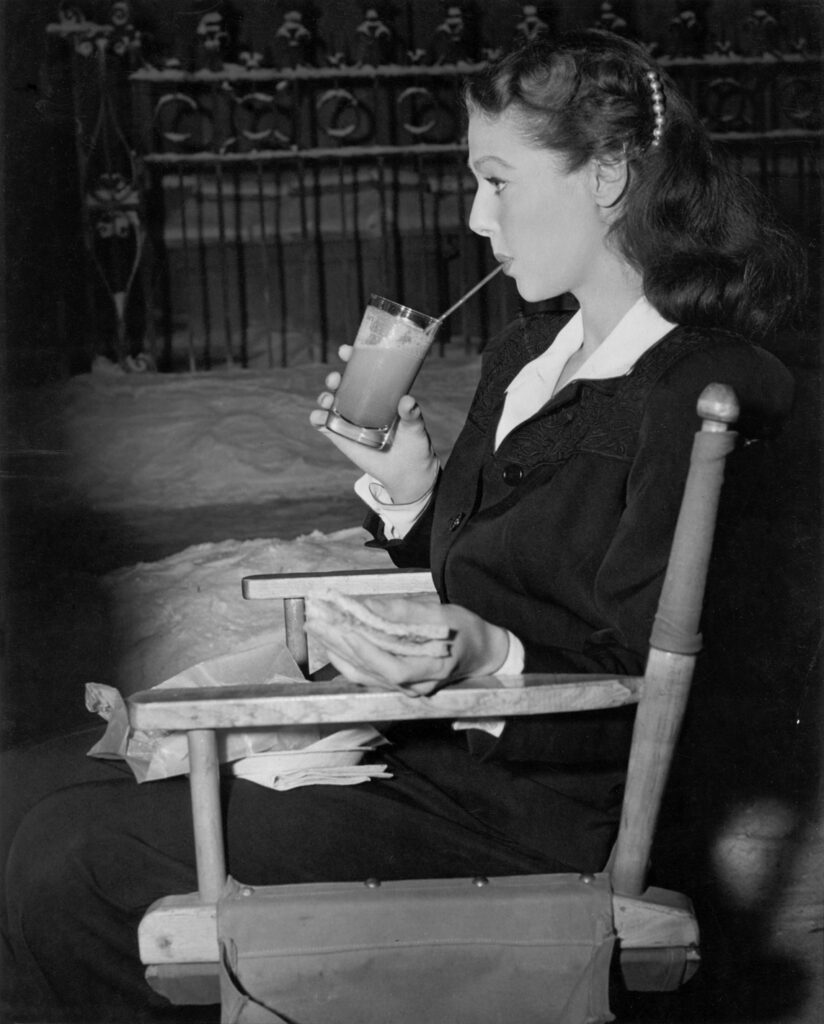
Production on The Bishop’s Wife first began in February of 1947 but by March Goldwyn shut down the production. He didn’t like the progress that director Seiter had made and decided to completely restart the film. He fired Seiter and replaced him with Henry Koster. Koster, Robert E. Sherwood, and Leonardo Bercovici rewrote Sherwood’s original script. Koster also realized that Grant and Niven were wrongly cast in their roles, so he switched their parts: Grant now played Dudley and Niven now played Henry. Sources differ as to whether Grant was disappointed by the switch or if he was always more interested in the part of Dudley and requested the change himself. Finally, Goldwyn chose to scrap and rebuild all of the interior sets on the film from scratch, a costly decision that added an extra $900,000 dollars to the film’s budget.
Koster began shooting the new version of The Bishop’s Wife in April of 1947 and filming went until June. A few of the exterior scenes were shot on location in Minneapolis, Minnesota. For example, the snowball fight scene was shot in Loring Park in Minneapolis. Most of the interior scenes in the film were shot back at Goldwyn’s production studio in California. Early on, while shooting a conversation scene, Grant and Young both insisted that Koster only show the left side of their faces (which would have made it impossible to conventionally shoot a conversation between the two). Grant and Young quickly dropped the idea once Goldwyn told them that if they only gave him half a face he would only give them half a paycheck. Other than that, Koster’s work on the production ran smoothly. Koster got along well with Loretta Young, and she was later cast in his film Come to the Stable (1949).
Fun Facts and Trivia: Several actors who had previously appeared in It’s a Wonderful Life (1946) appear in The Bishop’s Wife. Karolyn Grimes (Debby) played Zuzu Bailey, Robert J. Anderson (the snowball fight “defense captain”) played the child version of George Bailey, and Sarah Edwards (Mrs. Duffy) played Mrs. Hatch. In the long shots of the complex ice skating scene Dudley is played by a body double wearing a mask with Cary Grant’s features, Julia is also played by a double in that scene (the shots of the doubles are intercut with close ups of Grant and Young). Grant wanted to do the ice skating routine himself, but Goldwyn wouldn’t let him.
David Niven tried to mention the name of his friend Michael Trubshawe in most of the films in which he starred and The Bishop’s Wife is no exception. Later on in The Bishop’s Wife, when Henry and Julia are going to make some Parish calls to families, Henry tells Julia, “We go first to the Trubshawes.” Princess Elizabeth (later Queen) and Princess Margaret attended the British premiere of The Bishop’s Wife. According to David Niven, they both liked the film.
Reception: The Bishop’s Wife had its premiere in the United States on December 9 in New York. RKO wasn’t sure how to advertise The Bishop’s Wife to the general public, so it initially underperformed in its first few weeks. Goldwyn decided to advertise the film as a romantic comedy, so RKO retitled the film “Cary and the Bishop’s Wife” in some markets, and changed the film’s posters to emphasize Grant’s role in the film and the film’s comedic aspects. This ploy worked, and the film’s box office results improved as it went into wide release.
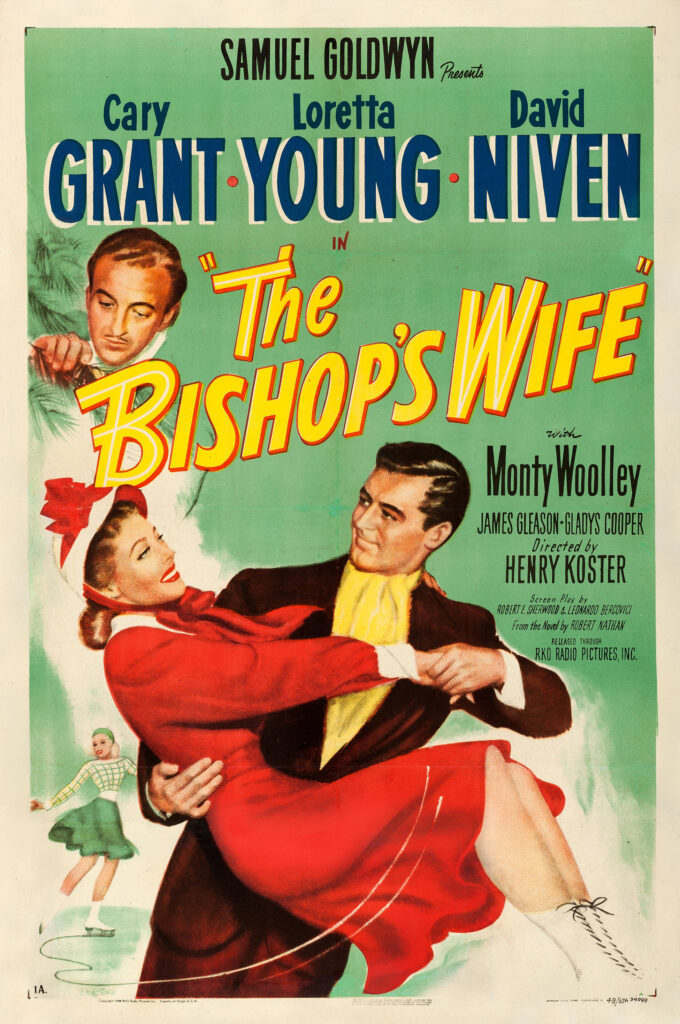
The Bishop’s Wife received generally positive reviews at the time of its release. Bosley Crowther of The New York Times gave The Bishop’s Wife a favorable review. Crowther thought the film was delightful and appropriate for the Christmas season. The Variety staff gave the film a positive review as well, they liked the “humanness” of the characters, and had strong praise for Cary Grant’s performance. Conversely, James Agee of Time Magazine gave the film a negative review because he though that it was done in poor taste.
In retrospect The Bishop’s Wife has also received generally positive reviews. Brian Viner of the Daily Mail gave the film a perfect score, he thought that the film was “a sweet, funny, captivating, and altogether delightful picture” that deserved to be more popular as a Christmas movie. Steven Crum of the Kansas City Kansan also gave the film a perfect score. In 2002, The Bishop’s Wife was one of the 400 films nominated by the American Film Institute for their “100 Years… 100 Passions” list of the most romantic American films. In 2006, the film was also one of the 300 films nominated by the AFI for their “100 Years… 100 Cheers” list of the top 100 most inspirational American films.
In March of 1948 The Screen Guild Theater radio program broadcast an adaptation The Bishop’s Wife with Cary Grant, Loretta Young, and David Niven all reprising their roles. Lux Radio Theater also adapted the film several times: in 1949, 1953, and 1955. Niven reprised his role in the 1949 broadcast, while Cary Grant reprised his role in the 1953 and 1955 broadcasts.
Oscars: The Bishop’s Wife was nominated for five Academy Awards: Best Picture (Samuel Goldwyn for RKO), Best Director (Henry Koster), Best Editing (Monica Collingwood), Best Score (Hugo Friedhofer), and Best Sound (Gordon E. Sawyer). The Bishop’s Wife only won one Oscar, Sawyer received the Academy Award for his sound recording.
Why You Should See It: The Bishop’s Wife is a fantastic Christmas film that deserves more appreciation than it gets. The film’s leads all give strong performances. It’s a good thing that Grant and Niven switched roles, as they are both perfectly cast for their parts in the final film. Grant’s acting style and demeanor is perfect for Dudley, and he is great in the role. David Niven and Loretta Young are also good in their roles. Koster does a skillful job balancing the comedic and dramatic moments in The Bishop’s Wife. He was able to add plenty of humor to the film without taking away from the dramatic impact. The ice skating scene and Dudley and Julia’s lunch together are both very funny scenes. The film contains some positive Christian themes and skillfully expresses them without coming across as “preachy.” Composer Hugo Friedhofer’s score is excellent. His musical cues perfectly follow and reflect the miracles occurring onscreen, and he definitely deserved his Oscar nomination.