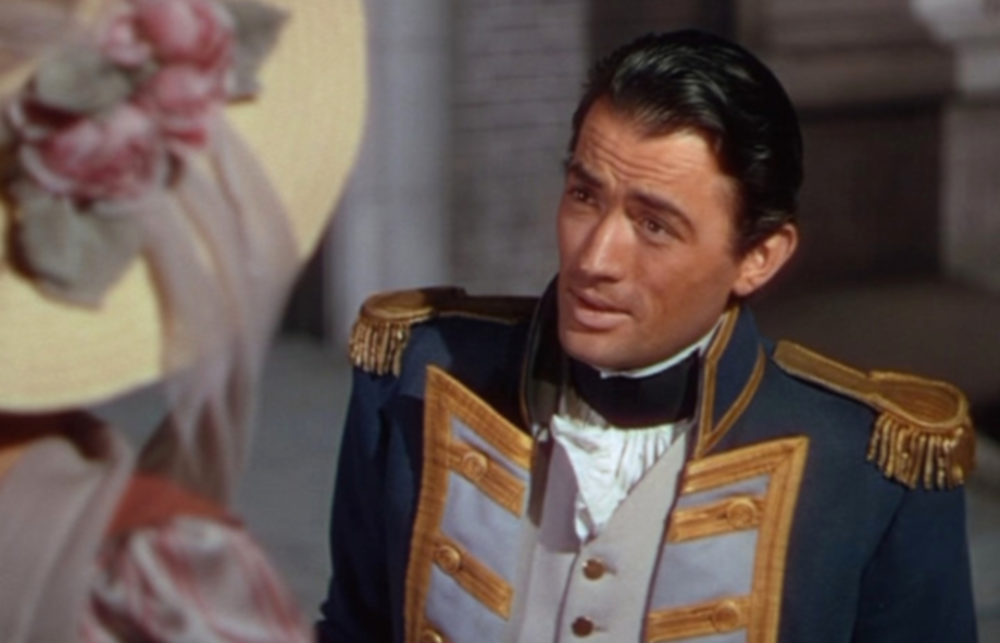
Captain Horatio Hornblower is a 1951 British-American adventure film directed by Raoul Walsh. The film stars Gregory Peck, Virginia Mayo, Robert Beatty, and James Robertson Justice. Captain Horatio Hornblower is based on the first three novels in C. S. Forester’s Horatio Hornblower series: The Happy Return (1937), A Ship of the Line (1938), and Flying Colours (1938).
Director: Raoul Walsh
Production Company: Warner Bros.
Distributor: Warner Bros.
Cast: Gregory Peck, Virginia Mayo, Robert Beatty, Moultrie Kelsall, Denis O’Dea, James Kenney, Terence Morgan, James Robertson Justice
US Box Office: $6,495,000 ($117,200,000 adjusted for inflation)
Film Format: Technicolor
Genre: Adventure, War
Release Date: April 10, 1951 (London premiere); September 13, 1951 (New York City premiere)
Plot Summary: During the Napoleonic Wars, Captain Horatio Hornblower (Gregory Peck) of the HMS Lydia is sent on a secret mission to Central America to deliver weapons to anti-Spanish rebels. While there, Captain Hornblower meets up with Lady Barbara Wellesley (Virginia Mayo), the sister of the Duke of Wellington, and agrees to transport her back to England. The two fall in love on the voyage back to England, but Lady Barbara is engaged to Admiral Rodney Leighton (Denis O’Dea) and Horatio has a wife back home (who he does not know has since died) which seemingly keeps them apart. Back in England, Horatio is soon sent on a new mission to patrol the French coast.
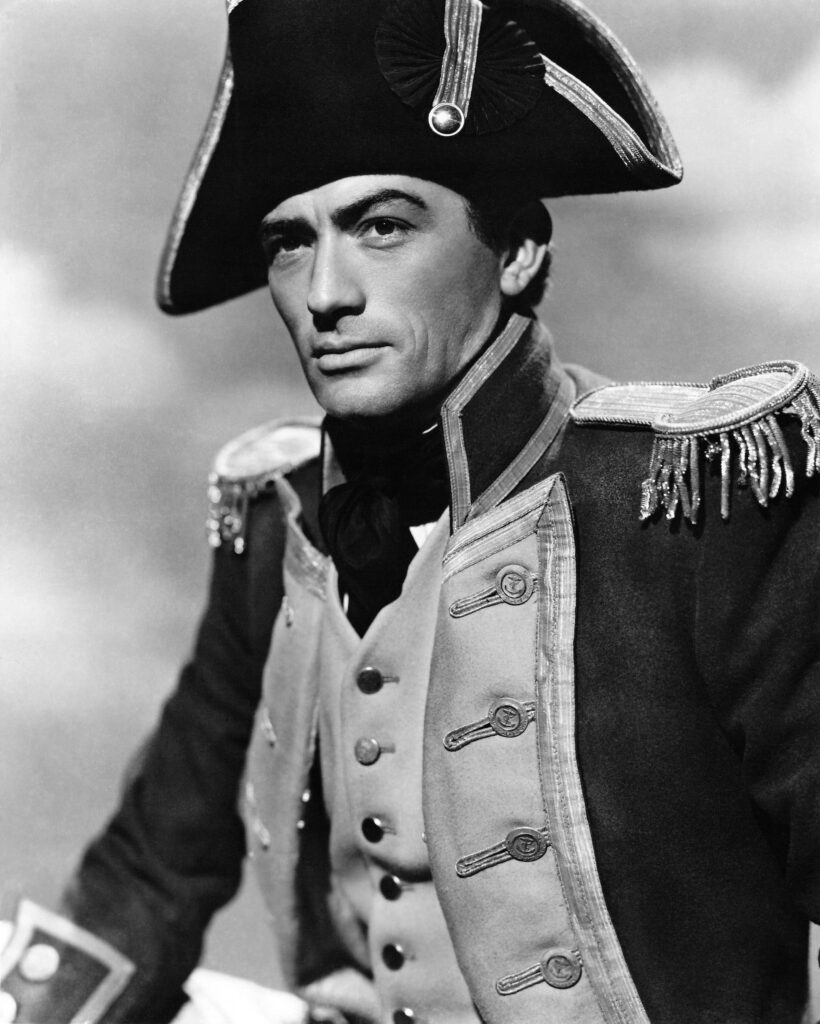
Production: In the 1940s, Warner Bros. studio executives purchased the film rights to the first three novels featuring the character Horatio Hornblower: The Happy Return (1937), A Ship of the Line (1938), and Flying Colours (1938) by C.S. Foster. The novels were about the adventures of Horatio Hornblower, a fictional English Navy captain, during the Napoleonic Wars. Warner Bros. studio head Jack L. Warner was originally interested in making a film based on the Hornblower novels because he believed that the film would be a good vehicle for Errol Flynn, one of the studio’s top stars. Ivan Goff, Ben Roberts, and Æneas MacKenzie wrote the screenplay for Captain Horatio Hornblower alongside original writer C.S. Foster. Raoul Walsh, who was under contract with Warner at the time, was chosen to direct Captain Horatio Hornblower. Walsh was a veteran director who had been working since the silent age. He recently directed the war film Fighter Squadron (1948) and the western Colorado Territory (1949).
Studio head Jack L. Warner originally planned to cast Errol Flynn as Captain Horatio Hornblower when he purchased the rights to the novels. The studio later removed Flynn from the project. Flynn’s recent swashbuckling adventure film Adventures of Don Juan (1948) was a financial failure and Mr. Warner was becoming tired of Flynn’s increasingly bad behavior on set. The younger Burt Lancaster, who the studio was attempting to build up as their new swashbuckling star, was also considered for the part of Hornblower. However, studio executives were concerned that his “anti-hero” persona would be unfitting for a noble British captain. Gregory Peck was ultimately cast as Horatio Hornblower. Peck was under contract with David O. Selznick at the time, who loaned him to Warner Bros for Captain Horatio Hornblower. He had recently been nominated for an Academy Award for his role in the war drama Twelve O’Clock High (1949).
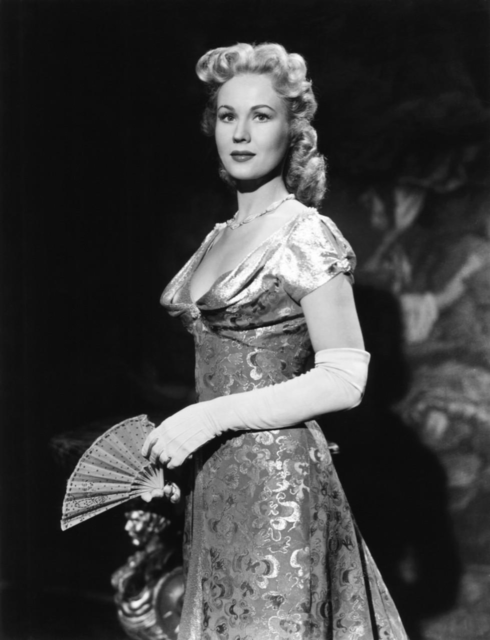
Several high profile British actresses were considered for the part of Lady Barbara, but they were either unavailable or not interested in the part. Gregory Peck suggested English actress Margaret Leighton to Jack Warner. Warner instead chose American actress Virginia Mayo, who already had a contract with the studio, because she was more beautiful. Raoul Walsh previously directed Mayo in the western Colorado Territory (1949) and the film noir White Heat (1949), and later directed her in the western Across the Great Divide (1951). Mayo also recently starred in the comedy The Secret Life of Walter Mitty (1947) and the acclaimed drama The Best Years of Our Lives (1946).
Filming on Captain Horatio Hornblower began in early 1950 and wrapped up midway through the year. The interior scenes and scenes of the actors aboard the HMS Lydia and the other ships were shot on set at Teddington Studios in England. Warner Bros. executives chose to shoot Captain Horatio Hornblower in the United Kingdom so that they could use funds frozen by the British government. Exterior shots of Hornblower’s house were filmed on location in the town of Rye, East Sussex. The scene where Hornblower and Lt. Bush (Robert Beatty) are on the Victory was filmed onboard the real HMS Victory, a historic ship of the line that served in the Napoleonic Wars. The Victory was docked in Portsmouth, Hampshire at the time. Several scenes were also filmed on location in France. Don Julian Alvarado’s (Alec Mango) fortress in Captain Horatio Hornblower was represented by the Fort de Brégançon in France. The scene where the Witch of Endor was docked in the French harbor was shot at the town of Villefranche-sur-Mer in Alpes-Maritimes.
The HMS Lydia was primarily portrayed by the Hispaniola, a replica ship that had been built on set for use in Walt Disney’s adventure film Treasure Island (1950). The scenes of actors onboard the ship were shot on a massive soundstage at Teddington Studios. In Treasure Island the background was moved horizontally to simulate the Hispaniola’s movement, but in Captain Horatio Hornblower the ship itself was rocked. This created problems due to the combined weight of the film equipment, crew, and the ship itself. Battle scenes and extreme long shots were shot in the Mediterranean Sea and used real ships.
Fun Facts and Trivia: Captain Horatio Hornblower was the first film to feature Australian actress Diane Cilento. She voices Hornblower’s deceased wife Maria. The first film in which Cilento appears onscreen was Wings of Danger (1952). Cilento would later be known for her role in the British film Tom Jones (1963), for which she received an Oscar nomination for Best Supporting Actress. The Captain of the Natividad was played by British actor Christopher Lee in an early role. Lee was chosen for the part because he was a skilled fencer. Although Lee could speak Spanish, his voice was dubbed over to cover his British accent.
The Witch of Endor ship was portrayed by the Italian brigantine Marcel B. Surdo in long shots. The Marcel B. Surdo would later appear in other seafaring films including The Crimson Pirate (1952), The Master of Ballantrae (1953), and John Paul Jones (1959). Gregory Peck, Stanley Baker (Mr. Harrison), and James Robertson Justice (Quist) later appeared together in the war film The Guns of Navarone (1961).
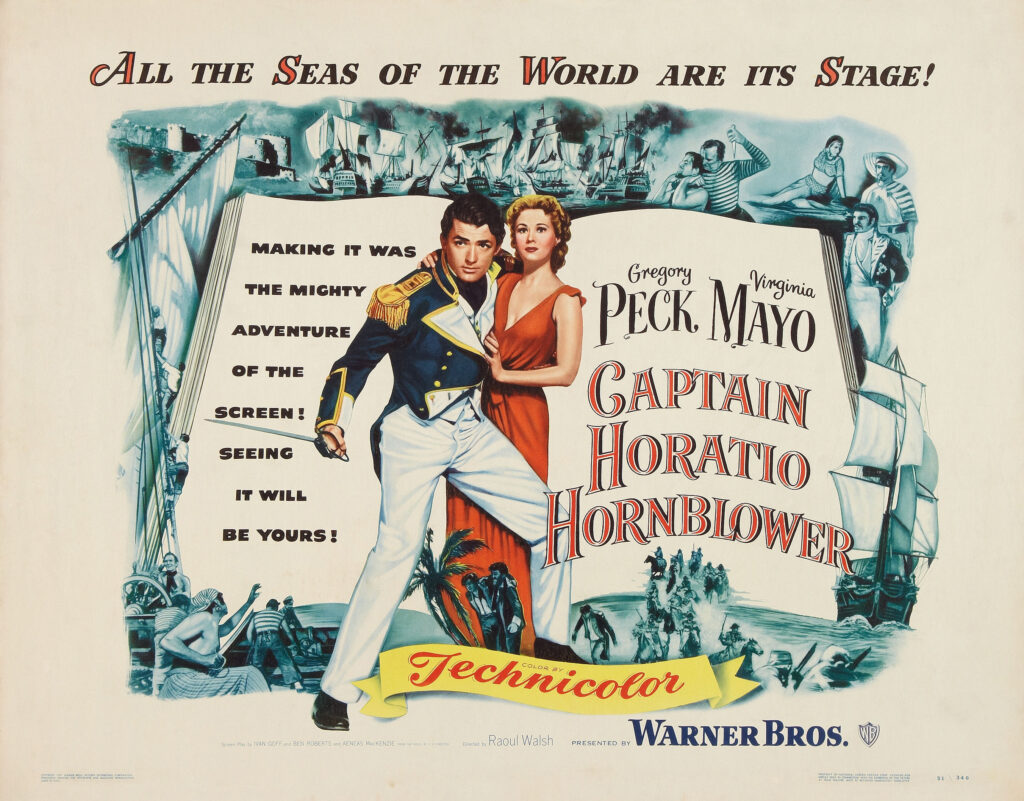
Reception: Captain Horatio Hornblower had its United Kingdom premiere at Warner Theatre in Leicester Square, London on April 10, 1951. Princess Margaret attended the premiere. The film premiered in New York City on September 13. Captain Horatio Hornblower was a box office hit and earned a profit for Warner Bros. It was one of the top ten highest grossing films in the United Kingdom that year. Gregory Peck and Virginia Mayo reprised their film roles in a Lux Radio Theater adaptation of Captain Horatio Hornblower that was broadcast on January 21, 1952.
Captain Horatio Hornblower received generally positive reviews from critics when it was first released. Jay Carmody of The Washington Star had strong praise for the performances of Gregory Peck and Virginia Mayo and also applauded the film’s Technicolor cinematography and battle scenes. Bob Thomas of the Associated Press described Captain Horatio Hornblower as “excellent adventure stuff.” Thomas thought that the dialogue was “stilted at times” but noted that the film’s excitement and Technicolor cinematography made up for this shortcoming. Bosley Crowther of The New York Times gave Captain Horatio Hornblower a mildly positive review. He didn’t think that the film was as interesting as Foster’s novels, but noted that fans of adventure films would enjoy it. Photoplay magazine ranked Captain Horatio Hornblower as being one of the top ten best films of 1951.
Captain Horatio Hornblower continues to receive generally positive reviews from modern critics. TV Guide magazine praised Raoul Walsh’s fast-paced direction, Robert Farnon’s score, and Guy Green’s Technicolor cinematography. Jeffrey M. Anderson of Combustible Celluloid also lauded Walsh’s direction. Carol Cling of the Las Vegas Review-Journal gave Captain Horatio Hornblower a 4/5 star review.
Why You Should See It: Captain Horatio Hornblower is an excellent adventure film. Raoul Walsh does a great job directing the film. He skillfully balances the exciting action scenes, the character interactions, and the film’s more humorous moments. The battle between the Lydia and the Natividad was especially exciting. The Technicolor cinematography by Guy Green is top-notch. The relationship between Gregory Peck and Virginia Mayo in Captain Horatio Hornblower is charming and they make a likeable couple. The film also deserves praise for celebrating the British navel tradition.