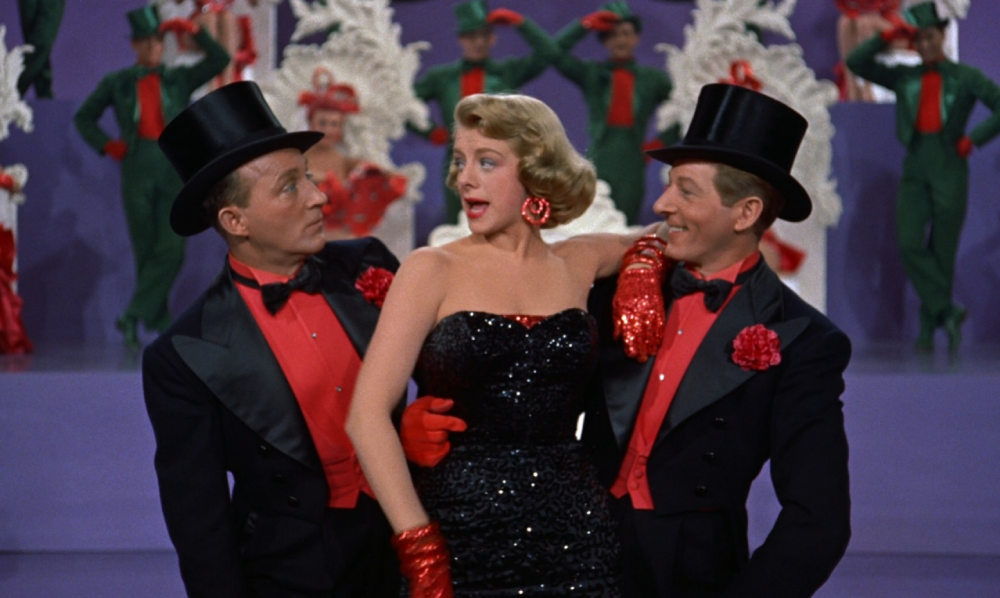
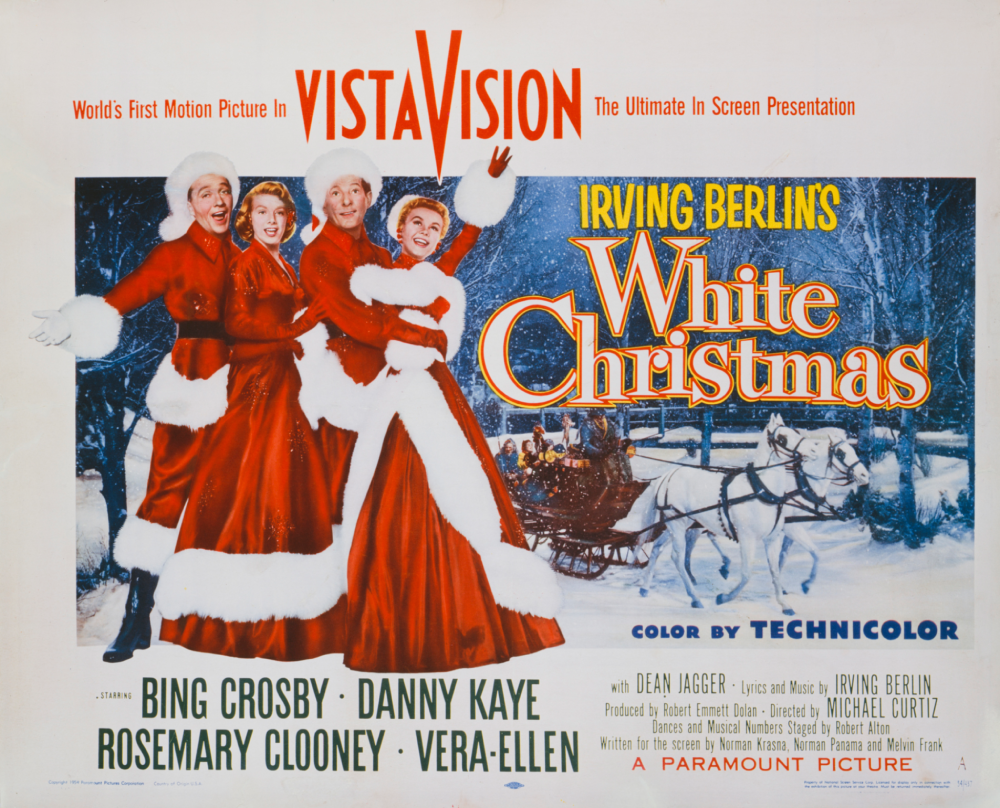
White Christmas is a 1954 musical comedy film directed by Michael Curtiz. The film stars Bing Crosby, Danny Kaye, Rosemary Clooney, and Vera-Ellen. White Christmas features songs composed by Irving Berlin, including the titular “White Christmas” (1942). White Christmas is also notable for being the first film to be shot in Paramount’s VistaVision format.
Director: Michael Curtiz
Production Company: Paramount Pictures
Distributor: Paramount Pictures
Cast: Bing Crosby, Danny Kaye, Rosemary Clooney, Vera-Ellen, Dean Jagger, Mary Wickes, John Brascia, Anne Whitfield
US Box Office: $32,800,094 ($641,200,000 adjusted for inflation) [Updated to include the 2024 re-release]
Film Format: Technicolor (shot in VistaVision)
Genre: Musical, Comedy
Release Date: October 14, 1954 (New York premiere)
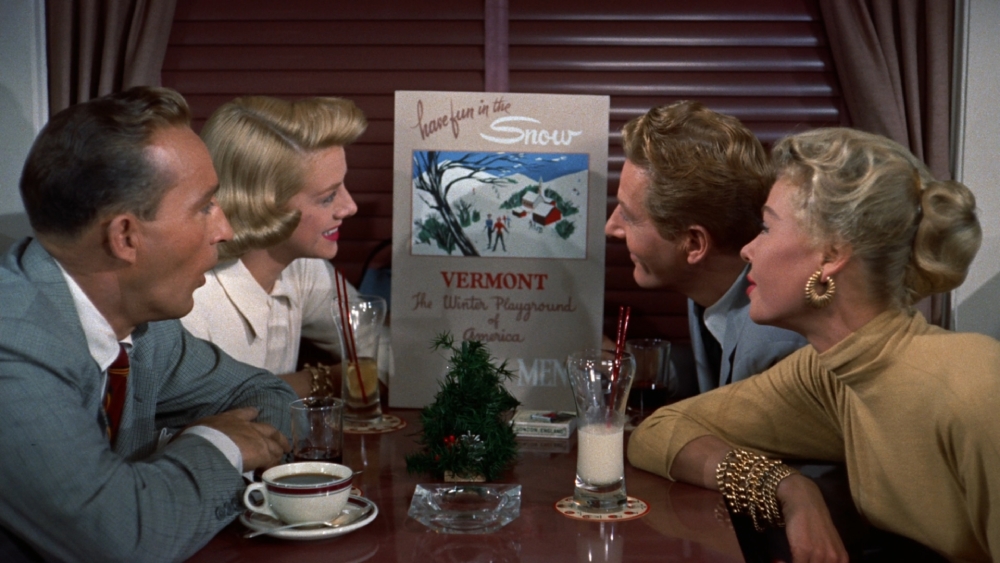
Plot Summary: Bob Wallace (Bing Crosby) and Phil Davis (Danny Kaye) served together under the command of the beloved General Tom Waverly (Dean Jagger) during World War II. Ten years later, Bob and Phil work together as stage performers and producers. While in Florida, they meet a female singing duo: sisters Betty (Rosemary Clooney) and Judy Haynes (Vera-Ellen). Phil and Judy quickly fall for each other, but Bob and Betty are more hesitant. They all end up traveling to a Vermont Inn, where the Haynes sisters are scheduled to perform. They learn that a now-retired General Waverly owns the inn, so Bob and Phil decide to put on a big show there to help Waverley’s struggling inn.
Production: In 1948, composer Irving Berlin came up with the idea to base a new Technicolor musical film around his popular song “White Christmas,” which had been created for the film Holiday Inn (1942). The film was intended to serve as a follow up Holiday Inn and Blue Skies, which paired Bing Crosby and Fred Astaire together and featured music composed by Berlin. Berlin proposed the concept to the Paramount Pictures executives, who were very interested in the idea, and agreed to produce the film. Robert E. Dolan was assigned to produce the film, which was titled White Christmas. Dolan was a musical director for Paramount who had worked with Berlin before on Holiday Inn and Blue Skies. The original script for White Christmas was written by writer and director Norman Krasna. Paramount executives hired Michael Curtiz to to direct White Christmas. Curtiz was known for his long stint as a contract director for Warner Bros. and worked on a variety of films including The Adventures of Robin Hood (1938) and Casablanca (1942). Curtiz had recently directed the musicals Young Man with a Horn (1950) and I’ll See You in My Dreams (1951).
Paramount’s original intention was that White Christmas would star Bing Crosby and Fred Astaire, as the two were previously paired together in the successful musicals Holiday Inn and Blue Skies. However, Astaire declined the offer after reading the script. Astaire didn’t care for Krasna’s script and he had been considering retiring from acting at the time, so he asked to be released from his contract from Paramount. Bing Crosby left the project in November of 1952 because he wanted to spend more time with his sons following the death of his wife Dixie Lee. However, Crosby soon rejoined White Christmas in January of 1953. Crosby’s character was singer Bob Wallace, who eventually falls in love with Betty Haynes. He had recently starred in the musical Here Comes the Groom (1951) and the comedy Road to Bali (1952).
After Crosby rejoined the project Paramount announced that actor and dancer Donald O’Connor would co-star with Crosby. Shortly before production was scheduled to begin, O’Connor contracted an illness and the production was put on hold. Paramount initially delayed the shoot so that O’Connor could recover, but eventually dropped O’Connor after waiting a few months. Actor and comedian Danny Kaye was eventually hired to replace O’Connor as Crosby’s co-star. Kaye’s character was singer-comedian Phil Davis. Unlike Astiare and O’Connor, Kaye was not a professional dancer, so the script would have to be modified. Screenwriting duo Mel Frank and Norman Panama were brought in to modify the script by adding more comedic moments that were better tailored to Kaye’s persona. Frank and Panama thought that Krasna’s screenplay was bad, so with the permission of Dolan and Curtiz, they rewrote the entire script in eight weeks.
Actress and singer Rosemary Clooney was cast as Betty Haynes, the sister who initially dislikes, but eventually falls in love with, Bing Crosby’s character. Clooney took the part because she was a fan of Bing Crosby and wanted the chance to star with him. She had recently starred in the musicals The Stars Are Singing (1953) and Here Come the Girls (1953). Actress and Dancer Vera-Ellen was cast as Judy Haynes, the sister who falls in love with Danny Kaye’s character. She previously starred with Kaye in the comedies Wonder Man (1945) and The Kid from Brooklyn (1946).
Michael Curtiz began shooting White Christmas in September and principle photography wrapped up in December. Curtiz shot White Christmas in the widescreen VistaVision format, which was Paramount’s response to Fox’s CinemaScope format. White Christmas was the first film to be shot in that format. Despite having a fairly big budget, the film was shot almost entirely on set at Paramount Studios. The Vermont inn in White Christmas was represented by the set originally created to portray the Connecticut inn in Holiday Inn. The scenes set at the Vermont train station were shot at 20th Century Fox’s studio. This was because Fox was the only Hollywood studio that had a standing train station set at the time.
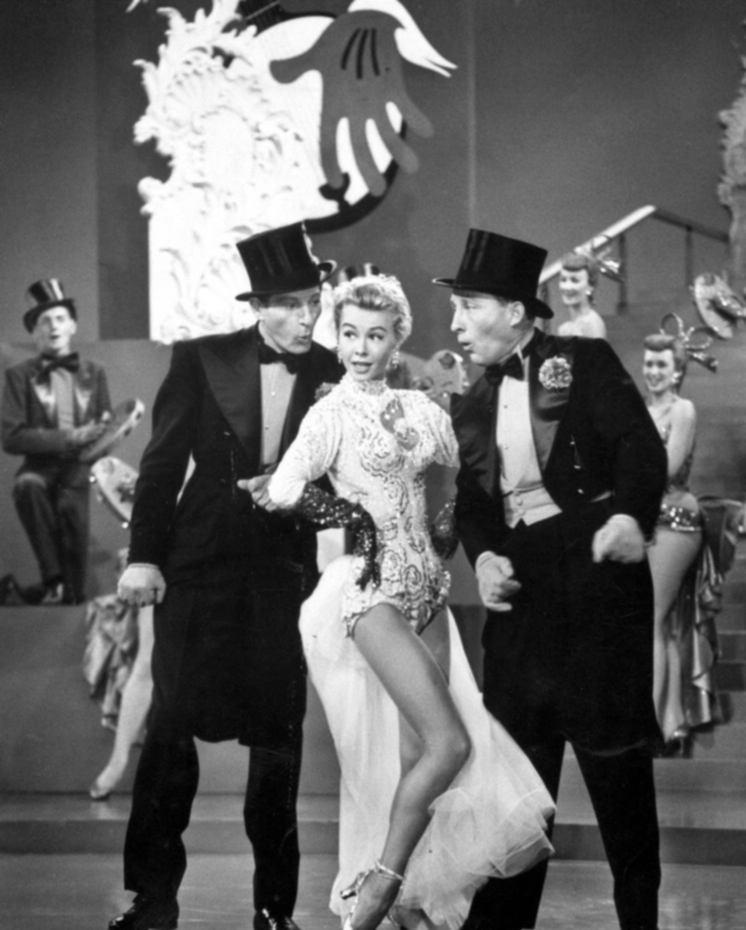
According to Rosemary Clooney, the scene where Bing Crosby and Danny Kaye lip-sync and dance to the song “Sisters” was not originally in the script. The two were clowning around on the set, and director Michael Curtiz thought it was so funny that he decided to film it. Crosby’s laughs in the scene are genuine and unscripted, as he was unable to hold a straight face due to Kaye’s dancing and antics with the blue feather fan prop!
Fun Facts and Trivia: Although General Waverly is presented as being much older than Bob and Phil in White Christmas, Bing Crosby was actually six months older than Dean Jagger. Similarly, Betty is supposed to be older than Judy, but Rosemary Clooney was actually seven years younger than Vera-Ellen. One of the dancers in Rosemary Clooney’s “Love, You Didn’t Do Right By Me” solo number is actor and dancer George Chakiris. Chakiris would later become well known for his supporting role as Bernardo in the musical drama West Side Story (1961).
Percy Helton, who played the railroad conductor in White Christmas, previously portrayed the drunken Santa Claus actor in fellow Christmas classic Miracle on 34th Street (1947). A photograph of actor Carl Switzer is shown in White Christmas to represent Benny Haynes, the unseen brother of Betty and Judy. Switzer was best known for playing Alfalfa in the Our Gang short films of the 1930s when he was a child. Much like Helton, Switzer had also previously appeared in another Christmas classic, It’s a Wonderful Life (1946).
Reception: Although Paramount had wrapped up post-production on White Christmas in early 1954, the studio decided to hold the film back till fall, so that they could release it closer to the Christmas season. White Christmas had its New York premiere on October 14, 1954 and went into wide release in November. The film was a massive success at the box office and was the highest grossing film of the year. White Christmas was highly popular with audiences due to its likeable cast, memorable songs, beautiful Technicolor cinematography, and its overall sweet and sentimental nature. Since Paramount’s VistaVision format required special projectors White Christmas was only shown in that format in select locations. Most theaters just showed the film in the standard 35mm format.
Although it was extremely popular with theater goers, critics were mixed on White Christmas at the time of its original release. Bosley Crowther of The New York Times gave the film a negative review. He liked Curtiz’s color cinematography, but he criticized the film’s songs and humor. The critics at TIME magazine also gave White Christmas a bad review. They admired the film’s production values and Berlin’s songs, but criticized the plot. Clyde Gilmore of Maclean’s magazine was more positive. Gilmore had strong praise for the Technicolor cinematography and performances of Bing Crosby and Danny Kaye, though he noted that not all the musical numbers were as good as they should have been. Variety similarly applauded the performances of Crosby and Kaye, Irving Berlin’s songs, and the film’s production values. Philip K. Scheuer of the Los Angeles Times was enthusiastic as well and described White Christmas as a, “great, big, physically glittering, two-hour Technicolor musical that sounds like a dream production with a dream cast.” The San Francisco Examiner praised White Christmas for its entertainment value.
In retrospect, White Christmas has continued to receive a mixed-to-positive response from critics. Ken Hanke of Mountain Xpress gave the film a positive review. Hanke commended the actors and the singing, but noted that the film’s plot was lacking. Steve Crum of the Kansas City Kansan praised the film for its romantic elements, music, and technicolor cinematography. Conversely, Dave Kehr of the Chicago Reader thought that White Christmas seemed “forced” and he complained about its overly cheery nature. John J. Puccio of Movie Metropolis stated that White Christmas was pleasant enough, but wasn’t a great musical.
White Christmas has remained very popular with audiences over the years, thanks to its memorable songs and its frequent showings on television during the Christmas season. Even in the twenty-first century, White Christmas remains one of the most popular and well-known Christmas films from the Golden Age of Hollywood. In 2008 White Christmas was one of 180 films to be nominated by the American Film Institute for their “AFI’s Greatest Movie Musicals” list of the top 25 best American musicals. The song “Count Your Blessings Instead of Sheep” was previously one of 400 songs nominated by the group for their “AFI’s 100 Years…100 Songs” list in 2004. The song “White Christmas” was ranked fifth on AFI’s list, for its use in Holiday Inn.
Oscars: White Christmas was only nominated for one Oscar at the 27th Academy Awards ceremony: Best Song (Irving Berlin for the song “Count Your Blessings Instead of Sheep” which was sung by Bing Crosby and Rosemary Clooney). Berlin lost the Academy Award to Jules Styne and Sammy Cahn for their song “Three Coins in the Fountain” from the film of the same name. The song “White Christmas” had previously won an Academy Award at the 1943 ceremony for its original use in Holiday Inn.
Why You Should See It: White Christmas is a really good Christmas classic. The film is cute, charming, and very funny. Most of the songs in White Christmas are very good and memorable. Aside from the iconic “White Christmas”, I also really liked “Snow” (sung by the four leads) and “Count Your Blessings Instead of Sheep” (sung by Bing Crosby and Rosemary Clooney). The “The Best Things Happen While You’re Dancing” number that Danny Kaye and Vera-Ellen dance to, and the “I’d Rather See a Minstrel Show” scene were well choreographed. The film’s finale was quite impressive as well. It’s not the best Christmas movie, but I think that White Christmas perfectly epitomizes what a light-hearted Christmas movie is supposed be. It’s pleasant, escapist, family-friendly fun, with a nice theme about the importance helping others on Christmas.