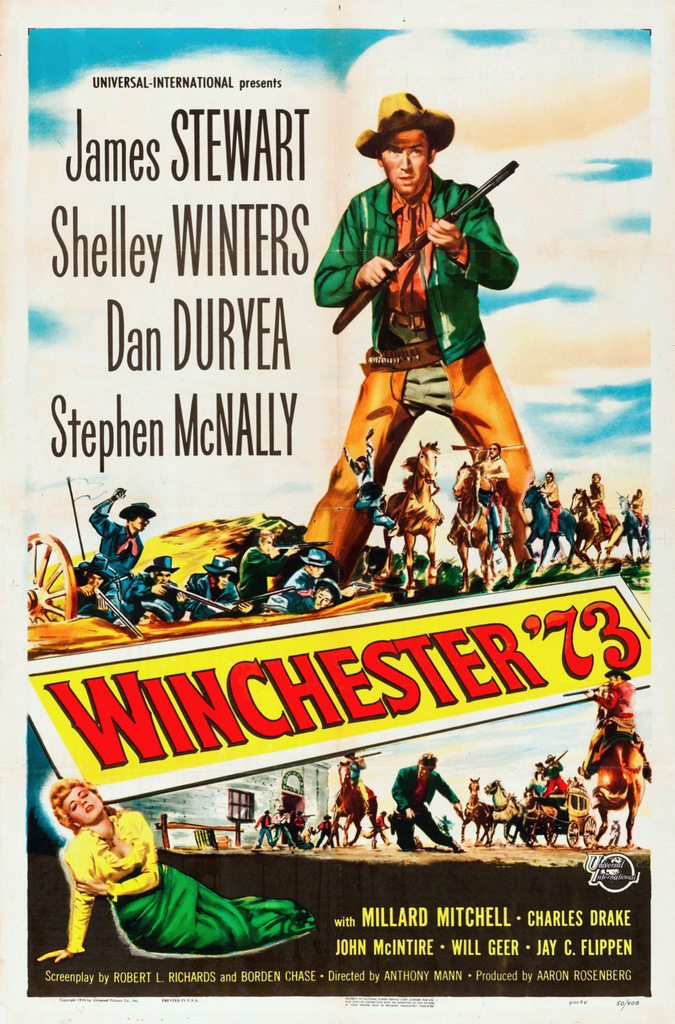
Winchester ’73 is a 1950 western directed by Anthony Mann. The film stars James Stewart, Shelley Winters, Dan Duryea, and Stephen McNally. Winchester ’73 is notably the first of eight films to pair director Mann and actor Stewart together.
Director: Anthony Mann
Production Company: Universal Pictures
Distributor: Universal Pictures
Cast: James Stewart, Shelley Winters, Dan Duryea, Stephen McNally, Millard Mitchell, Charles Drake, John McIntire, Will Geer, Jay C. Flippen, Rock Hudson
US Box Office: $5,625,000 ($107,700,000 adjusted for inflation)
Film Format: Black & White
Genre: Western, Drama
Release Date: June 1, 1950 (New Haven, CT premiere); June 7, 1950 (New York City premiere); July 12, 1950 (general release)
Plot Summary: In 1876 Lin McAdam (James Stewart) and his friend “High-Spade” Frankie Wilson (Millard Mitchell) are hunting outlaw Dutch Henry Brown (Stephen McNally), the man who killed Lin’s father, through the Great Plains. Lin tracks Dutch to Dodge City, Kansas where both men enter a shooting contest to win a special “One in One Thousand” Winchester 1873 repeating rifle. Lin wins the contest, but Dutch steals the rifle from Lin and flees. Lin and High-Spade continue their search for Dutch and eventually meet up with saloon singer Lola Manners (Shelley Winters). Lola’s boyfriend Steve Miller (Charles Drake) desperately needs money and is planning to rob a bank in Tascosa, Texas with Dutch Henry Brown and the psychotic outlaw Waco Johnny Dean (Dan Duryea).
Production: Universal Pictures began working with director Fritz Lang on a proposed western film for the studio, titled Winchester ’73, in the 1946. Lang’s idea for the story involved the main character’s 1873 Winchester rifle (which was his only source of strength) being stolen, forcing him to go on a dangerous quest to get it back. The film’s original screenplay was written by Richard L. Roberts based on a story treatment by Stuart N. Lake. Lake would end up publishing his treatment for Winchester ’73 in a magazine before the film was released. Lang’s plan was to produce Winchester ’73 independently through his company Diana Productions and to have the film only be distributed by Universal. Universal executives weren’t thrilled about this and insisted they produce the film themselves. The studio assigned producer Aaron Rosenberg to Winchester ’73. The film was delayed for several years, but eventually began production in 1949.
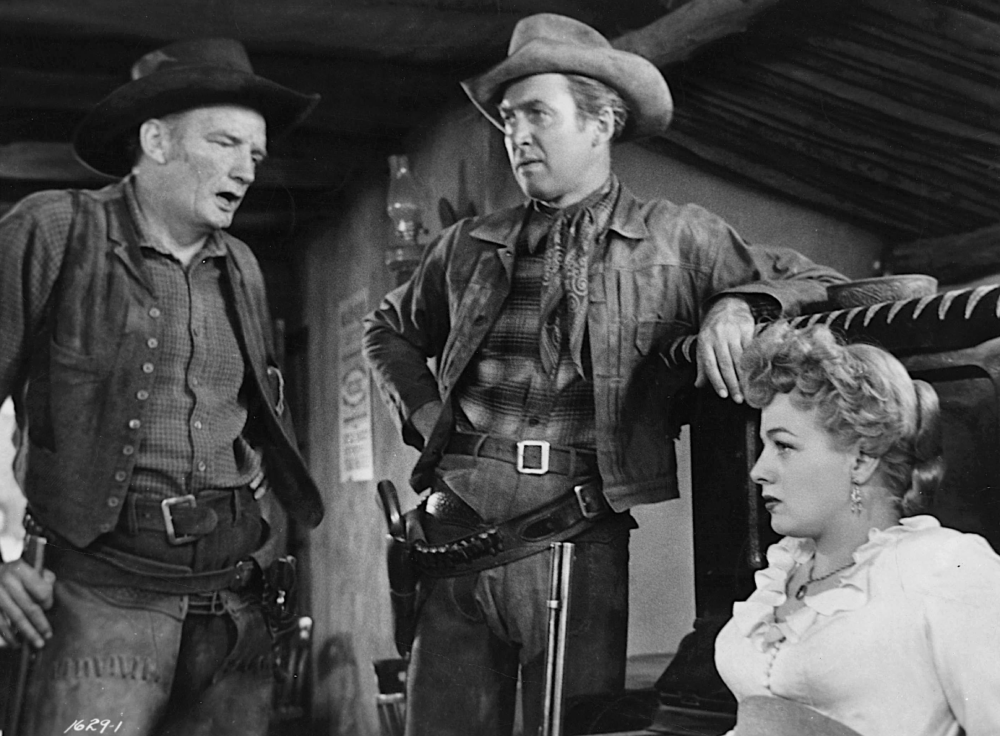
Universal executives cast James Stewart in the lead role of cowboy Lin McAdam. Stewart was popular leading man in the 1930s and 1940s who was best known for playing likeable “good guy” protagonists. Stewart had recently starred in the Christmas film It’s a Wonderful Life (1946) and the sports drama The Stratton Story (1948). Stewart made Winchester ’73 as part of a two film contract with Universal Pictures, the other film was the fantasy comedy Harvey (1950). Stewart initially requested a $200,000 salary for each of the two films. As the budgets for Winchester ’73 and Harvey were relatively modest, the studio instead agreed to pay Stewart a percentage of the profits each film received. In the case of Winchester ’73, Stewart’s agent Lew Wasserman arranged for his client to receive about fifty percent of the profits. Jimmy Stewart specifically wanted to play the role of Lin McAdams because he was interested in more challenging parts that went against his typical “nice guy” persona, and was concerned that the public perceived him as having limited acting range. The part of McAdams was tougher and more morally-gray (as he’s on a mission of revenge rather than justice) than the characters Stewart usually played, but was still likeable.
Director Fritz Lang didn’t think that Jimmy Stewart was right for the role of Lin McAdam and he left production shortly after Stewart was cast. Around this time, Stewart watched a rough cut of the MGM western Devil’s Doorway (1950), which had been directed by Anthony Mann. Stewart was impressed with the film and recommended Mann to Universal executives. The studio offered Mann the chance to direct Winchester ’73 and he accepted the offer. Aside from Devil’s Doorway, Mann had also recently directed the film noirs Border Incident (1949) and Side Street (1949). Mann disliked Richards’ script and had Borden Chase, a writer known for westerns like Red River (1948), rewrite the screenplay. Mann came up with the idea to have the rifle consistently pass from one owner to the next throughout the film.
Actress Shelley Winters was cast as saloon singer Lola Manners. Winters began her career on Broadway and had minor roles in a variety of different films in the 1940s. She first got attention for her supporting role in the film noir A Double Life (1947), which lead to Winters being chosen to be the leading lady in the noirs Johnny Stool Pigeon (1949), and Take One False Step (1949). Winters disliked Winchester ’73 because she didn’t understand the plot and thought her part was too small. She later noted that if her character wasn’t in the film nobody would have noticed.
Director Anthony Mann began shooting Winchester ’73 in February of 1950 and principle photography wrapped up in late March. The Exterior scenes of Winchester ’73 were primarily shot on location in Arizona. The scene set at Tascosa was filmed at Old Tuscan Studios, Arizona, an outdoor movie set originally build for the western Arizona (1940). The Saguaro National Park and the town of Mescal, Arizona were also used as shooting locations. Other exterior scenes were shot at the “Six Points Texas” backlot set at Universal Studios in California.
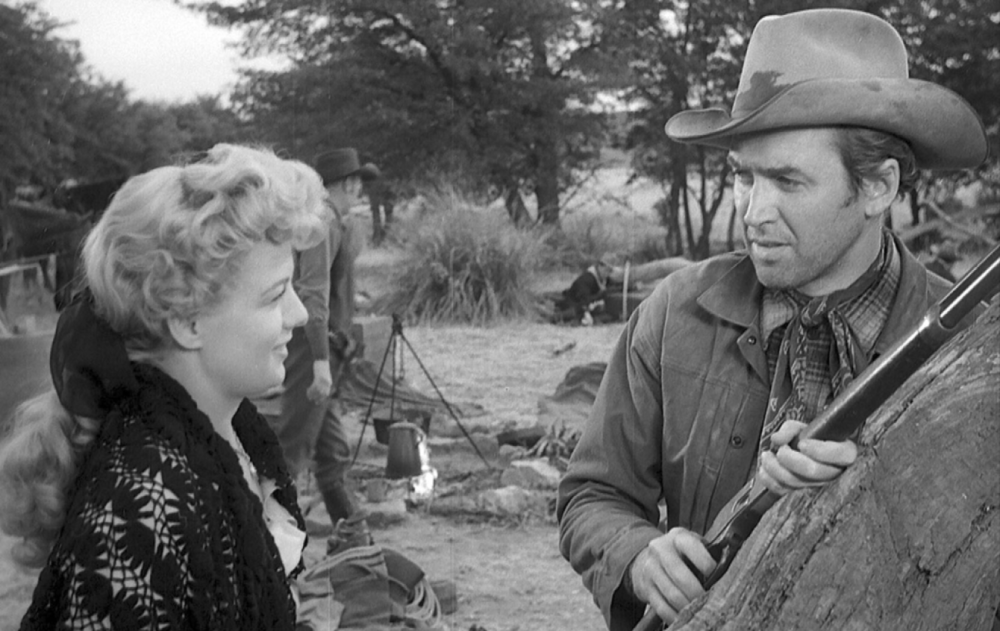
James Stewart and Anthony Mann both cared a great deal about authenticity, so Stewart spent hours practicing using a Winchester rifle. According to Mann, Stewart was “magnificent walking down a street with a Winchester rifle cradled in his arm. And he was great too actually firing the gun. He studied hard at it. His knuckles were raw with practicing… It was those sorts of things that helped make the film look so authentic, gave it its sense of reality.” Herb Parsons, an expert marksman for the Winchester company, assisted Stewart in his training and perfromed the trick shots in Winchester ’73. Despite having a poor opinion of the film on the whole, Shelley Winters got along well with Jimmy Stewart. Winters and Stewart both considered the left side of their faces to be the best side. Since Stewart was the bigger star, Winters assumed that she would have to be shot from the right in their conversation scenes. However, Stewart knew that being shot from the right made Winters uncomfortable, so he arranged it so that her left side would be shown in the conversation scenes between the two actors.
Fun Facts and Trivia: Future leading man Rock Hudson has a supporting role in Winchester ’73 as Indian chief Young Bull. Hudson’s acting career had only begun in 1948 and mostly had supporting roles at this point in his career, including in Bend of the River (1948), another Stewart-Mann western. He later became a popular leading man after starring in the dramas Magnificent Obsession (1954), All That Heaven Allows (1955), and Giant (1956). Another future star, Tony Curtis, has a minor role in Winchester ’73 as Dean (one of the soldiers), where he was credited as “Anthony Curtis.” Curtis became a big star following his role in Sweet Smell of Success (1957), and would later be best known for starring in the comedy Some Like It Hot (1959).
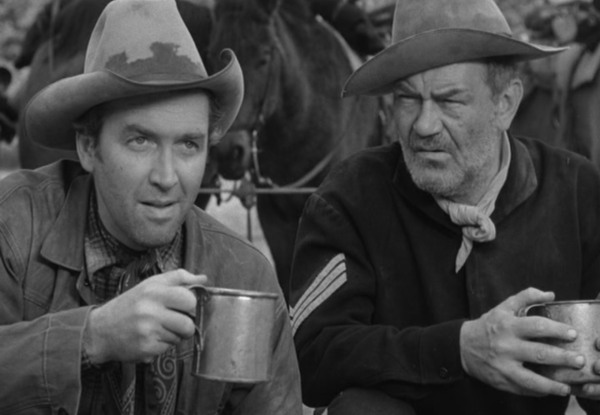
James Stewart and Millard Mitchell later costarred together in The Naked Spur (1953), another western directed by Anthony Mann. Winchester ’73 was the first of eight film to feature Stewart and Jay C. Flippen (Sergeant Wilkes). The later films were: Bend of the River (1952), Thunder Bay (1953), The Far Country (1954), Strategic Air Command (1955), Night Passage (1957), How the West Was Won (1963), and Firecreek (1968). Stewart and character actor John McIntire (Joe Lamont) also appeared together in Call Northside 777 (1948), The Far Country, and Two Rode Together (1961).
Reception: Winchester ’73 initially premiered at the Shubert Theater in New Haven, Connecticut on June 1, 1950. This event was a press screening and New Haven was chosen as the location because Olin Industries, the parent company for the Winchester rifles, was headquartered in New Haven. The film had a more conventional premiere that featured the cast and crew on June 7, 1950 in New York City. Winchester ’73 went into wide release in the United States on July 12. The film was an unexpectedly big hit at the box office and earned a strong profit for Universal. Stewart’s agent had arranged that his client would receive fifty percent of Winchester ’73‘s profit, so Jimmy Stewart received around $600,000 from the film!
James Stewart and Anthony Mann worked well together on Winchester ’73, so the two worked together on seven more films. Mann would later direct Stewart in the westerns Bend of the River (1952) for Universal, The Naked Spur (1953) for MGM, The Far Country (1954) for Universal, and The Man from Laramie (1955) for Columbia. Mann also directed Stewart in the adventure Thunder Bay (1953) for Universal, the biopic The Glenn Miller Story (1954) for Universal, and the aviation drama Strategic Air Command (1955) for Paramount.
As part of the publicity campaign for Winchester ’73, Universal sponsored a contest through magazine ads to encouraging the public to locate surviving antique “One of One Thousand” Model 1873 Winchester rifles. The winner of the contest received a brand new Winchester Model 1894 rifle, as even the regular 1873 model was out of production by this time. James Stewart reprised his role as Lin McAdam in a 60 minute radio adaptation of Winchester ’73 for Lux Radio Theater, which was broadcast on November 12, 1951. Stewart won the Reno Silver Spurs award for best western actor for his role as Lin McAdam in Winchester ’73. Winchester ’73 was also named the best western of the year and Mann was named the best western director of the year at the Reno Silver Spurs award ceremony.
Winchester ’73 received positive reviews from critics when it was first released. The critics at Time magazine enjoyed the film. Time praised the black & white cinematography, the script’s natural dialogue, and Anthony Mann’s direction, particularly his use of suspense. Harry McArthur of The Washington Star described Winchester ’73 as “a lively Western.” McArthur praised the acting performances, especially James Stewart, the film’s humor, and Anthony Mann’s directing. Gadsden County Times commended Winchester ’73 for its excitement and good acting performances. Clyde Gilmour of Maclean’s magazine and Bosley Crowther of The New York Times also gave the film positive reviews.
Winchester ’73 was loosely remade as a television movie in 1967, which was also named Winchester ’73. Dan Duryea and John Doucette (who had an uncredited bit part in the original film) played different characters in the 1967 version. Many years later, Jimmy Stewart recorded an audio commentary for the 1987 LaserDisc edition of Winchester ’73 (the commenatary was also included on later DVD releases). This was the only time that Stewart recorded an audio commentary for one of his films.
Winchester ’73 continues to receive positive reviews from modern critics. Martin Chilton of The Daily Telegram gave Winchester ’73 a 5/5 star review and noted that the film had a important influence on future westerns as it “featured more complex idea of the noble hero of the west — a man plagued by personal problems and violent impulses.” TV Guide magazine gave the film a 4/5 star review, and similarly noted that Stewart and Mann’s westerns had a significant influence on the direction of the Western genre, due to their more complex protagonists. Dennis Schwartz stated that Winchester ’73 was “one of the truly great Westerns” and praised the acting and Mann’s directing. In a 5/5 star review for Empire magazine, William Thomas strongly praised the acting performances.
Why You Should See It: Winchester ’73 is an excellent classic western. The film’s black & white lighting and location-shooting are both top notch. James Stewart gives a good performance as Lin McAdam. Lin is darker and more vengeful than the characters Stewart previously played, but is still likeable. The battle between the cavalry and the Indian tribe and the final mountain gunfight between Lin and Dutch were exciting, standout moments.
Leave a Reply