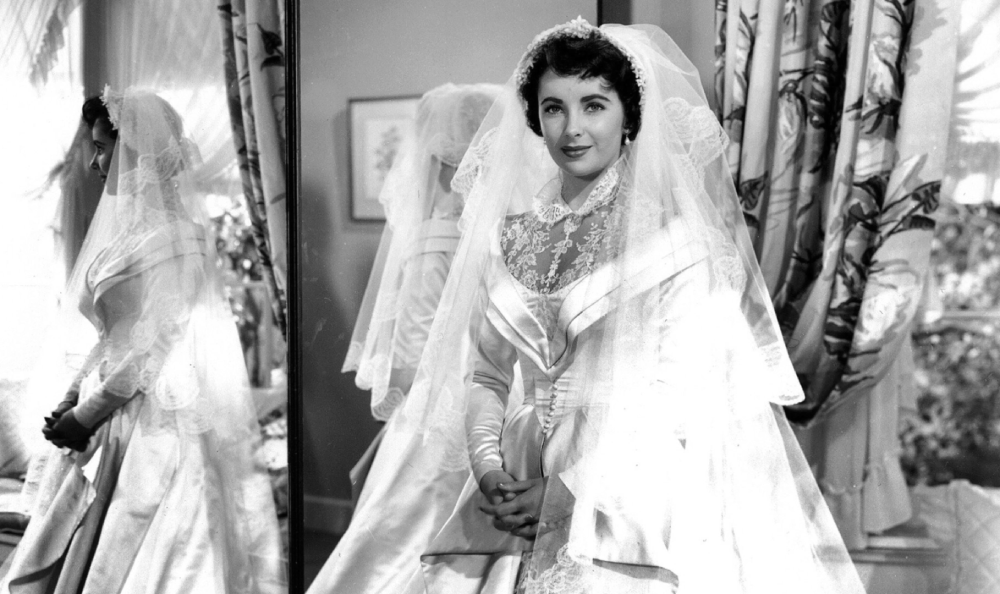
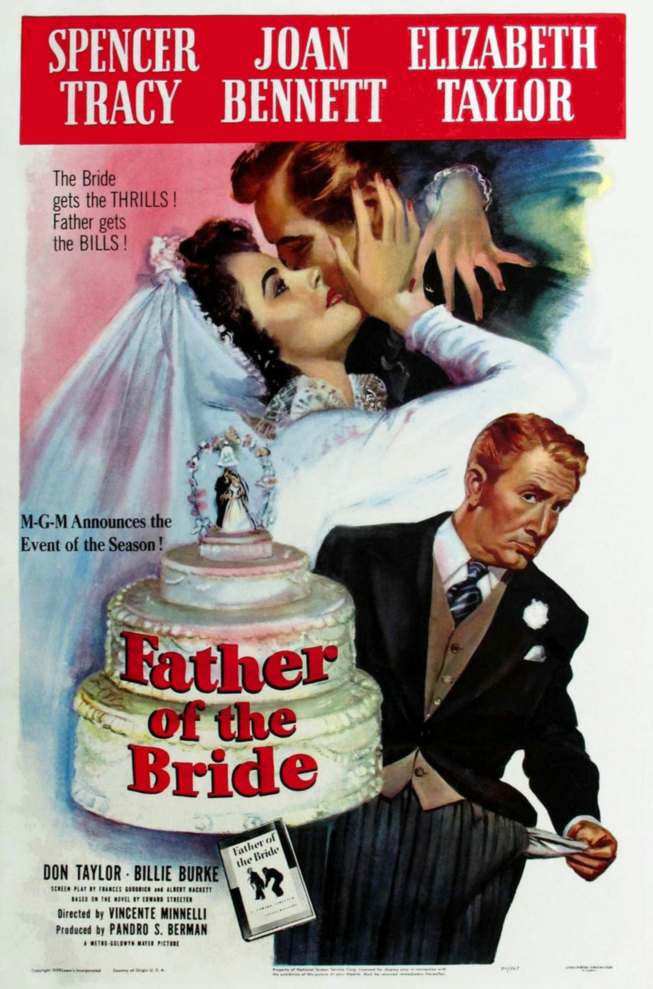
Father of the Bride is a 1950 family comedy film directed by Vincente Minnelli. The films stars Spencer Tracy, Elizabeth Taylor, and Joan Bennett. Father of the Bride is based on Edward Streeter’s 1949 novel of the same name.
Director: Vincente Minnelli
Production Company: Metro-Goldwyn-Mayer
Distributor: Metro-Goldwyn-Mayer
Cast: Spencer Tracy, Joan Bennett, Elizabeth Taylor, Don Taylor, Billie Burke, Leo G. Carroll, Moroni Olsen, Melville Cooper
US Box Office: $10,135,000 ($194,000,000 adjusted for inflation)
Film Format: Black & White
Genre: Comedy, Family
Release Date: May 18, 1950 (New York premiere); June 16, 1950 (general release)
Plot Summary: Lawyer Stanley T. Banks (Spencer Tracy) lives with his wife Ellie (Joan Bennett) and their three children, including their daughter Kay (Elizabeth Taylor). One day, Kay tells her parents that she’s going to marry Buckley Dunstan (Don Taylor). Stanley is initially hesitant, but warms up to Buckley after spending some time with him. However, Stanley is less than thrilled when he realizes how expensive Kay’s wedding is going to be! Ellie and Kay’s wedding plans grow increasingly extravagant with plenty of wedding dresses and suits, expensive catering, and a large reception ceremony at their home. Stanley isn’t happy about the bills, but ultimately accepts them because he knows that it’s important for him to make Kay’s wedding special.
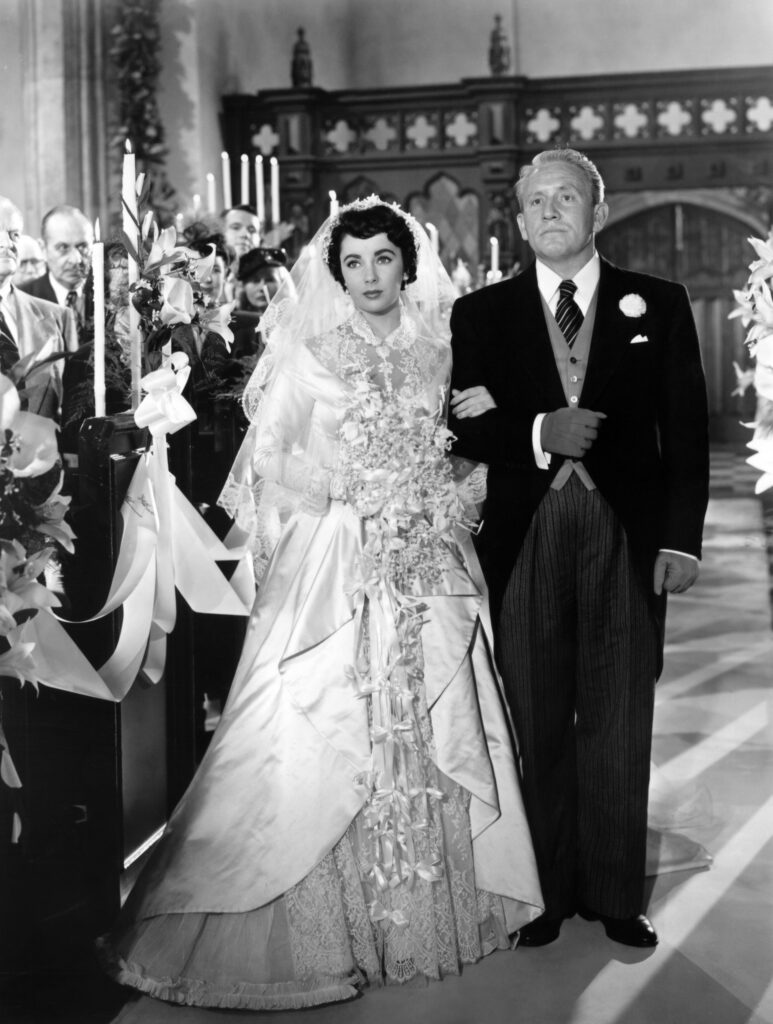
Production: Metro-Goldwyn-Mayer studio executives purchased the film rights to Edward Streeter’s novel Father of the Bride (1949) in November of 1948, several months before the novel was officially published. The novel was about a father’s humorous joys and troubles as he prepares for his daughter’s upcoming wedding. Pandro S. Berman was assigned to produce Father of the Bride. The film’s screenplay was written by Frances Goodrich and Albert Hackett. Vincente Minnelli was chosen to direct Father of the Bride. Minnelli had a contract with MGM and he was known for his work on musicals and comedies. Minnelli was married to Judy Garland at the time and he recently directed her in the musicals Meet Me in St. Louis (1944), Ziegfeld Follies (1945), The Pirate (1948), and in the drama The Clock (1945).
Spencer Tracy had always been MGM’s first choice for the role of father Stanley Banks, and the screenplay was written with Tracy in mind for the character. Minnelli thought that Tracy would be perfect for the perfect for the role which balanced comedy and emotional drama. Despite this, Berman had comedian Jack Benny perform a screen test for the role. Benny didn’t get the part because he was too comedic and wasn’t as good with the dramatic aspect. When Tracy heard that another actor had been tested, he initially turned down the part. Minnelli asked actress Katherine Hepburn (Tracy’s longtime girlfriend) to arrange a dinner meeting between the two, and Minnelli convinced Tracy to accept the part. Tracy had recently starred in the western The Sea of Grass (1947), the drama State of the Union (1948), and the comedy Adam’s Rib (1949).
Once Spencer Tracy was cast as Stanley Banks, he hoped that Katherine Hepburn would be cast as Ellie Banks, the wife of his character. MGM executives felt that the chemistry between Tracy and Hepburn was too romantic for the two to be believable as a long-married couple with children, so Hepburn wasn’t given the part. Joan Bennett was cast in the part instead. Many years ago, Bennett had co-starred with Tracy in She Wanted a Millionaire (1932) and Me and My Girl (1932). Bennett recently appeared in the in several Film Noirs including Scarlet Street (1945), The Woman on the Beach (1947), and Hollow Triumph (1948). British-American actress Elizabeth Taylor was given the role of Kay Banks, the daughter of Stanley and Ellie. Taylor was a popular child star in the 1940s and the role of Kay was one of the first adult characters she played. Taylor recently appeared in the musical comedy A Date with Judy (1948) and the spy film Conspirator (1949).
Director Vincente Minnelli began filming Father of the Bride in mid-January of 1950 and shooting wrapped up in mid-February. Father of the Bride was primarily shot on set at MGM Studios in Carver City, California. Some of the scenes featuring the church were shot on location at All Saints’ Episcopal Church in Beverly Hills, CA.
Fun Facts and Trivia: Stanley Banks has a photograph of Kay with a horse on his nightstand. This picture is an actual photograph of Elizabeth Taylor when she was a child. Elizabeth Taylor and Joan Bennett each played the role of Amy March in two different film adaptations of Louisa May Alcott’s novel Little Women. Bennett played the character in the 1933 film, while Taylor played the role in the 1949 version. Character actor Leo G. Carroll (Mr. Massoula) previously had a bit part in Captains Courageous (1937), an adventure-drama that starred Spencer Tracy. Joan Bennett and Carroll later appeared together in the comedy film We’re No Angels (1955).
Reception: Father of the Bride had its premiere at Radio City Music Hall in New York City on May 18, 1950. Twelve days before the film’s premiere, Elizabeth Taylor married Nicky Hilton, son of the Hilton Hotels founder Conrad Hilton. Taylor’s wedding dress was designed by Helen Rose, who also designed the wedding gown worn by her character in Father of the Bride. MGM advertisers used public interest in Taylor’s real wedding to generate publicity for the film. Father of the Bride went into wide release on June 16.
Father of the Bride was a massive box office success when it was released. A recognizable and likeable cast, the film’s combination of humor and emotion, and the publicity surrounding Taylor’s wedding all contributed to the film’s strong performance. Father of the Bride was one of the top ten highest grossing films of the year, and was MGM’s third highest grossing film of the year after the adventure King Solomon’s Mines and the musical Annie Get Your Gun. Theater Guild on Air broadcast a radio adaption of the film on February 25, 1951 which featured Spencer Tracy, Joan Bennett, and Elizabeth Taylor reprising their roles.
MGM executives were pleased with Father of the Bride‘s box office results and they quickly rushed a sequel titled Father’s Little Dividend (1951) into production. Father’s Little Dividend was directed by Vincente Minnelli and featured most of the original cast: Spencer Tracy, Joan Bennett, Elizabeth Taylor, Don Taylor, Billie Burke (Doris Dunstan), Moroni Olsen (Herbert Dunstan), Marietta Canty (Delilah), Russ Tamblyn (Tommy Banks), Tom Irish (Ben Banks), and Paul Harvey (Reverend Galsworthy) all reprised their roles in the sequel. It was rare for A-list films to receive direct sequels at the time. Streeter’s novel was later adapted into the TV series Father of the Bride (1961-1962) for CBS which starred Leon Ames, Ruth Warrick, and Myrna Fahrey. In 1991, Charles Shyer directed a remake of the original film that starred Steve Martin and Diane Keaton as the parents. That film was also a box office success and received a sequel in 1995.
Father of the Bride received mostly positive reviews from critics when it was first released. Bosley Crowther of The New York Times gave the film a favorable review. Crowther stated that Father of the Bride was “equally wonderful” when compared to the novel and he had strong praise for Spencer Tracy’s performance. Variety also praised Tracy’s performance and noted that film packed a lot of content in its relatively short runtime. Richard L. Coe of The Washington Post described Father of the Bride as, “a cheerful package of smiles and laughter.” Harrison’s Reports complimented the film’s humor and correctly predicted that it would be popular with audiences. The July edition of Photoplay chose Father of the Bride as one of the best films of the month, and ranked Tracy, Bennett, and Taylor as giving some of the best performances of the month. A later issue of Photoplay ranked Father of the Bride as the magazine’s sixth favorite film of the year.
Father of the Bride continues to receive a mostly positive response from modern critics. Matt Brunson of Film Frenzy gave the film a perfect 4/4 star rating. Brunson described Father of the Bride as, “a genuine cinematic treasure” and argued that the role of Stanley Banks was Spencer Tracy’s best performance. Emanuel Levy also enjoyed Spencer Tracy’s performance, which he called, “wonderful.” Tim Dirks of Filmsite, Geoff Andrew of Time Out, and Daniel M. Kimmel of the Worcester Telegram & Gazette additionally gave the film positive reviews. Mike Massie of Gone With The Twins conversely gave Father of the Bride a negative review. He thought that the film needed slapstick comedy and eccentric comic relief characters to contrast with the typical humor and stress generated by marital preparation. In 2000 the American Film Institute ranked Father of the Bride as the 83rd funniest American film on its “AFI’s 100 Years…100 Laughs” list.
Oscars: Father of the Bride was nominated for three Oscars at the 23rd Academy Awards ceremony: Best Picture (Pandro S. Berman for MGM), Best Actor (Spencer Tracy), and Best Adapted Screenplay (Frances Goodrich and Albert Hackett, based on Father of the Bride by Edward Streeter). The film didn’t win any of the awards it was nominated for, being the only Best Picture nominee that year to have not won any of the Oscars it was nominated for. All About Eve received the Best Picture Oscar. Jose Ferrer won the Best Actor award for his performance in Cyrano de Bergerac. Joseph L. Mankiewicz was awarded the Best Adapted Screenplay Oscar for All About Eve.
Why You Should See It: Father of the Bride is a likeable and funny family comedy film. Spencer Tracy gives a great performance as Stanley Banks. Tracy balances the film’s humor with plenty of dramatic emotion and is believable as a father who has mixed feelings on his daughter’s impending marriage. Father of the Bride has a few stand out comedic moments. Stanley’s initial reaction to Buckley, the engagement party, Stanley’s trouble fitting into his old suit, and the chaotic wedding rehearsal were all really funny. The film’s ending was also satisfying, despite all his trouble setting up, Stanley is ultimately happy for Kay and proud of the work he put into making her wedding the best it could be.