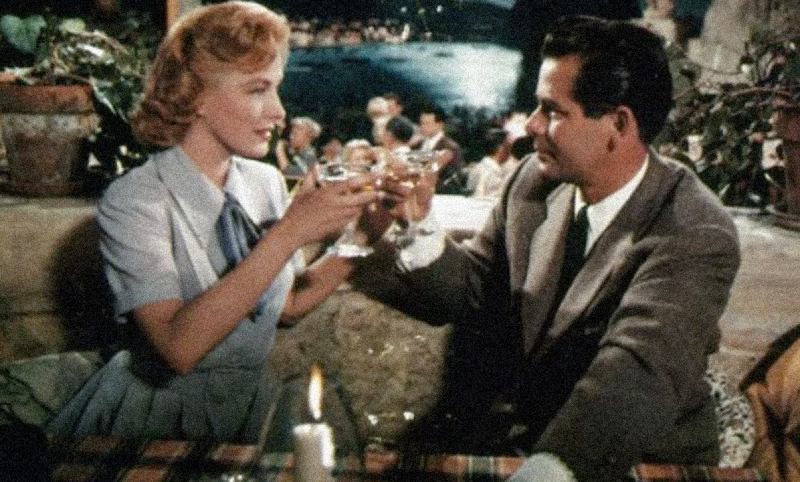
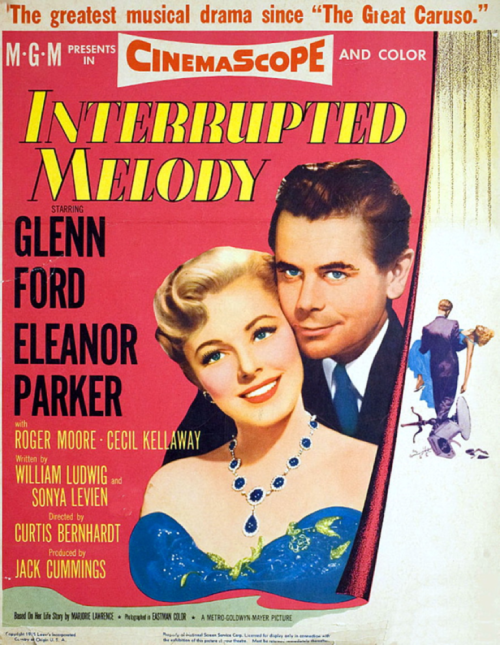
Interrupted Melody is a 1955 musical drama film directed by Curtis Bernhardt. The film stars Glenn Ford, Eleanor Parker, and Roger Moore. Interrupted Melody is based on the life of opera star Marjorie Lawrence and is an adaptation of her 1949 autobiography of the same name.
Director: Curtis Bernhardt
Production Company: Metro-Goldwyn-Mayer
Distributor: Metro-Goldwyn-Mayer
Cast: Glenn Ford, Eleanor Parker, Roger Moore, Cecil Kellaway, Peter Leeds, Evelyn Ellis, Walter Baldwin, Ann Codee
US Box Office: $4,502,500 ($89,800,000 adjusted for inflation)
Film Format: Eastman Color (shot in CinemaScope)
Genre: Musical, Drama
Release Date: April 20, 1955 (Melbourne premiere); May 5, 1955 (New York premiere); July 1, 1955 (US general release)
Plot Summary: After training in Paris on a scholarship, young Australian singer Marjorie Lawrence (Eleanor Parker) quickly becomes a popular opera star. Marjorie’s business-minded brother Cyril (Roger Moore) serves as her manager. Marjorie falls in love with and marries Dr. Thomas King (Glenn Ford) and she moves to New York City with him, though their diverging career paths cause some tension between the two. Tragedy strikes when Marjorie is diagnosed with polio, which leaves her immobile and appears likely to end her opera career. Although the depressed Marjorie has given up hope, Thomas still believes in her and he helps his wife to adapt to the disease, regain confidence, and recover as best as she can.
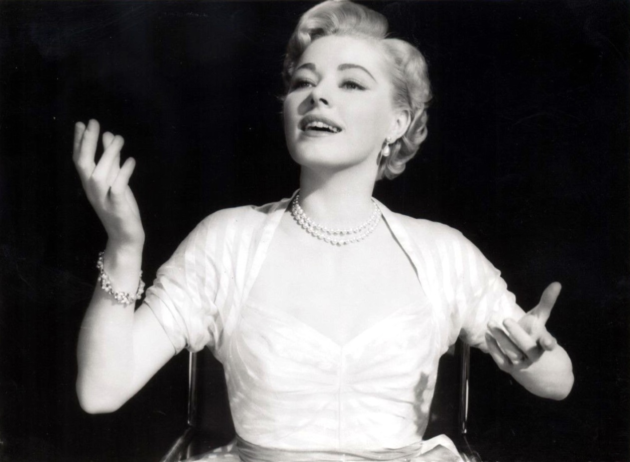
Production: In 1949 Australian opera singer Marjorie Lawrence published an autobiography of her life titled Interrupted Melody. Lawrence had been a rising opera star when she was crippled by polio in 1941. Although she could no longer walk, Lawrence adapted to the disease, regained her vocal range, and continued her opera singing career till 1952. In April of 1951, Metro-Goldwyn-Mayer released The Great Caruso, a biopic of opera singer Enrico Caruso. That film quickly became a box office hit for the studio, so MGM executives purchased the film rights to Lawrence’s book in June. Jack Cummings was assigned to produce the film.
MGM’s initial script for Interrupted Melody was written by Sonya Levien. The screenplay was later revised by William Ludwig. Levien and Ludwig previously wrote the script for The Great Caruso, MGM’s previous opera biopic. Producer Jack Cummings chose Curtis Bernhardt, a German director who had a long career in Hollywood and had a contract with MGM at the time, to direct Interrupted Melody. Bernhardt had recently directed the opera-based musical The Merry Widow (1952), the musical drama Miss Sadie Thompson (1953) and the historical drama Beau Brummell (1954).
When MGM first purchased the rights to Lawrence’s book in June, Kathryn Grayson, Greer Garson, and Deborah Kerr were all considered for the lead role of Marjorie Lawrence. In December of 1951, the studio announced that Lana Turner was cast in the part and that filming would begin in February 1952. This didn’t end up happening and in July Greer Garson was cast in the part. The film was postponed again and Garson left her contract with MGM in early 1954, necessitating that another actress be cast.
In April 1954, Eleanor Parker was cast as Marjorie. She had a contract with MGM at the time. Parker recently starred in the adventure films Scaramouche (1952), The Naked Jungle (1954), and Valley of the Kings (1954) as well as the film noir Detective Story (1951) and the western Escape from Fort Bravo (1953). Parker loved the script for Interrupted Melody and she felt passionately about giving the best performance she could for the film. Glenn Ford was cast as Thomas King, Marjorie’s husband. He recently starred in the film noir The Big Heat (1953) and the adventure film Appointment in Honduras (1953). Ford only agreed to star in Interrupted Melody if he received top billing. Thus, Ford was the top billed star, even though Eleanor Parker played the main character. British actor Roger Moore played Cyril Lawrence, Marjorie’s brother and agent. He recently signed a contract with MGM and his first film for the studio was the romantic drama The Last Time I Saw Paris (1954). Moore would later be best known for starring in the television series The Saint (1962-1969) and for playing James Bond in seven films from 1973 to 1985.
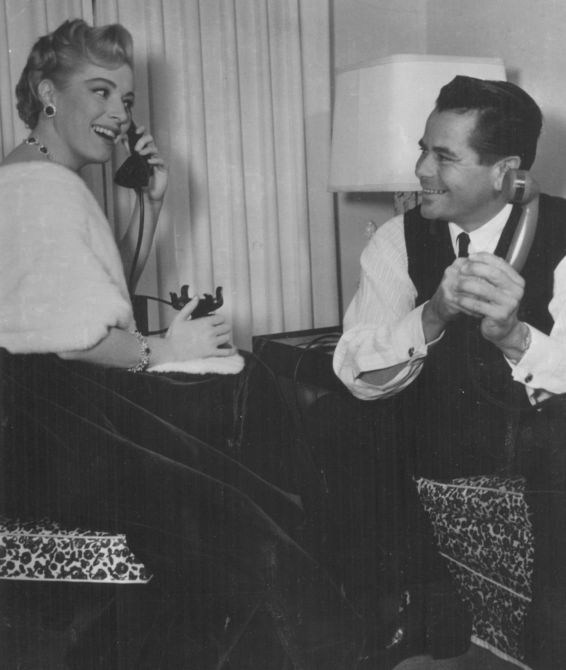
Director Curtis Bernhardt began shooting Interrupted Melody in September 1954. Principle photography wrapped up in November. Interrupted Melody was filmed in Eastman Color and in the wide-screen CinemaScope format. The film was primarily shot on set at MGM Studios in Culver City, California. Cinematographer Paul C. Vogel was replaced midway through production by Joseph Ruttenberg after the former was injured in a car accident. Both men were credited in the final film. Eleanor Parker would later describe Glenn Ford as being, “kind of a difficult man” to work with, but also noted that he was the right man to play Thomas King and was a very good actor.
In early 1954, the real Marjorie Lawrence recorded takes of the songs to be used in Interrupted Melody. Producer Jack Cumming’s initial intention was for Lawrence’s voice to dub over the leading lady in opera song sequences. The filmmakers chose to not use Lawrence’s voice because she no longer had the same vocal range she had in the 1930s and 1940s. The opera singing was instead recorded by Eileen Farrell before shooting began. To prepare for the opera songs, Eleanor Parker listened and sang along to Farrell’s recordings for several weeks until she perfectly memorized every detail of the songs. During shooting Parker sang the songs at her full voice (rather than lip-syncing to a recording, which is what would usually be done if an actor’s singing was being dubbed). Parker did such a great job memorizing the songs that she never needed to do re-takes to match Farrell’s recordings, her mouth movements always matched up perfectly!
Fun Facts and Trivia: Eileen Farrell, the Opera singer who dubbed Eleanor Parker’s singing in Interrupted Melody, also briefly appears on screen in the film. She plays the student struggling to sing a high note for Madame Gilly (Ann Codee) near the beginning of the film. Leopold Sachse, a long-time producer and director for the Metropolitan Opera, played himself in Interrupted Melody. In the film, Sachse directs Marjorie Lawrence in her Götterdämmerung play (this is the opera where Marjorie rides her horse into the fire) for the Metropolitan Opera. Although not born there, actor Cecil Kellaway (Bill Lawrence) lived in Australia from the 1920s to the mid-1930s and he got his start in the entertainment business as a stage actor there. Interrupted Melody was one of the few Hollywood films where Kellaway actually played an Australian character.
Reception: Interrupted Melody had its worldwide premiere in Melbourne, Australia on April 20, 1955. The film premiered in New York City on May 5 and went into general release in the United States on July 1. Interrupted Melody performed fairly well at the box office, both in the US and overseas, though it only earned a small profit for MGM due to its large production budget. The studio viewed Interrupted Melody as a disappointment, as it was not nearly as popular or profitable as The Great Caruso had been back in 1951. Eleanor Parker was proud of her work on Interrupted Melody. She put a great deal of effort into her role as Marjorie Lawrence and she later considered it to be her best performance.
Interrupted Melody received positive reviews from critics when it was first released. Bosley Crowther of The New York Times had strong praise for the film, which he described as “tender and moving.” Crowther approved of the film’s story, top-notch production values, and excellent singing. Gadsden County Times praised Eleanor Parker’s emotional performance as having “almost heartbreaking intensity” and thought that the film’s story was interesting. The newspaper also commended Interrupted Melody for its outstanding production values, costumes, CinemaScope cinematography, and variety of songs. Clyde Gilmour of Maclean’s praised Parker’s performance and the film’s opera singing. The Key West Citizen had similarly applauded Parker’s acting and the film’s music.
Oscars: Interrupted Melody was nominated for three Oscars at the 28th Academy Awards ceremony: Best Actress (Eleanor Parker), Best Story and Screenplay Writing (William Ludwig and Sonya Levien, based on Marjorie Lawrence’s book), and Best Color Costume Design (Helen Rose). The film received one Oscar, which Ludwig and Levian won for their screenplay. Eleanor Parker lost the Best Actress award to Ann Magnani, who won for her role in The Rose Tattoo. Charles LeMaire won the Best Color Costume Design award for Love Is a Many-Splendored Thing.
Why You Should See It: Interrupted Melody is an excellent musical drama film. The film’s production values, cinematography, and costumes are all top-notch. Curtis Bernhardt did a good job directing Interrupted Melody. He skillfully handles the film’s more lighthearted and romantic moments, as well as the serious drama. Eleanor Parker gives a fantastic performance as Marjorie Lawrence. Parker is likeable in the role and she does a great job in the film’s more emotional moments. Interrupted Melody is a very inspirational film and it is satisfyingly to see Marjorie’s recovery.