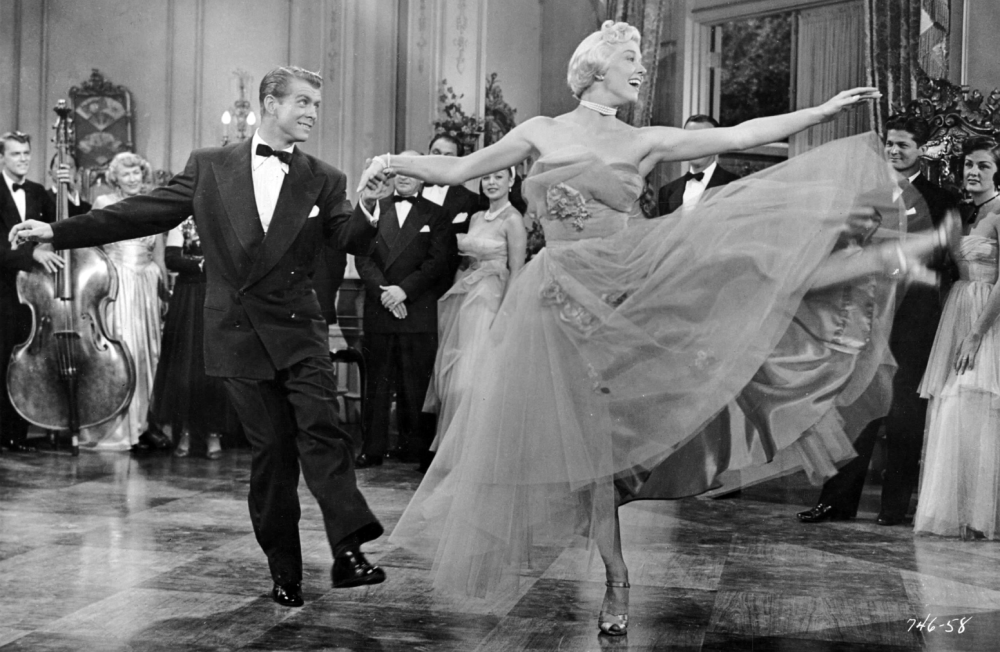
Lullaby of Broadway is a 1951 musical comedy film directed by David Butler. The film stars Doris Day, Gene Nelson, S.Z. Sakall, and Billy De Wolfe. Lullaby of Broadway features and is named after the 1935 song “Lullaby of Broadway,” which was originally written by Harry Warren and Al Dubin.
Director: David Butler
Production Company: Warner Bros.
Distributor: Warner Bros.
Cast: Doris Day, Gene Nelson, S.Z. Sakall, Billy De Wolfe, Gladys George, Florence Bates, Anne Triola
US Box Office: $5,255,000 ($94,900,000 adjusted for inflation)
Film Format: Technicolor
Genre: Musical, Comedy
Release Date: March 26, 1951 (premiere); April 24, 1951(general release)
Plot Summary: Melinda Howard (Doris Day), who is a successful stage perfromer in England, travels back home to New York City to surprise her mother, Broadway singer Jessica Howard (Gladys George). Unbeknownst to Melinda, her mother has since become an alcoholic saloon singer. To keep Melinda from discovering the disappointing truth about her, Jessica’s friend “Lefty” Mack (Billy De Wolfe) convinces Melinda that her mother is away on tour and that the mansion owned by his boss Adolph Hubbell (S.Z. Sakall) is actually owned by Jessica. Feeling sorry for Melinda, Mr. Hubbell agrees to cast her as the star of a new stage production based on the song “Lullaby of Broadway” and she is paired with dancer Tom Farnham (Gene Nelson).
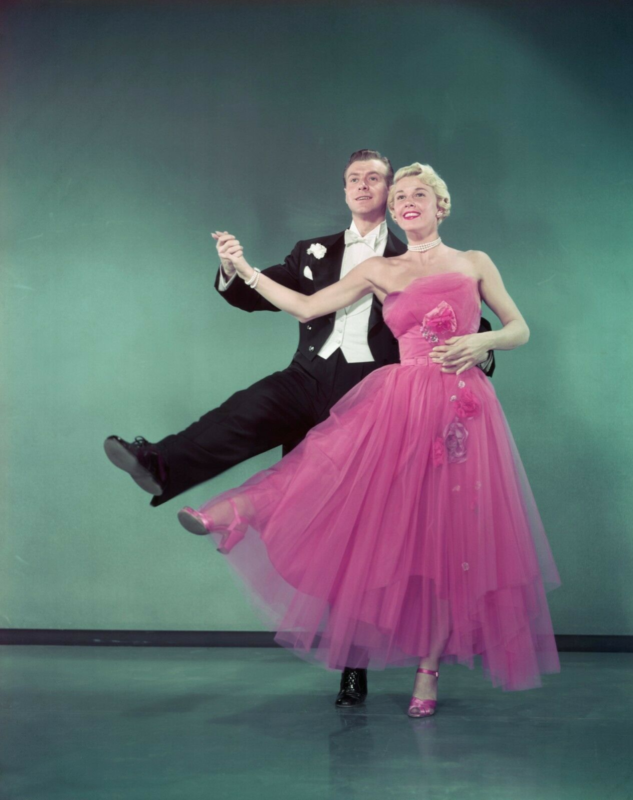
Production: In 1950, Warner Bros. producer William Jacobs began working on a new musical film for the studio. Jacobs frequently produced musicals and comedy films for the studio. The film was named after and based around the hit 1935 song “Lullaby of Broadway.” “Lullaby of Broadway” was originally written by Harry Warren (music) and Al Dubin (lyrics) for use in the Warner Bros. musical Gold Diggers of 1935, where it was sung by Wini Shaw. The song was highly popular and won the Oscar for Best Song at the 8th Academy Awards ceremony. The script for Lullaby of Broadway was written by Earl Baldwin. Jacobs chose David Butler to direct Lullaby of Broadway. Butler had a contract with Warner Bros. and frequently directed musical and comedy films for the studio at this time. He recently directed the musicals My Wild Irish Rose (1947), Look for the Silver Lining (1949), and The Daughter of Rosie O’Grady (1950).
William Jacobs cast Doris Day in the lead role of stage performer Melinda Howard. Day’s first acting role was in the musical Romance on the High Seas (1948) for Warner Bros. Day signed a contract with WB after completing that film and she quickly became one of the studio’s most popular musical stars. David Butler had previously directed Day in the musicals It’s a Great Feeling (1949) and Tea for Two (1950). He later directed Day in April in Paris (1952), By Light of the Silvery Moon (1953), and Calamity Jane (1953). Gene Nelson was cast as dancer Tom Farnham, who becomes Melinda’s love interest. Nelson previously had supporting roles in two of Doris Day’s films, Tea for Two and The West Point Story (1950). At the time, Warner Bros. executives were promoting Nelson as their version of MGM’s dancing musical star Gene Kelly, though Nelson ultimately never achieved the same level of success as Kelly.
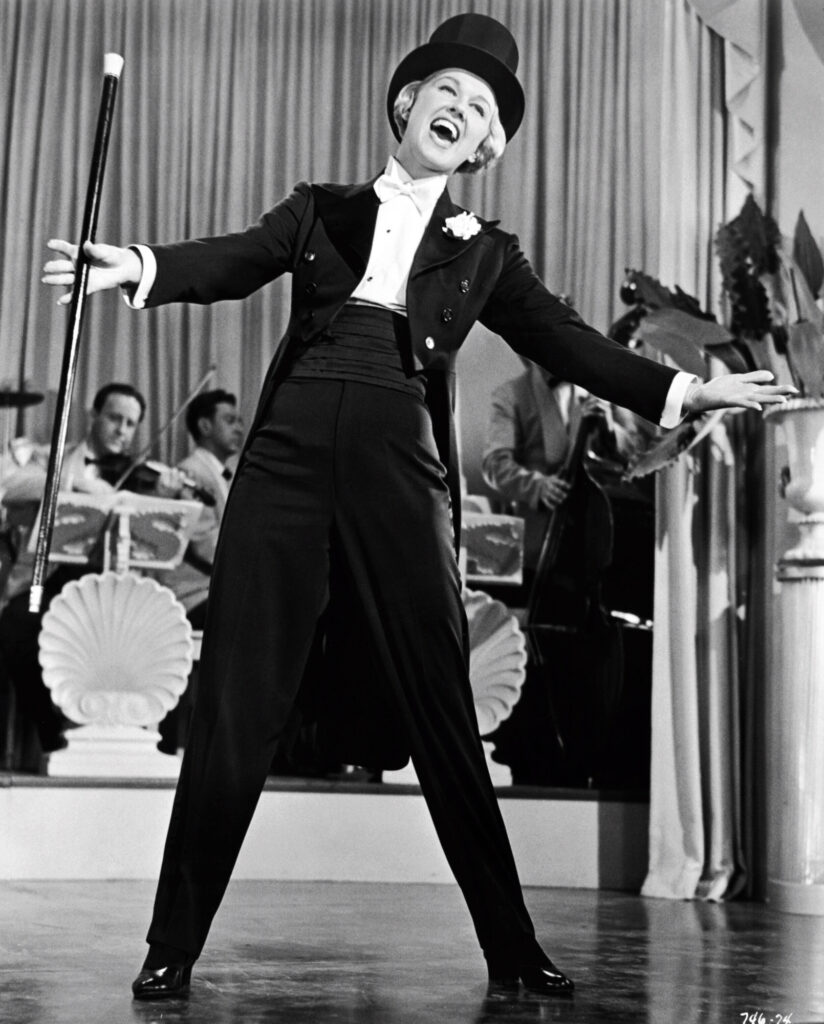
David Butler began shooting Lullaby of Broadway at the end of 1950 and filming wrapped up in early 1950. The film was shot almost entirely on set at Warner Bros. Studios in Burbank, California. Aside from the titular song, a number of other classic songs were also used in Lullaby of Broadway, including “You’re Getting to Be a Habit with Me” (1932) by Harry Warren and Al Dubin and “Just One of Those Things” (1935) by Cole Porter. When Doris Day was a teenager in the 1930s, she initially wanted to be a professional dancer. However, her dancing career ended when she broke her leg in 1937, and she instead focused on her singing. Day was worried about the complex dance routines she was required to perform in Lullaby of Broadway, but Gene Nelson’s wife Miriam (who was also a dancer) helped her train for them. Doris Day would later state in her autobiography that the dance on the staircase during the finale of Lullaby of Broadway was one of the most difficult dance numbers she ever had to perform.
Fun Facts and Trivia: In the scene where Melinda is surrounded by news reporters who falsely allege she is having an affair with Mr. Hubbell, one of the reporters asks Melinda, “Is it true you call him ‘Cuddles’?” This line was added to the script as an inside joke reference to actor S.Z. Sakall. Warner Bros. studio head Jack L. Warner nicknamed Sakall “cuddles” due to the latter’s rotund figure, likeable personality, and overall cuteness. In a few films Sakall was even listed in the credits as “S.Z. ‘Cuddles’ Sakall.”
Lullaby of Broadway was the last of four films to pair Doris Day and S.Z. Sakall together. The previous films were Romance on the High Seas (1948), My Dream is Yours (1949), and Tea for Two (1950). Day got along well with Sakall and she considered him to be one of her favorite co-stars. David Butler directed Sakall in a total of ten films. The other nine films were Thank Your Lucky Stars (1943); Shine On Harvest Moon (1944); San Antonio (1945); The Time, The Place and the Girl (1946); Two Guys from Milwaukee (1946); Look for the Silver Lining (1949); The Daughter of Rosie O’Grady (1950); Tea for Two; and Painting the Clouds with Sunshine (1951).
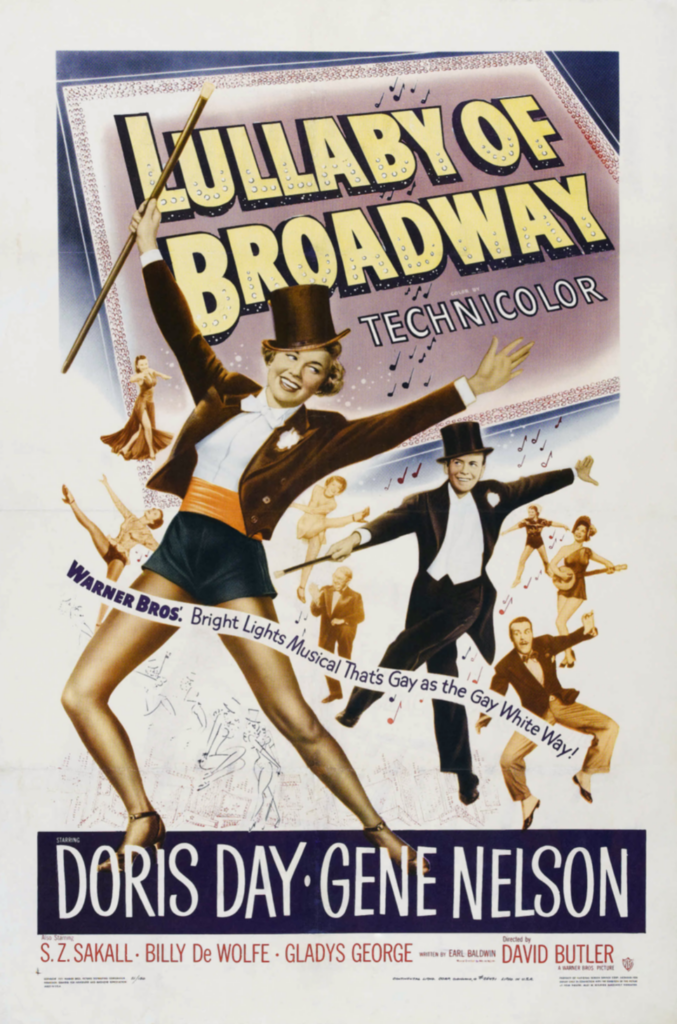
Reception: Lullaby of Broadway premiered in New York City on March 26, 1951. The film went into wide release on April 24. Lullaby of Broadway was a financial success and it earned a profit for Warner Bros. The film’s success was due to the appeal of Doris Day, who had quickly become one of Warner’s most popular stars. Day’s singing talent and her sweet and wholesome performances endeared her to millions of fans. 1951 was the first year that she was ranked as one of the “Top Ten Money Making Stars” by Quigley Publishing Company.
Lullaby of Broadway received mostly positive reviews from critics when it was first released. Harry K. MacArthur of The Evening Star had strong praise for Doris Day’s performance, including her personality and singing, and the film’s Technicolor cinematography. MacArthur also liked Gene Nelson’s dancing and enjoyed S.Z. Sakall and Billy De Wolf’s comedic performances. Gadsden County Times also gave the film a positive review and praised the comedy and the songs. The newspaper described the film as a “heart-warming story draped against a background of some of the most lavish production numbers ever filmed.” A. H. Weiler of The New York Times was more mixed. He had some praise for the musical numbers, but was unimpressed with the plot. The May edition of Photoplay ranked Lullaby of Broadway as one of the best films of the month, and the magazine later ranked Doris Day as the “Most Popular Female Star” of 1951 for her role as Melinda Howard.
Lullaby of Broadway receives mixed-to-positive reviews from modern critics. Steve Crum of Video-Reviewmaster.com gave the film a 4/5 star review. He praised Doris Day’s performance and described the film a “grand Warner’s musical.” Emmanuel Levy praised some of the film’s musical numbers, but disliked the plot, which he criticized as being bland. However, he liked Day’s performance and thought that she made Lullaby of Broadway enjoyable. Matt Brunson of Film Frenzy gave the film a mixed review. He disliked the plot and some of the film’s more dramatic moments, but enjoyed the musical numbers.
Why You Should See It: Lullaby of Broadway is an enjoyable classic musical. The dance numbers are great, especially the grand finale, where Doris Day performs “Lullaby of Broadway.” Day gives a sweet and charming performance, and as usual she is very likeable. S.Z. Sakall is very funny in his supporting role as Adolph Hubbell. Although she doesn’t have much screen time, Gladys George gives a good dramatic performance as Jessica Howard, and her moments with Day are emotional.