
King Solomon’s Mines is a 1950 adventure film directed by Compton Bennett and Andrew Marton. The film stars Deborah Kerr, Stewart Granger, and Richard Carlson. King Solomon’s Mines is based on the 1885 novel of the same name by Henry Rider Haggard.
Director: Compton Bennett, Andrew Marton
Production Company: Metro-Goldwyn-Mayer
Distributor: Metro-Goldwyn-Mayer
Cast: Deborah Kerr, Stewart Granger, Richard Carlson, Hugo Haas, Lowell Gilmore
US Box Office: $13,965,000 ($267,300,000 adjusted for inflation)
Film Format: Technicolor
Genre: Adventure
Release Date: November 9, 1950 (premiere); November 24, 1950 (general release)
Plot Summary: In the late 19th Century, British safari guide Allan Quatermain (Stewart Granger) is hired by Elizabeth Curtis (Deborah Kerr) and her brother John Goode (Richard Carlson) to take them deep into the unexplored center of Africa to find Elizabeth’s lost husband. Elizabeth’s husband went missing while searching for the legendary King Solomon’s diamond mines. Quatermain doesn’t believe in the treasure, or that anyone could survive looking for it, but he agrees to take Elizabeth and John into the Heart the Africa. Along the way they encounter wild animals, dangerous terrain, the untrustworthy fugitive Van Brun (Hugo Haas), an isolated African tribe, and a deadly feud between African royalty.
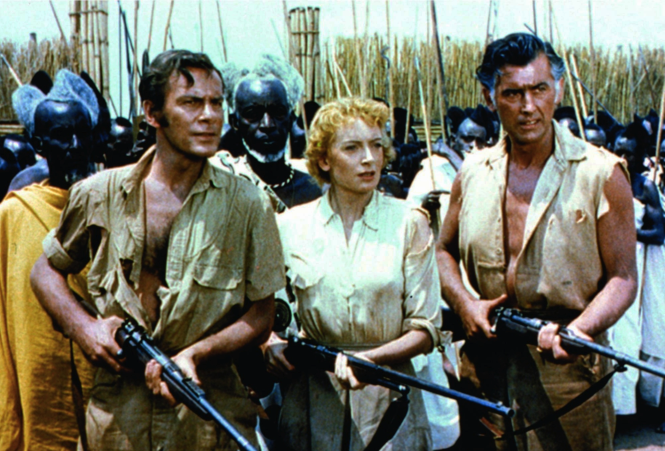
Production: In 1946, MGM executives purchased the rights Henry Rider Haggard’s novel King Solomon’s Mines (1885) from the Gaumont-British Picture Corporation, who had previously adapted the novel into a film in 1937. MGM chose Sam Zimbalist to produce the film, though it would be a few years before the company got around the making the film. In October of 1948, Helen Deutsch was assigned to write the script for King Solomon’s Mines. Later on, MGM hired British director Compton Bennett to direct the film. Around this time, MGM typically filmed one or two big-budget spectacle films overseas per year. When the studio decided to postpone Quo Vadis to 1951, Zimbalist was given permission to shoot King Solomon’s Mines on location in Africa.
In mid-1949, British actress Deborah Kerr asked MGM production chief Dore Schary if she could play the part of Rose in an adaptation of The African Queen. Schary told her that another studio had the rights to The African Queen, but that she could instead be the leading lady in MGM’s planned adaptation of King Solomon’s Mines. As a result, Kerr was cast as Elizabeth in the film. She had recently starred in the comedy film The Hucksters (1947) and received an Oscar nomination for Best Actress for her role in the drama Edward, My Son (1949). MGM originally planned to cast Errol Flynn as Allan Quatermain. Flynn tuned down the offer, because he didn’t want to have to sleep in a tent on location in Africa, and he made Kim (1950) with MGM instead. In August of 1949, MGM cast British actor Stewart Granger in the role. He had recently starred in the adventure Saraband for Dead Lovers (1948) and the comedy Woman Hater (1948). King Solomon’s Mines was Granger’s first film for MGM (and his first American-produced film in general), he had an exclusive contract with the studio until 1957.
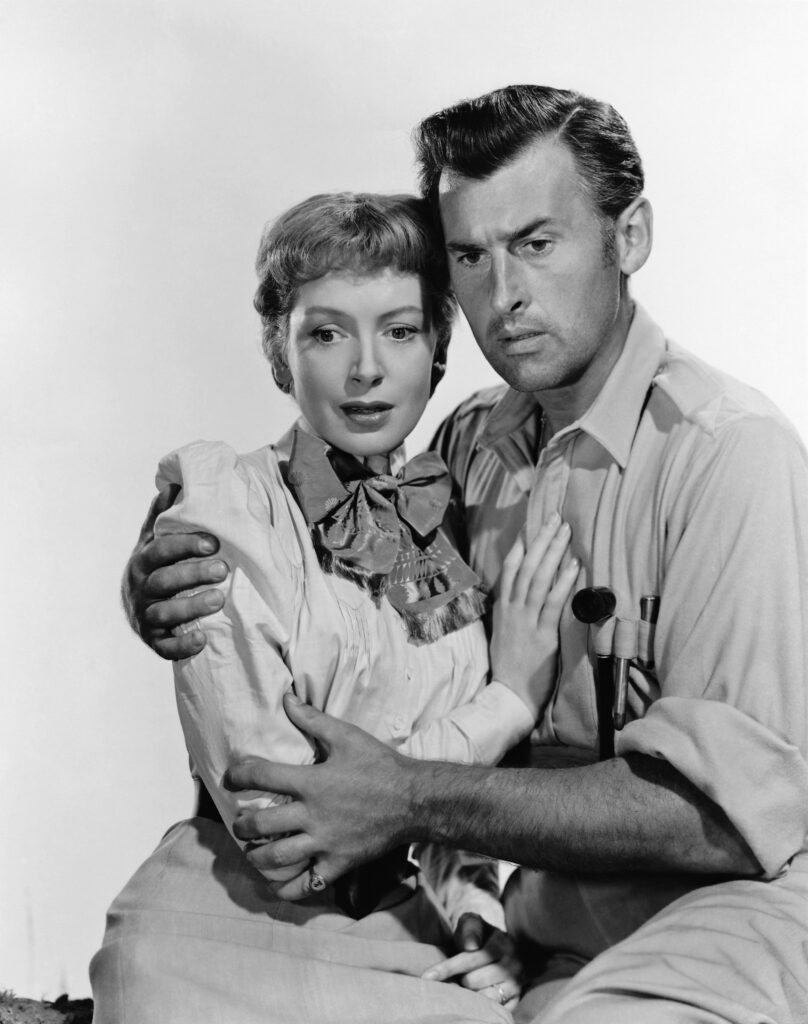
King Solomon’s Mines was the first big-budget American film to be primarily shot on location in Africa since MGM’s Trader Horn (1931). African shooting locations included Tanganyika; Murchison Falls in Uganda; Rumuruti and Machakos in Kenya; Astrida in Belgian Rwanda; and Volcano Country and Stanleyville in the Belgian Congo. MGM used a convoy of Dodge trucks to transport the cast, crew, and production equipment between the various locations with a combined travel distance of over 70,000 miles! Nairobi, Kenya was used as MGM’s headquarters. The interior scenes and several of the exterior scenes were shot back in the United States. The cave scene near the end of the film was shot on location in the “Slaughter Canyon Cave” in Carlsbad Caverns National Park, New Mexico. Several other scenes were filmed nearby at Sitting Bull Falls in Lincoln National Forest, NM.
The cast and crew generally got along well during filming, with one notable exception. Stewart Granger and director Compton Bennett couldn’t stand each other, so Zimbalist replaced Bennett with Andrew Marton in February of 1950. Granger got along much better with Marton. Both Bennett and Marton received a director’s credit in the finished film.
Fun Facts and Trivia: King Solomon’s Mines does not feature a conventional musical score. Nearly all of the music in the film is diegetic (exists within the context of the film and heard by the characters) and mostly consists of African tribal instruments and various “nature sounds” heard throughout. Stewart Granger actually speaks Swahili in the film, and does a fairly good job pronouncing the words, which was rare for films at the time. For example, Clark Gable spoke an African language in Mogambo (1953), but pronounced most of the words incorrectly.
Deborah Kerr unintentionally left a permanent mark at one of the shooting locations. At Carlsbad National Park’s New Cave in New Mexico, Kerr wrote her initials “DK” in lipstick on a rock formation. A burnt out lamp from the shoot was also left in a hole near the rock formation. The cave is still “active” so new sediment minerals are slowly encasing the old formations. Kerr’s lipstick writing and the lamp have since been encased by a thin, transparent layer of limestone. They are still visible in the cave today and cannot be removed without breaking the stone. The rock she wrote her initials on is now referred to as the “Deborah Kerr Formation.”
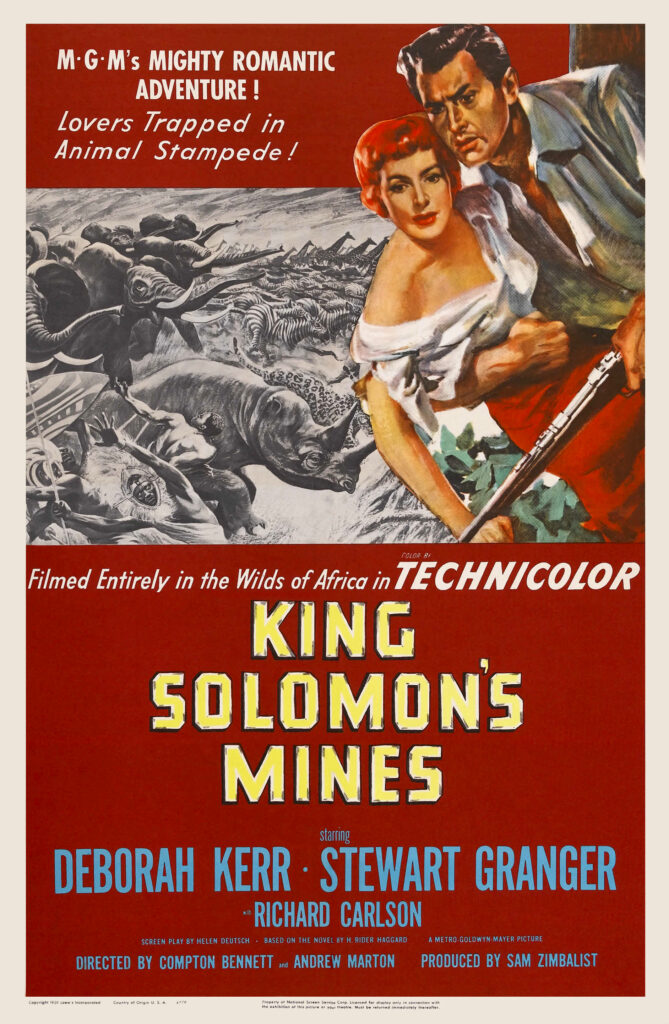
Reception: King Solomon’s Mines was massive success in the United States and in overseas markets. It was MGM’s most profitable film of the year. King Solomon’s Mines was initially the highest grossing film of 1950, though Walt Disney’s Cinderella (1950) has since accumulated a higher gross due to its many re-releases. Deborah Kerr and Stewart Granger reprised their film roles for a Lux Radio Theatre adaptation of King Solomon’s Mines broadcast in December of 1952.
King Solomon’s Mines received generally positive reviews from critics on its initial release. The critics at Variety described King Solomon’s Mines as a “striking adventure film” and praised the film for its excitement. Harrison’s Reports wrote that King Solomon’s Mines was “a highly spectacular romantic adventure melodrama that has the rare quality of holding an audience captivated from start to finish.” Bosley Crowther of The New York Times thought that the plot was a little silly, but that the impressive location shooting and gorgeous scenery made the film worth watching. The Monthly Film Bulletin, a British magazine, was less impressed with the film and described it as “stilted.”
King Solomon’s Mines has also received mainly positive reviews from modern film critics. Bob Bloom of Journal and Courier praised King Solomon’s Mines as being “one of the top adventure films of all-time.” Steve Crum of the Kansas City Kansan and James Sanford of the Kalamazoo Gazette both gave King Solomon’s Mines perfect 5/5 star reviews. Matt Brunson of Film Frenzy praised the film for its Technicolor cinematography and high production values. In 2001, King Solomon’s Mines was one the 400 films nominated by the American Film Institute for their “100 Years… 100 Thrills” list of the top 100 most exciting American films.
Oscars: King Solomon’s Mines was nominated for three Academy Awards: Best Picture (Sam Zimbalist for MGM), Best Color Cinematography (Robert L. Surtees), and Best Editing (Ralph E. Winters and Conrad A. Nervig). The film received two Oscars: Surtees won for his cinematography, and Winters and Nervig won for their editing.
Why You Should See It: King Solomon’s Mines is a fantastic adventure film. Stewart Granger and Deborah Kerr are both very good in their leading roles. The film has a grand scope, which is clearly evident in its high production values. The color cinematography of King Solomon’s Mines is beautiful and the nature footage is also impressive. While it is somewhat forgotten today, King Solomon’s Mines is a thrilling adventure film that looks incredible.